Lesson 2
What Is a Margin Call?
Updated Sep 2, 2026 · Reviewed by Terence Scott, founder
- FINRA Minimum
- 25% maintenance equity
- Typical House Level
- 30-40%
- Trigger
- Equity falls below requirement
- Broker's Right
- Liquidate without notice
- Level
- Intermediate
On this page
A margin call is your broker's demand to restore the safety cushion on your loan: your account's equity has fallen below the required minimum, and you must deposit cash or securities — or reduce the position — promptly. Fail to act, or fall far enough fast enough, and the broker sells your holdings for you. It is the enforcement mechanism behind everything in lesson 1, and understanding its math before borrowing is what separates margin users from margin casualties.
The Maintenance Requirement
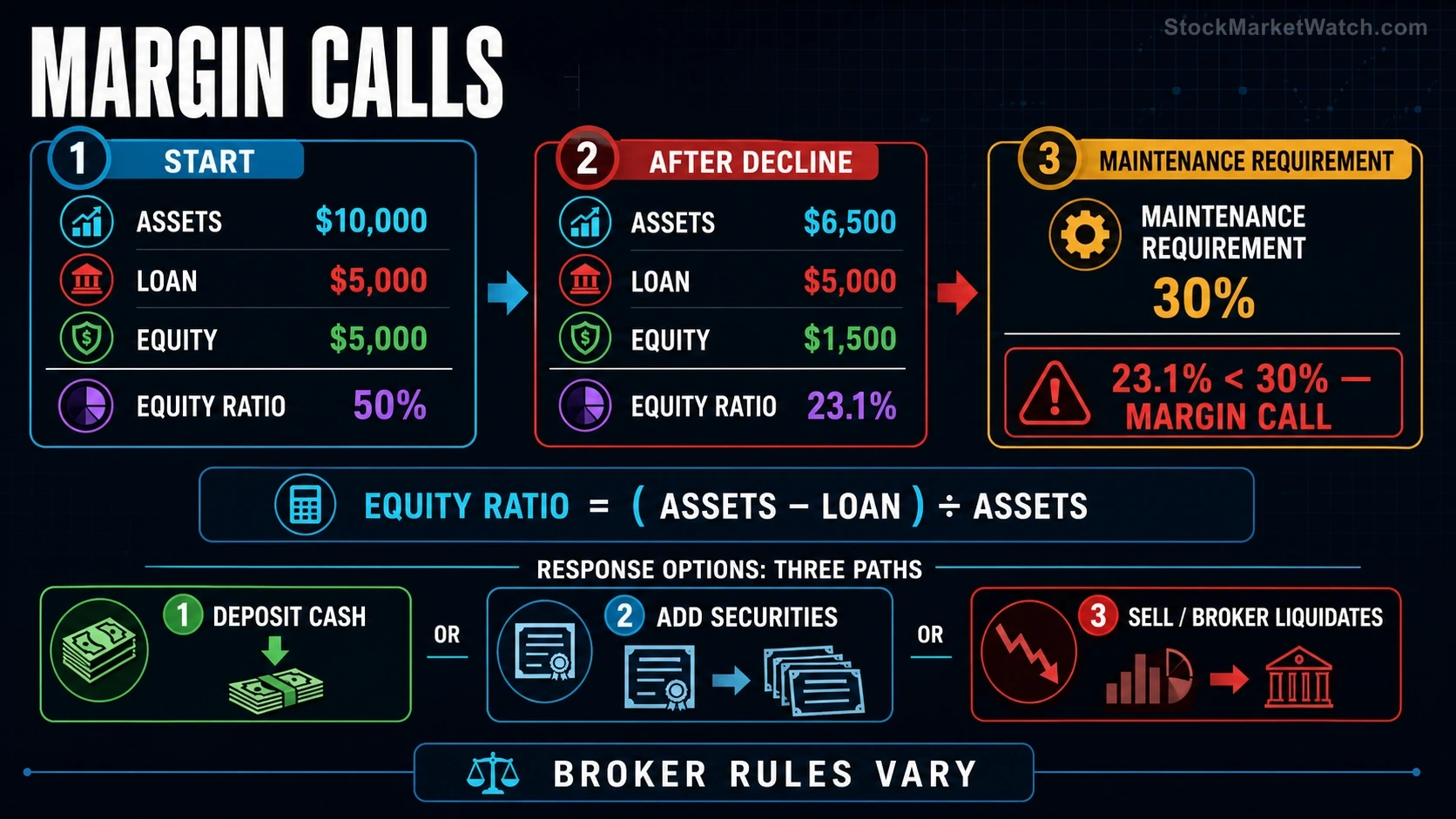
After a purchase, Reg T's 50% rule steps aside and the maintenance requirement takes over: your equity (position value minus loan) must stay above a floor percentage of the position's current value. FINRA's regulatory minimum is 25%, but almost every broker sets stricter "house" requirements — commonly 30–40%, and higher still for volatile or concentrated positions. The house number is the one that matters, and brokers can raise it at any time, without your consent — including mid-crisis, when volatile markets make them nervous. Positions fine on Monday can be under-margined on Wednesday without a single price moving, purely by rule change.
The Math, Worked
Continue lesson 1's example: $20,000 of stock, $10,000 loan, 30% house maintenance. Your equity is position value minus the (fixed) $10,000 loan; the requirement is 30% of position value. The call comes when:
Position value − $10,000 < 0.30 × Position value → position value below $14,286 — the stock falling about 29% from $100 to roughly $71.43.
At that point your equity is $4,286 and shrinking dollar-for-dollar with the stock, while the requirement shrinks only 30 cents on the dollar — the gap widens fast. That's the treacherous property of margin math: the closer to the line, the faster it approaches. A general formula worth knowing: with 2:1 initial leverage, a maintenance level of m is hit when the position falls by 1 − 0.5/(1−m) — about 29% at m=30%, about 33% at m=25%. Borrow less than the maximum and these distances stretch dramatically, which is exactly why professionals rarely use full buying power.
What Happens When It Triggers
- Best case: the broker notifies you and gives a short window — often two to five business days for a standard maintenance call — to deposit cash, deposit marginable securities, or sell positions.
- The case the agreement actually permits: the broker liquidates positions immediately, without notice, and without choosing the positions you'd prefer. Every margin agreement grants this. In fast markets — precisely when calls cluster — brokers routinely exercise it, because their risk desk is not waiting on your wire transfer.
- Worst case: a gap move (overnight news, a halt reopening) blows through the maintenance level so fast that liquidation happens at prices leaving your equity negative — you can owe the broker money beyond your entire account. Rare, real, and the reason "the most you can lose is your deposit" is false on margin.
Responding to a Call
In order of preference: deposit cash (cleanest — no positions disturbed, no taxes triggered); deposit fully-paid securities from another account; or sell into the call yourself — choosing what goes and at what limit price beats the broker's algorithm doing it for you at market. What consistently makes things worse: meeting calls by selling the account's best positions to protect its worst, or treating the call as a dip-buying signal and adding exposure. A margin call is the market telling you the position is too big; the correct direction of travel is smaller.
Not Getting Called in the First Place
- Borrow a fraction of the maximum. At 25% of buying power instead of 100%, the decline needed to trigger a call moves from ~29% into ranges that ordinary corrections don't reach.
- Know your number. Compute the exact price level that triggers your call the day you open the position — not during the decline.
- Watch concentration. One volatile stock as collateral is a different animal from a diversified book; brokers apply higher requirements to concentrated positions for the same reason you should.
- Expect requirement hikes in storms. Volatile markets bring house-requirement increases at the industry level; leave room for the rules themselves to tighten.
The final lesson zooms out from the mechanism to the strategy question: what leverage actually does to returns — including the parts that made margin famous in the first place.