Lesson 3
Margin Risks and Leverage
Updated Sep 2, 2026 · Reviewed by Terence Scott, founder
- Amplification
- Symmetric, both directions
- Hidden Drag
- Interest compounds
- Worst Case
- Losses beyond your deposit
- Best Use
- Small, short-term, planned
- Level
- Intermediate
On this page
The first two lessons covered the machine; this one weighs it. Margin's advantages are real — that's why the product exists and why sophisticated investors use it. But the full accounting includes costs that don't appear on the order ticket, and risk behaviors that only reveal themselves at the worst possible times. Here is both sides, honestly.
The Genuine Advantages
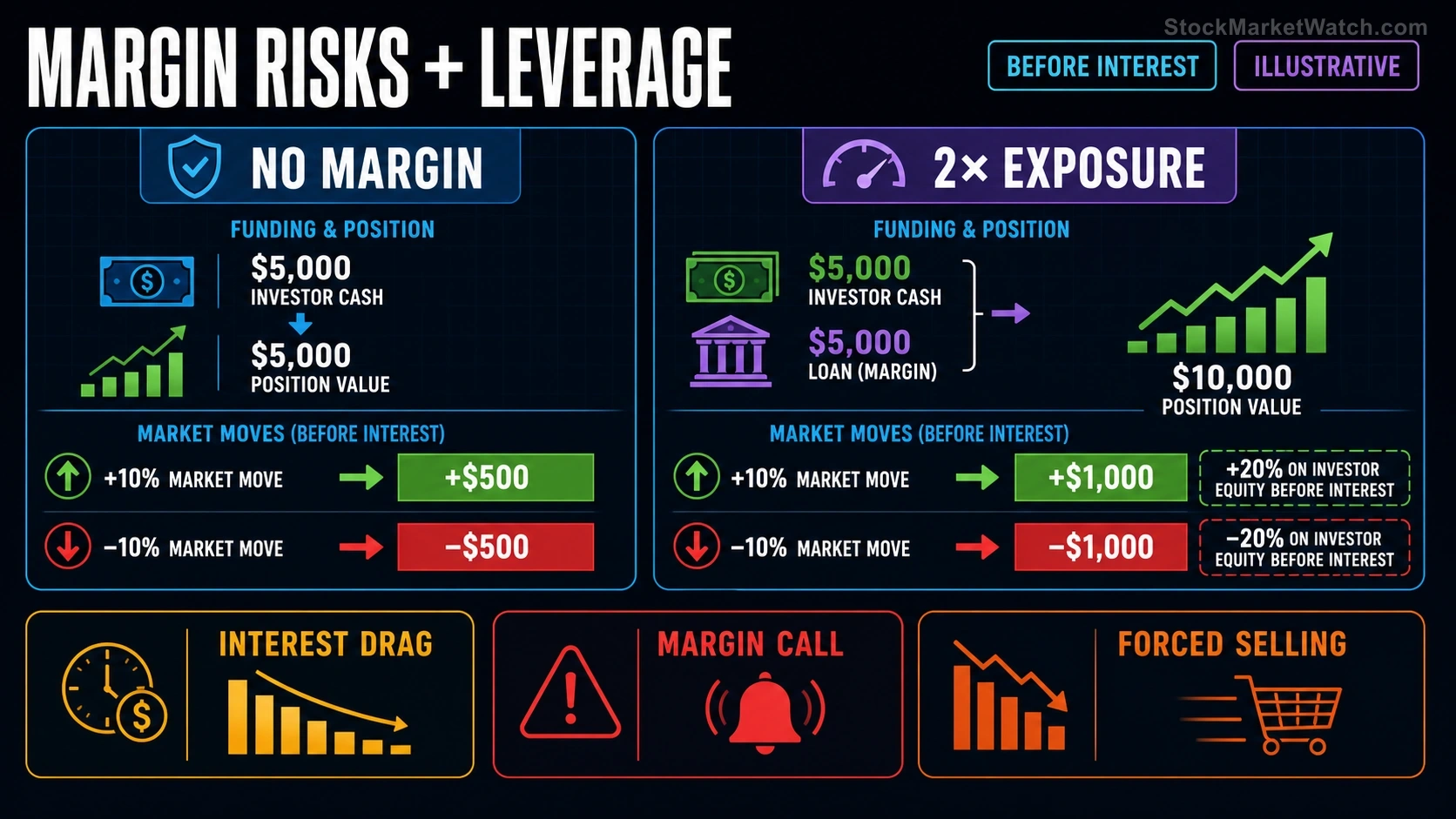
- Amplified upside. The 2:1 math from lesson 1 works exactly as advertised when you're right: a 20% gain becomes 40% on equity.
- Flexibility without selling. A margin loan takes minutes, requires no application, and lets you act on an opportunity without liquidating long-term positions — avoiding both the taxes and the regret.
- Strategy access. Short selling and most option-writing strategies exist only in margin accounts; for those uses margin is infrastructure, not leverage.
- Cheap credit — sometimes. At the low-rate brokers, margin can be among the cheapest consumer credit available. At the expensive ones it rivals credit cards. Same product, wildly different economics.
The Risks, Ranked by How Much They Hurt
1. Symmetric amplification meets asymmetric recovery
Leverage doubles losses as faithfully as gains — but losses and gains aren't symmetric in what they demand next. A 40% equity loss needs a 67% gain to break even; a 60% loss needs 150%. Deep leveraged drawdowns aren't just larger, they're disproportionately harder to climb out of — with interest ticking against you throughout the climb.
2. Forced selling at the bottom
The unlevered investor's superpower is the ability to do nothing through a decline. Margin revokes it. The margin call mechanism converts drawdowns into realized losses at moments chosen by a risk algorithm — and because calls cluster at market lows (that's what a market low is: everyone's forced selling arriving together), margin systematically sells bottoms. This is the single mechanism behind most historical margin catastrophes, from 1929's cascading calls onward.
3. Interest: the guaranteed negative return
The loan costs money every day, in flat markets, in down markets, on weekends. At a 10% rate with 2:1 leverage, your portfolio must return 5% annually just to break even — a permanent handicap set against an uncertain reward. This is why holding leverage for years "because stocks go up" quietly underperforms its own thesis: the drag compounds with certainty; the returns arrive with volatility.
4. Losses beyond your deposit
Gap moves can carry an account through its maintenance level and past zero before any liquidation can execute. The resulting negative balance is a debt you owe. Unlevered stock ownership can lose 100%; margin can lose more than 100%. That sentence should be in every margin agreement's first line rather than its middle pages.
5. The behavioral multiplier
Leverage compresses the time available for decisions and raises their stakes — a combination that reliably degrades decision quality. Positions that would be held calmly unlevered get sold in panic levered, not because the thesis changed but because the sizing did. The honest rule: if a position requires margin to be worth doing, the position is too small an edge; if it requires margin to feel exciting, the account is too small for margin.
If You Use It Anyway: The Discipline Set
- Cap it. A self-imposed ceiling well under buying power — many experienced users treat 20–30% of the Reg T maximum as their own limit.
- Give it a job and a deadline. "Bridge this position for three weeks" survives scrutiny; "be levered generally" doesn't.
- Know your liquidation price the day you borrow — and your plan if the requirement itself rises.
- Count the interest against the thesis. If the expected edge doesn't clearly beat the rate, the trade is for the broker, not for you.
- Never meet a call by hoping. The first call answered with size reduction is a lesson; the one answered with denial is a liquidation.
The Bottom Line
Margin is a professional's tool that retail brokers hand out casually because the interest is excellent business. Used small, short, and with a plan, it's a legitimate part of the toolkit — the course you've just finished is the prerequisite it should always have come with. Used as a permanent amplifier by investors who haven't computed their liquidation price, it converts the market's ordinary turbulence into permanent loss with mechanical reliability.
Where margin meets the market's most violent mechanics — borrowed shares, forced buying, and the squeezes that result — is covered from the other side in what is a short squeeze. And for the calmer path to amplified long-term results — diversification, allocation, compounding without borrowing — continue to the Investing Fundamentals course.