Lesson 1
Buying on Margin
Updated Sep 2, 2026 · Reviewed by Terence Scott, founder
- Initial Margin
- 50% (Reg T)
- Account Minimum
- $2,000 equity
- Interest
- Accrues daily, varies by broker
- Collateral
- Your securities
- Level
- Intermediate
Buying on margin means paying for part of a stock purchase with money borrowed from your broker, using the securities in your account as collateral. It is the stock market's version of a down payment: you put up a fraction, the broker finances the rest, and you own the whole position — its gains, its losses, and the interest bill — from day one.
The Ground Rules
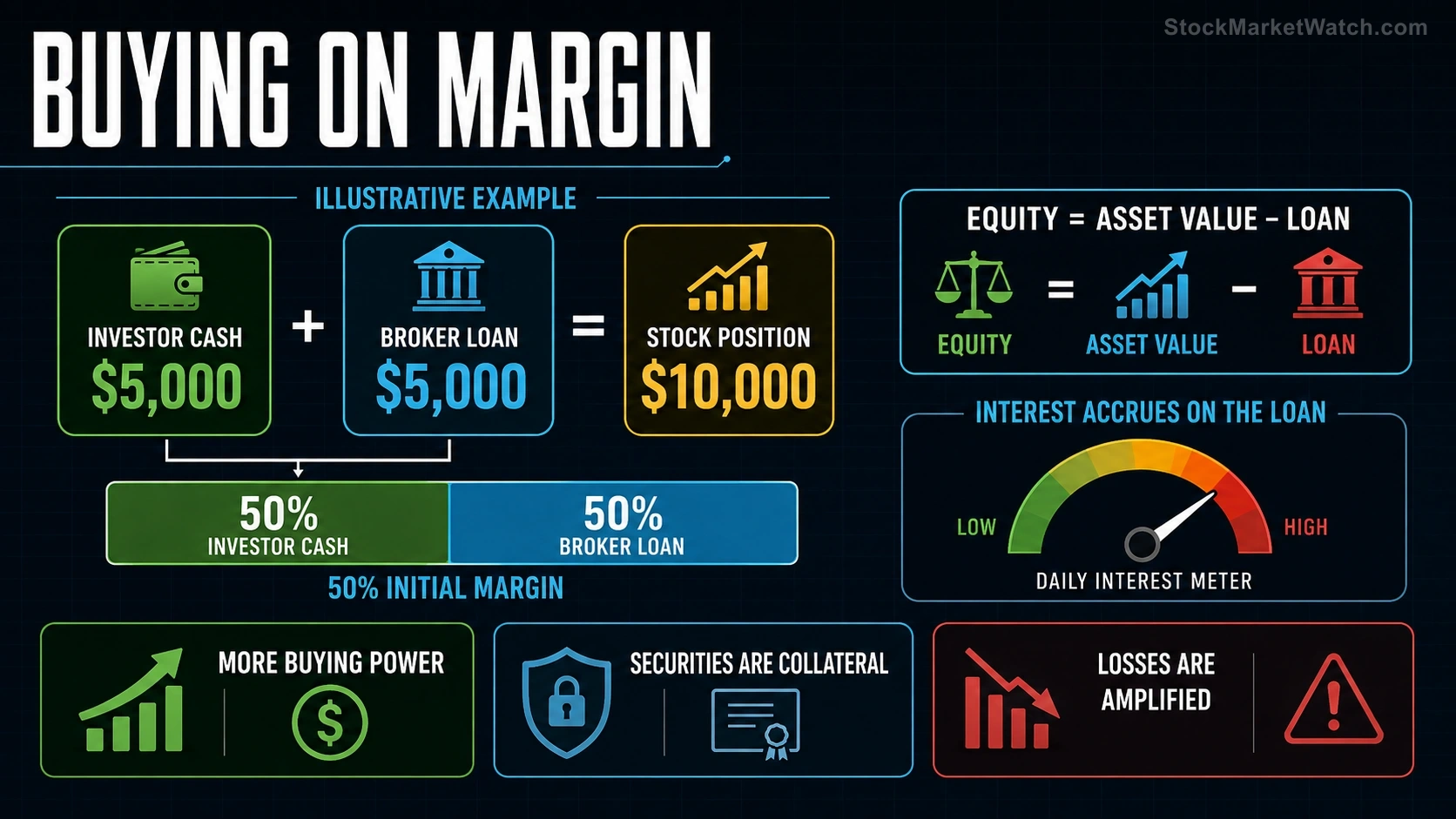
- You need a margin account. Standard cash accounts can't borrow; upgrading involves a margin agreement whose fine print — the broker's right to liquidate your positions without notice — is the most consequential document most investors never read. FINRA rules require at least $2,000 in equity to open and maintain margin borrowing.
- Regulation T caps the initial loan at 50%. The Federal Reserve's Reg T lets brokers lend up to half the purchase price of most marginable stocks. Deposit $10,000 and your theoretical buying power is $20,000. (Brokers may lend less on volatile names, and some securities aren't marginable at all.)
- Interest starts immediately. Margin loans accrue interest daily and post monthly. Rates vary enormously between brokers — from near benchmark rates at the cheapest to double digits at some large retail firms — and the rate matters more than most users realize, because it's a guaranteed cost set against uncertain returns.
- There's no repayment schedule. The loan persists as long as your collateral supports it. You repay by depositing cash or selling positions — or the broker repays it for you, by force, which is the next lesson.
A Worked Example
You deposit $10,000 and buy $20,000 of a stock at $100 per share — 200 shares, half yours, half borrowed. Ignore interest for a moment:
| Stock moves to | Position value | Loan | Your equity | Your return |
|---|---|---|---|---|
| $120 (+20%) | $24,000 | $10,000 | $14,000 | +40% |
| $100 (flat) | $20,000 | $10,000 | $10,000 | 0% minus interest |
| $80 (−20%) | $16,000 | $10,000 | $6,000 | −40% |
| $50 (−50%) | $10,000 | $10,000 | $0 | −100% |
The symmetry is the whole product: 2:1 margin doubles every move, in both directions. The stock falling by half wipes out your entire deposit — the loan is owed in full regardless. And the flat case isn't free: at, say, a 10% margin rate, a year of flat prices costs you $1,000 of interest on the $10,000 loan — a 10% loss on your equity for the crime of nothing happening.
What Margin Is Actually Used For
- Short-term opportunity — adding size to a high-conviction, defined-duration trade without selling long-term holdings (and triggering taxes).
- Liquidity bridging — covering a purchase for days rather than waiting on transfers or settlement.
- Strategy requirements — short selling and most options-writing strategies are only possible in margin accounts.
- What it's worst at: permanent buy-and-hold leverage. Interest compounds continuously while returns arrive irregularly, and the drawdowns along the way threaten forced liquidation — an asymmetry the final lesson makes concrete.
Details That Bite
- Buying power ≠ a target. The 50% maximum is a ceiling, not a suggestion; experienced margin users routinely borrow a fraction of what's offered, precisely to keep the maintenance math (next lesson) far away.
- The pattern day trader rule. Margin accounts making four or more day trades within five business days need $25,000 minimum equity or face restrictions — relevant if your margin use trends toward active trading.
- Your shares can be lent out. Positions held on margin can be rehypothecated and lent to short sellers; among the side effects, some dividends can arrive as differently-taxed "payments in lieu."
- Rates are negotiable at scale — and checking them before choosing a broker matters, because moving a margined account later is awkward.
Next — the mechanism that enforces all of this: the margin call, what triggers it, and what happens when you can't answer it.