Lesson 3
How to Trade a Short Squeeze
Updated Aug 30, 2026 · Reviewed by Terence Scott, founder
- Setup
- Squeeze breakout
- Direction
- Long
- Timeframe
- Days to weeks
- Key inputs
- SI % float, days to cover, breakout confirmation, volume
- Complexity
- Advanced
On this page
Trading a short squeeze from the long side means buying a heavily-shorted stock as forced covering begins, riding the most violent demand a market produces, and — the part that actually decides profitability — getting out before the artificial buying runs dry. This guide assumes you know what a squeeze is and how to read the short-interest metrics; it is about the trade itself.
One framing up front: a squeeze trade is a bet on mechanics, not merit. Heavily-shorted companies are usually shorted for good reasons, and the squeeze thesis is explicitly "trapped shorts must buy," not "this business is undervalued." Keeping that distinction clear is what makes the exit rules below feel natural instead of painful.
Step 1: Screen for Stored Energy
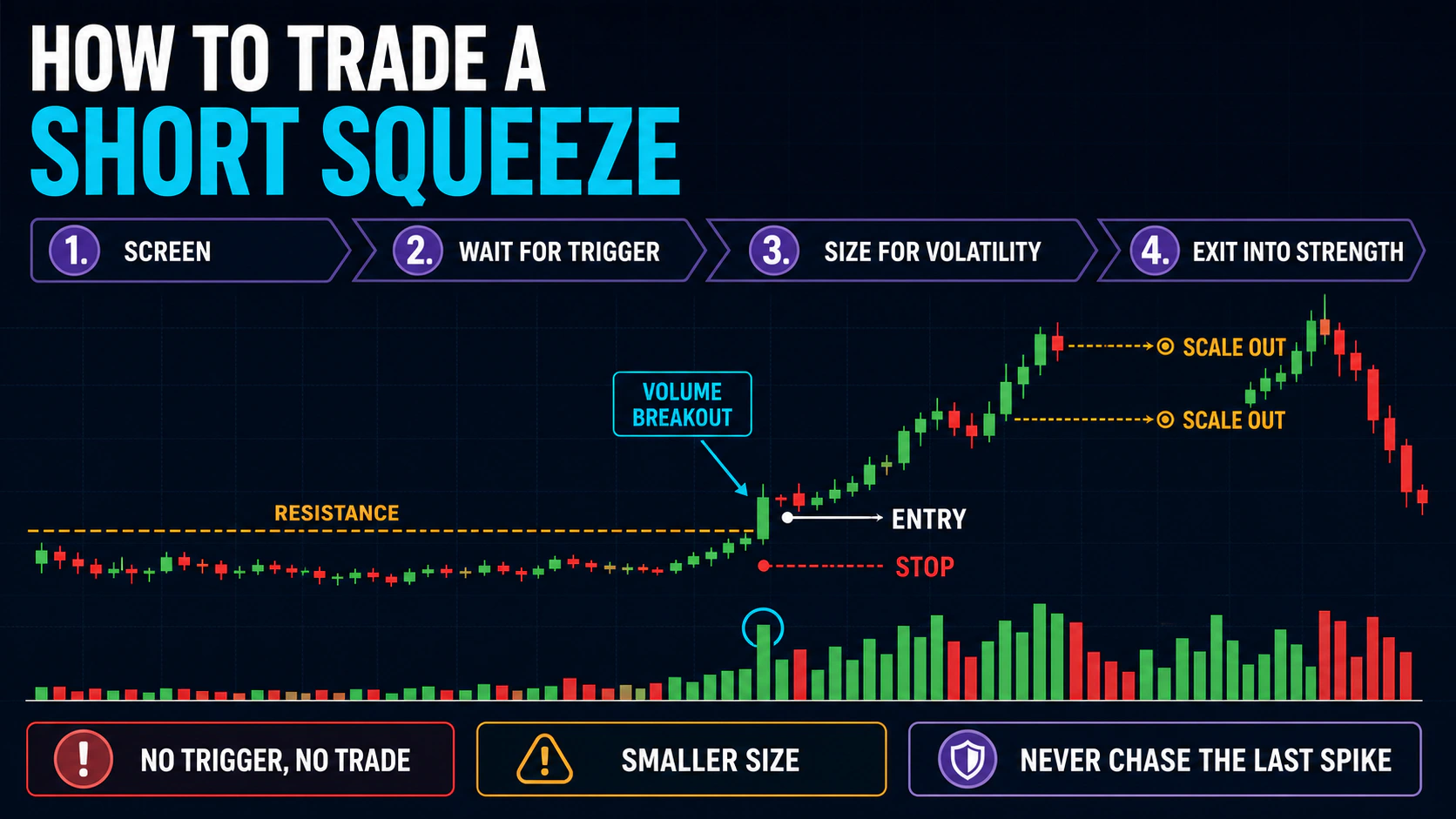
The candidate list is quantitative. The profile worth watching:
- Short interest above ~20% of float — crowded enough that covering moves the price.
- Days to cover in the mid single digits or higher — a narrow exit.
- Rising borrow fee or near-full utilization — the lending market already under strain.
- A float small enough to matter — the same short interest squeezes far harder in a 30M-share float than a billion-share one.
Our short-squeeze scanner maintains exactly this list daily — high short interest, rising days-to-cover, plus a confirming technical setup — ranked by composite squeeze score, so the screening step is largely done for you.
Step 2: Wait for the Trigger
This is where most squeeze trades are won or lost, because stored energy is not a trade. A stock can sit at 30% short interest for years while grinding lower — the shorts are winning, and nothing is forcing them out. Buying crowded shorts with no confirmation is just buying a troubled company.
The trigger is price proving that covering (or at least real buying) has begun:
- A breakout above defined resistance on expanding volume — the cleanest signal. The level that capped the stock breaks, every recent short is now underwater, and volume shows real participation. The general mechanics are covered in reversal patterns and breakout structure.
- A catalyst plus follow-through — better-than-feared earnings or an asset sale, followed by the stock holding and extending the gap rather than fading it. The follow-through is the tell; heavily-shorted stocks fade weak news constantly.
- Volume out of nowhere — multiples of average daily volume with price pushing through levels is what forced covering actually looks like on the tape.
Step 3: Size for Violence
Squeeze candidates move 10–30% in a day, halt intraday, and gap through stop levels. Risk management that works on an index ETF fails here:
- Cut normal position size substantially. The volatility does the work; the size just determines whether you survive being wrong. A position sized so a 30% adverse gap is acceptable is the honest test.
- Stops are structure-based but soft. A resting stop order in a halting, gapping stock guarantees nothing — LULD halts can reopen far through your price. The stop level defines when the thesis is dead; the size defines what that costs.
- No averaging down. If the breakout fails, the thesis failed. A squeeze setup that loses its trigger level is a heavily-shorted stock in a downtrend again — the exact thing not to own.
Step 4: Exit Into Strength
The squeeze's defining feature — buyers who are all temporary — dictates the exit style. The forced buying ends without announcement, and the aftermath retraces most of the spike. Practical rules traders use:
- Scale out on the verticals. Sell portions into climactic green candles, not after the reversal. In a squeeze, strength is the liquidity event — the up days are when exits are generous.
- Trail the remainder mechanically — behind each day's low, or a fast moving average — and let the trail take you out. Squeezes end with engulfing red candles and gap-downs; the trail converts "hoping it goes higher" into a rule.
- Watch for exhaustion signatures: enormous-volume days that close well off the high, shooting stars, and gaps that immediately fade — the same exhaustion-gap behavior that ends any vertical move.
- Never convert the trade into an investment. The most expensive sentence in squeeze trading is "it's still a good company anyway." It usually wasn't, and the position was never about that.
The Trade's Failure Modes
- Buying stored energy with no trigger — the most common. Crowded shorts + downtrend = the shorts are right, so far.
- Arriving late. After the third vertical day, the remaining upside belongs to the exit, not the entry. Late buyers are the people the squeeze finally sells to — the GameStop chart after January 28, 2021 is the permanent illustration.
- Confusing a rally for a squeeze. If short interest is modest, there is no forced-buyer fuel, and the "squeeze" narrative is just a story attached to a normal move.
- Shorting into it. The reverse trade — shorting a squeeze because it "has to come down" — has unlimited risk, hostile borrow mechanics, and a timing problem: it does come down, but from where? Squeezes have bankrupted shorts who were eventually right.
A Compact Checklist
| Stage | Requirement |
|---|---|
| Screen | SI > ~20% float, days to cover ≥ 5, borrow strain — per the squeeze scan |
| Trigger | Breakout over resistance on expanding volume, or catalyst + follow-through |
| Size | Small enough that a 30% adverse gap is survivable |
| Stop | Below the breakout structure — thesis dead if it fails |
| Exit | Scale out into vertical strength; trail the rest; out entirely on exhaustion signatures |
Today's ranked candidates: the short-squeeze scanner. Past squeezes and how they resolved: the squeeze performance reports.