Lesson 1
What Is a Short Squeeze?
Updated Aug 30, 2026 · Reviewed by Terence Scott, founder
- Setup
- Forced short covering
- Direction
- Long (violent)
- Timeframe
- Days to weeks
- Key inputs
- Short interest % float, days to cover, catalyst
- Complexity
- Beginner
On this page
A short squeeze is what happens when a bet against a stock is forced to unwind all at once. Short sellers profit when a stock falls — but when it rises instead, their losses grow without limit, and beyond a point they must buy shares back to close their positions. That buying pushes the price higher, which forces more shorts to buy, which pushes the price higher still. The result is a feedback loop that can send a stock vertical on no fundamental news at all.
Squeezes matter to traders because they produce some of the fastest, largest moves in markets — and because the conditions that precede them are measurable in advance.
Short Selling in One Minute
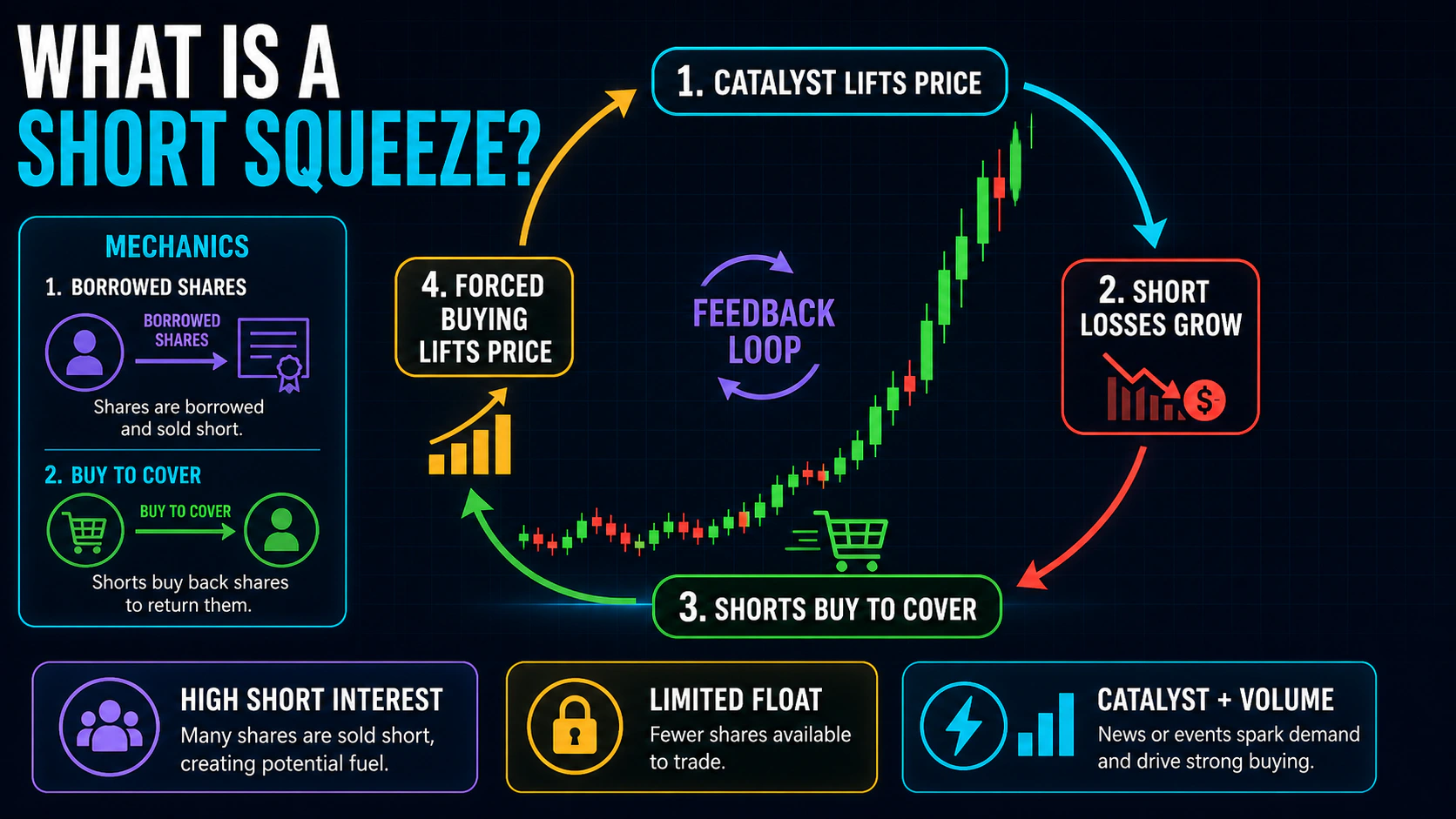
To short a stock, a trader borrows shares, sells them, and aims to buy them back later at a lower price, returning the borrowed shares and keeping the difference. Three features of that structure create squeeze fuel:
- Losses are uncapped. A stock bought at $10 can lose at most $10; a stock shorted at $10 can rise to $50, $100, or beyond, and the short owes the difference all the way up.
- The position is on margin. As the price rises, the broker demands more collateral. A short who can't post it gets bought in — the broker closes the position at market, whatever the price.
- The shares are borrowed. Lenders can recall them, and borrow fees on crowded shorts can climb to annualized rates that make simply holding the position expensive.
Every short position is, mechanically, a guaranteed future buy order. A squeeze is all of those buy orders being triggered at once.
The Anatomy of a Squeeze
- A crowded short. A large fraction of the stock's float is sold short — because the company is genuinely troubled, or because a trade got fashionable.
- A spark. Better-than-feared earnings, an asset sale, an activist stake, a sector rally — anything that starts the price moving up.
- Early covering. The most cautious shorts buy back, adding demand precisely when the price is already rising.
- Margin pressure. As losses mount, brokers issue margin calls. Covering stops being a choice.
- The vertical phase. Forced buying meets a float that is largely locked up — remaining holders smell the squeeze and stop selling. Price gaps up day after day on enormous volume.
- The round trip. Once the forced buying is exhausted, the artificial demand vanishes. Squeezes overwhelmingly retrace most of the spike, often nearly all of it, because nothing fundamental supported the peak price.
Two Famous Squeezes
Volkswagen, 2008
In October 2008, Porsche disclosed that between shares and options it had effective control of about three-quarters of Volkswagen — and with the state of Lower Saxony holding another fifth, almost no float remained for the many hedge funds short the stock. VW shares roughly quintupled in two trading days as shorts scrambled for shares that barely existed, briefly making Volkswagen the most valuable company in the world. It remains the canonical example of a squeeze driven purely by float mathematics.
GameStop, 2021
GameStop entered January 2021 with reported short interest exceeding its entire float — possible because borrowed-and-resold shares can be borrowed again. From under $20 at the start of the month, the stock hit an intraday high of $483 on January 28 as retail buying and forced covering fed each other, before giving most of it back within weeks. GameStop also popularized the related gamma squeeze: heavy call-option buying forces market makers who sold those calls to buy stock as it rises to stay hedged — a second, independent source of forced buying that can stack on top of short covering.
The Numbers That Set Up a Squeeze
Squeeze risk is quantifiable even though squeeze timing is not. The two core metrics:
- Short interest as % of float — how crowded the trade is. Single digits is normal; above ~20% of float is heavily shorted territory where squeezes become structurally possible.
- Days to cover — short interest divided by average daily volume: how many days of normal trading it would take all shorts to exit. High days-to-cover means the exit door is narrow.
Both metrics, along with borrow costs and how they're reported, are covered in depth in short interest metrics. Our short-squeeze scanner ranks the market daily on exactly these ingredients plus a confirming technical setup.
Squeeze vs. Ordinary Rally
Not every sharp rally in a shorted stock is a squeeze, and the difference matters for what happens after:
| Short squeeze | Fundamental rally | |
|---|---|---|
| Driver | Forced buying by trapped shorts | Buyers choosing to own the business |
| Shape | Vertical, gap-heavy, climactic volume | Trend with pullbacks |
| Aftermath | Retraces most of the spike once covering ends | Tends to hold repriced levels |
The squeeze ends when the shorts are out. That is why chasing the vertical phase late is the most reliable way to lose money on a squeeze — the buyers propping up the price are all temporary by definition.
Next Steps
How traders actually approach these — candidate selection, entries, and the risk rules that keep a squeeze trade survivable — is the subject of how to trade a short squeeze. Today's ranked candidates are on the short-squeeze scan.