Lesson 1
Types of Gaps in Trading
Updated Aug 30, 2026 · Reviewed by Terence Scott, founder
- Setup
- Overnight price gap
- Direction
- Either
- Timeframe
- Intraday to multi-day
- Key inputs
- Volume, catalyst, chart location
- Complexity
- Beginner
On this page
A gap is a price jump between one session's close and the next session's open, leaving a blank zone on the chart where no shares traded. Gaps happen because news arrives while the market is closed — earnings, guidance, analyst actions, macro data — and the opening auction reprices the stock all at once instead of tick by tick.
Not all gaps are alike, and the classic taxonomy matters for a practical reason: the gap type predicts what tends to happen next. A breakaway gap and a common gap look identical at the open; one starts a trend and the other fades by lunch. Everything in gap-and-go trading and gap-fill trading follows from reading the type correctly.
Common Gaps
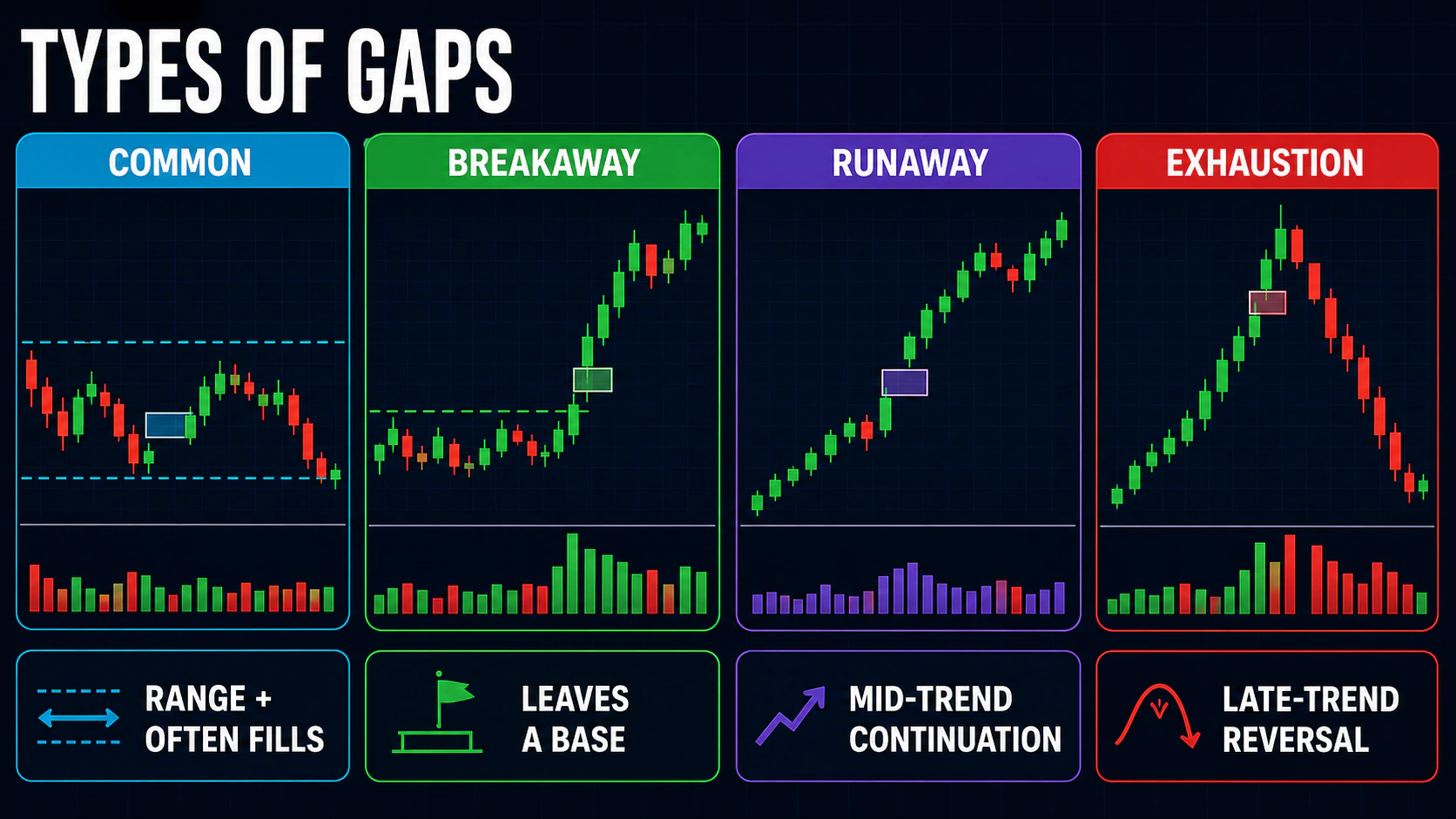
A common gap is a small overnight move with no meaningful catalyst behind it — an order imbalance at the open, a sector drifting on a broad-market move, or simple overnight noise. The identifying features:
- No news. Nothing company-specific happened; the gap is a byproduct of thin overnight trading.
- Ordinary volume. The open trades on unremarkable volume and the pace slows quickly.
- Inside the range. The gap opens within the stock's recent trading range rather than breaking it.
Common gaps are the ones most likely to "fill" — that is, retrace back to the prior close — and to fill quickly, because there is no fresh information holding price at the new level. They are the raw material of the gap-fade trade, and the type a momentum trader should leave alone.
Breakaway Gaps
A breakaway gap opens outside a consolidation — above the resistance of a base, a triangle, or a multi-week range — on a real catalyst and heavy volume. It marks the start of a new move: the stock was coiled, news forced a decision, and the auction settled it emphatically.
- Real catalyst — earnings beat with raised guidance, an approval, a contract win.
- Heavy volume — often several times the daily average, and sustained after the open rather than drying up.
- Escapes a defined pattern — the gap clears a level that had capped the stock repeatedly.
Breakaway gaps are the least likely to fill soon. The old floor-trader phrase is that a good breakaway "doesn't look back" — price may retest the top of the old range, but a full fill would mean the breakout failed. These are the gaps momentum traders want.
Runaway (Continuation) Gaps
A runaway gap — also called a continuation or measuring gap — appears in the middle of an established trend, not at its start. A stock already trending higher gaps up again as fresh buyers who missed the first leg give up waiting for a pullback. The trend is confirming itself.
The "measuring" nickname comes from the folk observation that these gaps often appear near the midpoint of the total move, letting traders project a rough target by doubling the distance already traveled. Treat that as a rule of thumb, not a law — its value is the reminder that a runaway gap implies the trend has further to go, while also warning that the move is now at least half-done.
Exhaustion Gaps
An exhaustion gap comes late in an extended trend and marks its final burst: the last holdouts capitulate into a stock that has already run, price gaps in the trend direction on enormous volume — and then the move dies. The tell is what happens after the open:
- Volume is climactic — often the highest of the entire move.
- Price fails to extend, stalls the same day or within a few sessions, and turns back.
- The gap fills quickly, because there are no buyers left above it.
When price gaps up, stalls, and then gaps down a few sessions later, the price bars in between are stranded above both gaps — an island reversal, one of the more reliable signs a trend has ended. Exhaustion gaps also frequently coincide with reversal candles like the shooting star or bearish engulfing printed on the gap day itself.
Telling Them Apart in Real Time
The uncomfortable truth is that gap types are easiest to name in hindsight. At 9:31 AM, a breakaway and an exhaustion gap can look the same. Three questions separate them at the open:
| Question | Points toward |
|---|---|
| Is there a real, new catalyst — or no news? | Catalyst → breakaway/runaway. No news → common. |
| Where is the gap on the chart — out of a base, mid-trend, or after a long run? | Out of a base → breakaway. Mid-trend → runaway. Late and vertical → exhaustion. |
| What is volume doing after the open — building or evaporating? | Building → breakaway/runaway. Evaporating → common or exhaustion. |
Chart location does most of the work. A gap out of a six-week base on triple average volume is a different animal from the third consecutive gap-up in a stock that has doubled in a month, even if both are "+6% premarket."
A Note on "All Gaps Fill"
You will hear that "gaps always fill." Over a long enough horizon many do — but that framing is useless for trading, because when is the entire question. A breakaway gap may take years to fill; a common gap may fill by 10:30 AM. The saying survives because it is unfalsifiable, not because it is a strategy. Trade the gap type, not the folklore.
Where to Find Each Day's Gaps
The premarket movers page lists the session's biggest gappers before the open, and the gap analytics page breaks down how the current day's gaps compare historically. The next guide, finding premarket gappers, covers how to turn that raw list into a trade-ready watchlist.