Lesson 2
Finding Premarket Gappers
Updated Aug 30, 2026 · Reviewed by Terence Scott, founder
- Setup
- Premarket scan
- Direction
- Either
- Timeframe
- Before the open
- Key inputs
- Gap %, premarket volume, float, catalyst
- Complexity
- Beginner
On this page
Every gap trade starts the same way: with a list. Between 4:00 and 9:30 AM Eastern, the stocks that will dominate the day's action announce themselves in the premarket session, and the trader's first job is to find them, rank them, and throw most of them out. This guide covers what to scan for and how to turn a raw list of gappers into two or three names actually worth watching at the open.
The premarket movers page does the first step for you — it lists the session's biggest premarket gainers and losers with live prices and volume. What follows is the filtering.
Why Stocks Gap
A premarket gap is almost always a reaction to information released while the market was closed:
- Earnings and guidance — the most common catalyst, clustered around earnings season.
- FDA decisions and trial results — the biggest single-day movers in biotech.
- Analyst upgrades and downgrades — usually smaller gaps, more likely to fade.
- M&A news — acquisition targets gap to near the offer price and then barely move; usually untradeable.
- Offerings and dilution — a stock gapping down on a priced offering behaves differently from one gapping down on bad news.
- Sector sympathy and macro — a stock gapping only because its sector or the index futures moved has the weakest gap of all.
The catalyst determines how much conviction sits behind the gap, which is why two stocks both up 8% premarket can be entirely different trades.
The Filters That Matter
Gap size
Most day traders want a gap large enough to signal real repricing but not so large the move is spent — commonly somewhere in the 3–10% band for liquid stocks, wider for small caps. A 1% gap is noise; a 60% gap on a buyout is finished.
Premarket volume — in dollars, not shares
A stock that has traded 200,000 premarket shares at $5 has done $1M of business; at $80 it has done $16M. Dollar volume is what tells you whether real money has participated and whether you will be able to exit without moving the price. Thin premarket volume means wide spreads, and wide spreads quietly tax every entry and exit.
Float
Float is the share count actually available to trade. Low-float stocks (roughly under 20 million shares) move violently on modest volume — bigger opportunity, far bigger risk, and a much higher chance of halts. Large-float stocks gap smaller but trade cleaner. Know which game you are playing before the bell.
Catalyst quality
Rank the news, not just the percentage. Raised full-year guidance outranks a headline EPS beat; a partnership with revenue attached outranks a vague letter of intent; and "no news" is itself information — it marks the gap as common and fade-prone, per the gap taxonomy.
Building the Watchlist
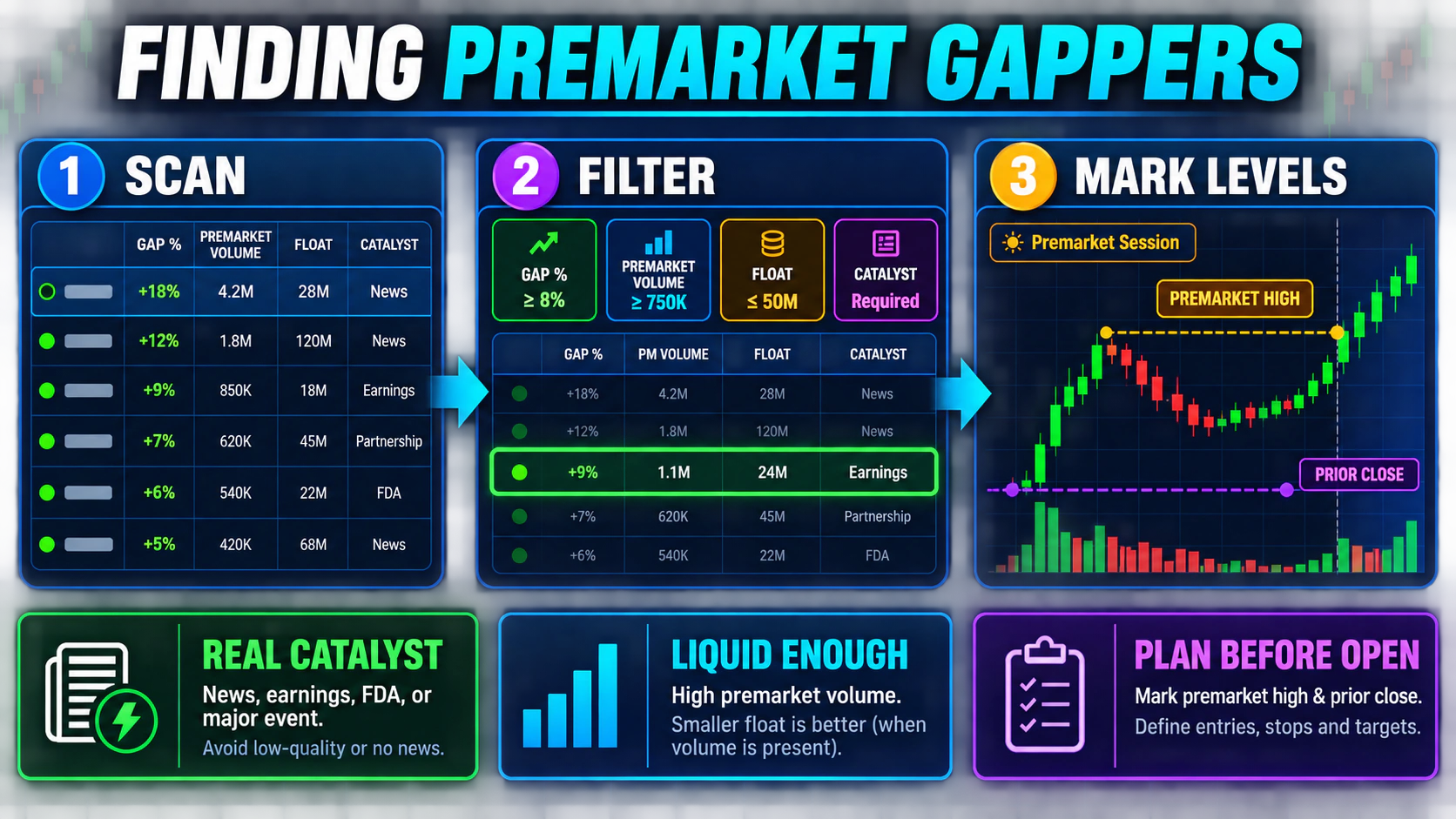
From a raw list of twenty gappers, a disciplined premarket routine usually keeps two to four. For each survivor, prepare the numbers you will need instantly at the open:
- Premarket high and low — the first reference levels of the day. The open trading above or below them is the earliest signal of gap-and-go versus gap-fade.
- Prior day's close — the gap-fill target if the move fades.
- Prior day's high/low and any obvious daily level — a gap that opens directly into major resistance has a headwind a clean-sky gap does not.
- Short interest — a heavily shorted stock gapping up on real news can squeeze; see what a short squeeze is and the short-squeeze scan.
- Average daily volume — premarket volume approaching a meaningful fraction of the daily average signals an unusually active day ahead.
Halts: The Risk Peculiar to Gappers
Fast-moving gappers regularly trigger LULD (Limit Up-Limit Down) volatility halts — an automatic five-minute trading pause when price moves outside a rolling band. Halts matter because you cannot exit during one, and the reopening price can be far from the halt price. Low-float stocks on big catalysts can halt repeatedly in both directions. If you trade these, size the position so that a halt reopening against you is survivable, not ruinous.
A Realistic Premarket Routine
- Scan the premarket movers list and note everything gapping more than ~3% with real dollar volume.
- Read the news for each candidate — thirty seconds per stock is enough to classify the catalyst.
- Cut the no-news gaps, the buyout targets, and anything too thin to exit.
- Mark levels on the two to four survivors: premarket high/low, prior close, prior day high/low.
- Decide the playbook per stock before 9:30 — is this a momentum candidate for gap-and-go, or a fade candidate for the gap fill? The worst time to make that decision is after the bell rings.
The scan is the easy part — the edge is in the throwing away. Most gappers are not trades, and the traders who last are the ones who let the bad ones go untouched.