Lesson 4
Gap Fill Trading
Updated Aug 30, 2026 · Reviewed by Terence Scott, founder
- Setup
- Gap fade / mean reversion
- Direction
- Either (fade the gap)
- Timeframe
- Intraday
- Key inputs
- Catalyst absence, volume, premarket levels
- Complexity
- Intermediate
On this page
A gap "fills" when price trades back to the prior session's close, erasing the overnight move. Gap-fill trading — also called fading the gap — bets on exactly that: shorting a gap-up, or buying a gap-down, on the thesis that the overnight move was an overreaction that the regular session will unwind.
It is the mirror image of the gap-and-go. Same premarket list, same levels, opposite premise — which is why the most important skill in gap trading is not executing either strategy, but deciding which one today's gap deserves.
Why Gaps Fill
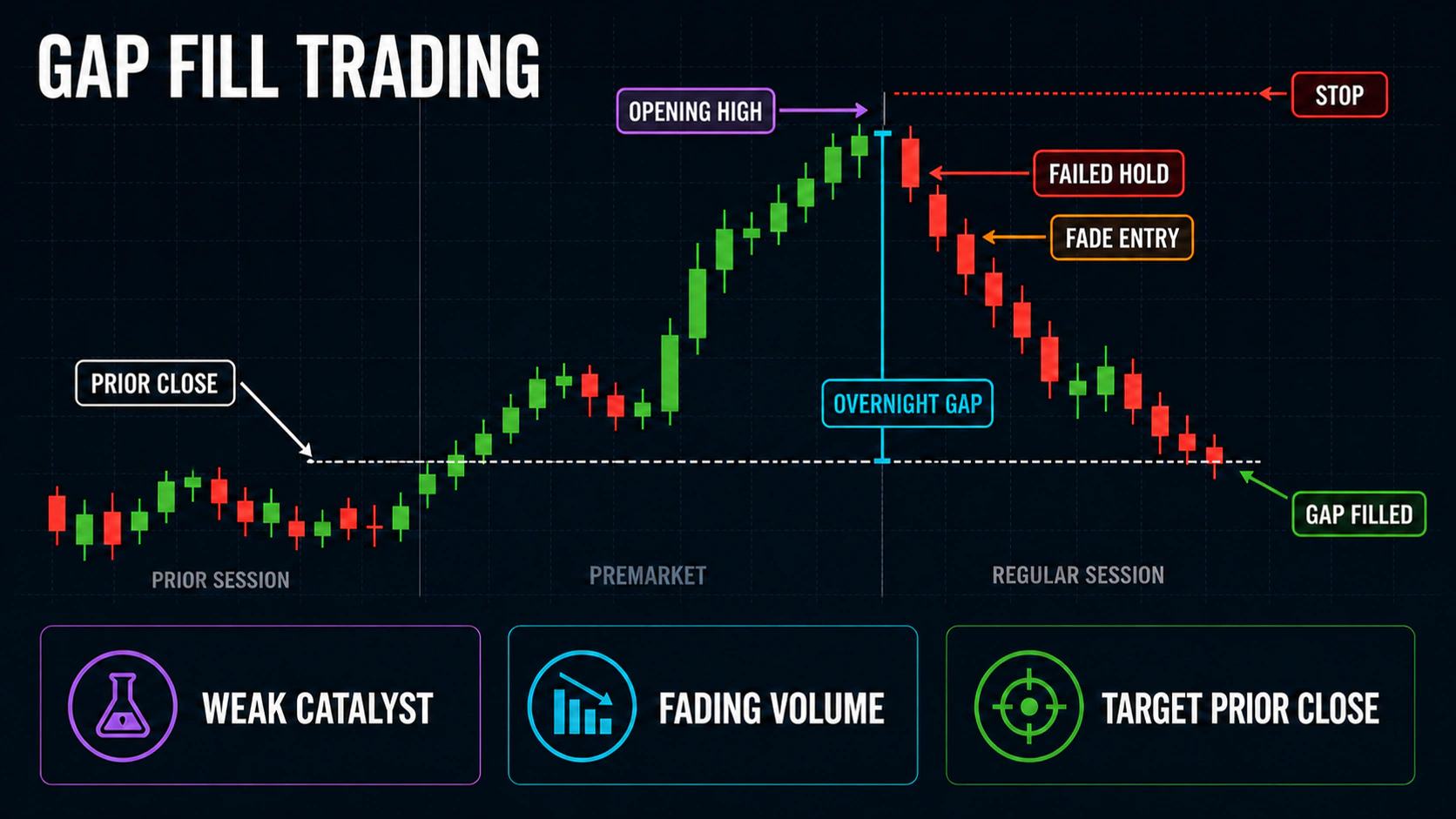
The mechanics of a fade are straightforward supply and demand:
- No fresh information at the new price. If a stock gapped up on nothing — sympathy, a thin premarket, an overnight index drift — there is no reason for buyers to defend the higher price once real volume arrives.
- Profit-taking. Overnight longs are handed an instant gain at the open; their selling is the first wave of supply.
- The auction overshoots. Opening prices are set in a thin, emotional auction. The regular session, with far deeper liquidity, frequently reprices more soberly.
The prior close acts as a magnet in these cases because it is the last price the full market agreed on.
Which Gaps Are Fade Candidates
Gap type, as always, decides. From the taxonomy:
| Gap profile | Fade candidate? |
|---|---|
| No news, modest size, inside recent range (common gap) | Yes — the textbook fade. |
| Analyst upgrade/downgrade only, no fundamental change | Often — these gaps have a long reputation for fading. |
| Gap into major overhead resistance | Yes, with the level as the entry reference. |
| Late-stage vertical move gapping again (exhaustion) | Yes, but confirmation matters — tops are violent. |
| Strong earnings/guidance gap out of a base (breakaway) | No. Fading real repricing is how fade traders blow up. |
| Heavily shorted stock gapping on real news | Absolutely not — that is short-squeeze fuel. |
Structuring the Trade
Using a gap-up fade (short) as the example; the gap-down version mirrors it.
Entry
Fade entries want evidence the gap is already failing, not just a price that "looks too high":
- Failure at the premarket high: the stock opens, pushes toward the premarket high, cannot break it, and prints a lower high — often with a reversal candle like a shooting star on the intraday chart.
- Loss of the open: a break back below the opening price, or below the first pullback low, confirms sellers are in control of the session.
- VWAP rejection: price losing VWAP and then failing to reclaim it from below is the intraday trend turning down.
Stop
Above the premarket high (or the failed lower high) — the level whose reclaim would prove the fade thesis wrong. The premise is "the gap is failing"; if the stock instead breaks to new highs, the premise is dead and the position must be too, because the other side of the trade is a gap-and-go with momentum behind it.
Target
The prior session's close — the definition of the fill. Many traders take partial profit at obvious way-stations (the opening price, round numbers, the morning low) since gaps often fill partially and stall. A partial fill that finds buyers at, say, half the gap is common; demanding the full fill on every trade gives back a lot of open profit.
How the Trade Fails
- Fading real news. The single biggest killer. A genuine breakaway gap does not need to fill, may never fill, and will happily trend against a fader all day. The trade requires the discipline to leave strong-catalyst gaps alone no matter how "extended" they look.
- Shorting into a squeeze. A gapping stock with high short interest punishes early shorts with forced-buying fuel. Check short interest before shorting any gapper.
- No confirmation. Shorting at the open purely because the gap is large is guessing at the top of an auction. The fade wants a lower high or a broken level first — the confirmation costs a little price and saves a lot of pain.
- Borrow and halt mechanics. Hard-to-borrow gappers may be expensive or impossible to short, and LULD halts can strand a short through a reopening spike. Size accordingly.
A Worked Example
A retailer closes at $30 and opens at $31.50 — up 5% — on no company news; its sector ETF is up 1% on a macro print. Premarket high: $31.80, on light volume. It opens, tags $31.70, prints a lower high at $31.55, then breaks below the opening price on rising volume.
- Entry: short $31.35 on the break of the open.
- Stop: $31.85 — above the premarket high. Risk: $0.50.
- Targets: half covered at $30.75 (the morning's halfway level), remainder at $30.10, just above the prior close — in front of the magnet, not at it, since the last few cents of a fill are the most crowded.
Related
Candidates surface every morning on the premarket movers page; the gap analytics page shows how the day's gaps compare to history. For the opposite playbook on the same list, see the gap-and-go strategy; for the taxonomy behind the fade/go decision, types of gaps.