Lesson 3
Gap-and-Go Strategy
Updated Aug 30, 2026 · Reviewed by Terence Scott, founder
- Setup
- Gap continuation
- Direction
- Long
- Timeframe
- First hours of the session
- Key inputs
- Catalyst, premarket high, volume, VWAP
- Complexity
- Intermediate
On this page
The gap-and-go is the classic momentum day trade: a stock gaps up on genuine news, holds its gap after the open, and continues higher as the market piles into the day's strongest story. The strategy buys that continuation — it does not predict the gap, it joins one that is already proving itself.
That distinction is the heart of the trade. The gap-and-go trader is not asking "will this stock go up?" but "is this gap holding?" — and is willing to pay a higher price for an answer instead of guessing at a cheaper one.
What Qualifies as a Candidate
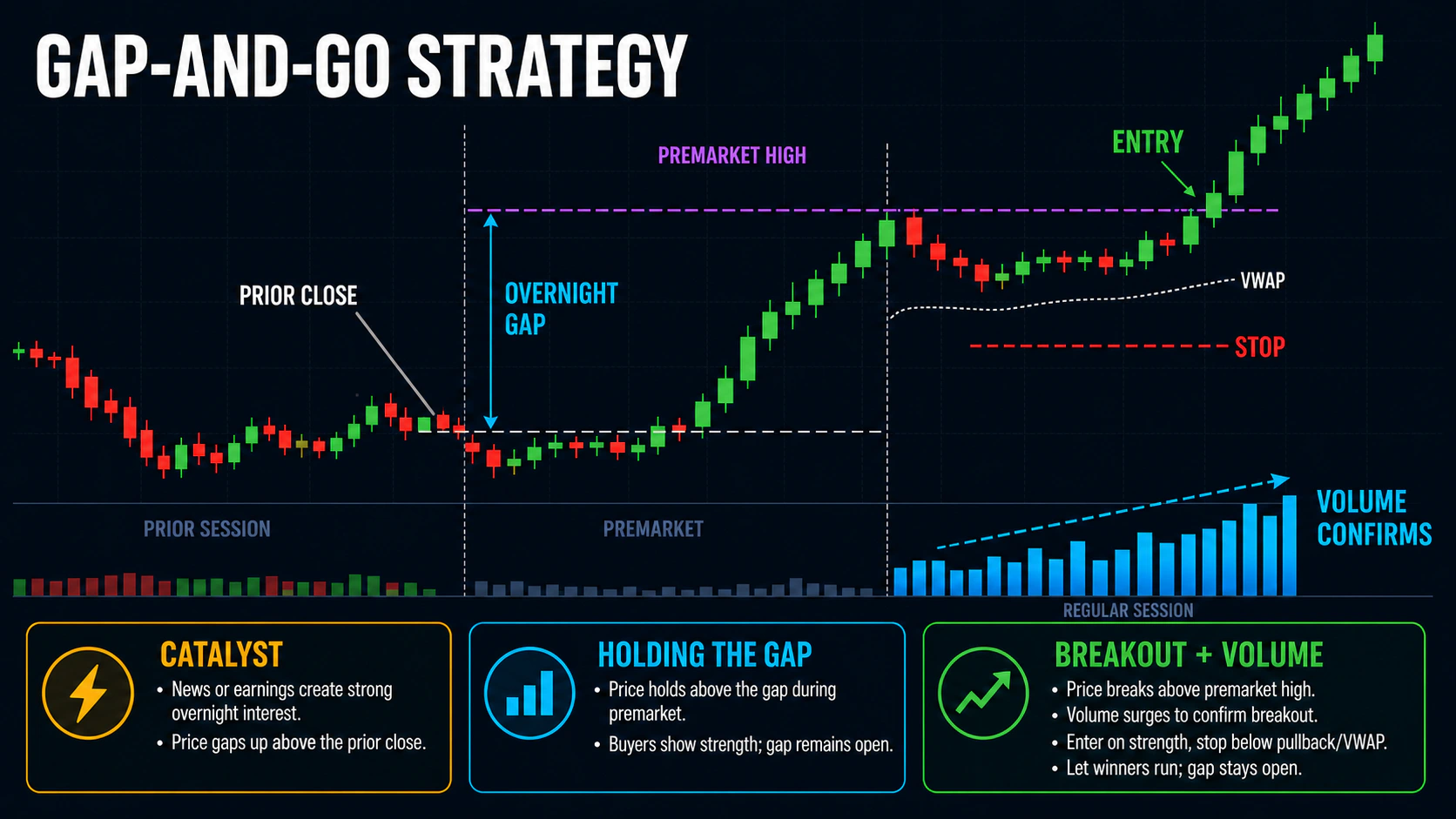
Gap-and-go candidates come from the premarket gappers list, filtered as covered in finding premarket gappers. The setup wants:
- A real catalyst — earnings with raised guidance, an approval, a genuine contract. In gap-taxonomy terms, a breakaway gap, not a common one.
- Heavy premarket dollar volume — proof that institutions, not just retail, are repricing the stock.
- A gap that clears resistance — a gap above the prior day's high, or out of a multi-week base, has open sky; a gap into overhead supply has sellers waiting.
- Premarket structure holding — the stock building higher lows into the open, rather than bleeding back toward yesterday's close.
The Entry Triggers
Two standard entries, both requiring the market to confirm first:
1. Break of the premarket high
The premarket high is the first level everyone is watching. If the stock opens, holds above the prior close, and then takes out the premarket high on expanding volume, that breakout is the trigger. The logic: every premarket buyer is now in profit, nobody who bought earlier is trapped, and the stock is at a fresh high for the move with no immediate supply.
2. First pullback
Stocks rarely go straight up from the bell. A common alternative is to let the first push happen, wait for the initial pullback — ideally shallow, on declining volume, holding above a fast moving average or the intraday VWAP — and enter as price turns back up. The pullback entry accepts a slightly worse win rate in exchange for a much better price and a tighter stop.
What both triggers refuse to do is buy the open blindly. The first minutes of a gapper are dominated by the opening auction's leftovers — early spikes that immediately reverse are routine, and the trader who waits for structure misses only the trades that were coin flips anyway.
Stops and Trade Management
- Initial stop: below the trigger structure — under the pullback low for a pullback entry, or under the opening range low for a premarket-high breakout. A gap-and-go that trades back below its opening range has, by definition, stopped going.
- VWAP as the line in the sand: many intraday traders treat a decisive loss of VWAP as the exit regardless of anything else — the average buyer of the day is now underwater, and the momentum premise is gone.
- Scaling out: because these moves are fast and often front-loaded, a common plan takes partial profit into the first extension (many use a first target near 2R — twice the risked amount), then trails the remainder behind higher lows or a fast moving average.
- Time exit: momentum concentrates in the first 60–90 minutes. A gapper still chopping sideways at 11:00 AM has usually told you the answer — the go never came.
How the Trade Fails
Knowing the failure modes is worth more than knowing the setup:
- The gap-and-crap: the stock breaks the premarket high by a few cents, sucks in the breakout buyers, and reverses hard. This is why the stop goes under structure, not "a comfortable distance away" — the trade is wrong quickly or it is working.
- Buying an exhausted open: a stock already up 40% premarket on its third green day is closer to an exhaustion gap than a breakaway. The gap-and-go wants the start of a repricing, not the end of one.
- Thin names and halts: low-float rockets halt repeatedly, and a halt can reopen far below your stop price. Stops do not protect you through a halt — only position size does.
- Chasing extension: entering after the move is multiple pullbacks old, with the nearest support far below, turns a defined-risk trade into a hope. If the clean entry is gone, the trade is gone.
A Worked Example
A mid-cap software company reports earnings after the close: revenue beat, full-year guidance raised. It closed at $40 and trades up to $44 premarket on heavy volume, building higher lows from 8:00 AM. Premarket high: $44.60. It opens at $44.20, dips to $43.60 in the first five minutes, and reclaims $44.
- Entry: $44.65, as the premarket high breaks on a burst of volume.
- Stop: $43.55 — under the opening range low. Risk: $1.10.
- First target: $46.85 (2R). Half the position comes off there.
- Trail: remainder follows each higher low until the stock loses its 9-period EMA in the afternoon at $47.80.
The numbers are illustrative, but the shape is the whole strategy: confirmation in, structure-based stop, partial profit into strength, and no opinion about what the stock "should" do next week.
Related
The opposite read of the same open — a gap that fails to hold — is the subject of gap-fill trading. Today's candidates are on the premarket movers page, with historical gap behavior on the gap analytics page.