Lesson 2
How the Futures Market Works
Updated Sep 2, 2026 · Reviewed by Terence Scott, founder
- Two Camps
- Hedgers & speculators
- The Guarantee
- Central clearinghouse
- Hours
- Nearly 24h, Sunday-Friday
- Settlement
- Physical or cash
- Level
- Beginner
On this page
The futures market is best understood as a risk-transfer machine. Price risk exists whether anyone trades or not — the farmer holds it from the moment seed goes in the ground, the airline from the moment it publishes next summer's fares. Futures don't create that risk; they move it, from parties who are paid in peace of mind to parties who are paid in potential profit. This lesson covers the two camps and the referee standing between them.
Hedgers: Paying to Remove a Bet
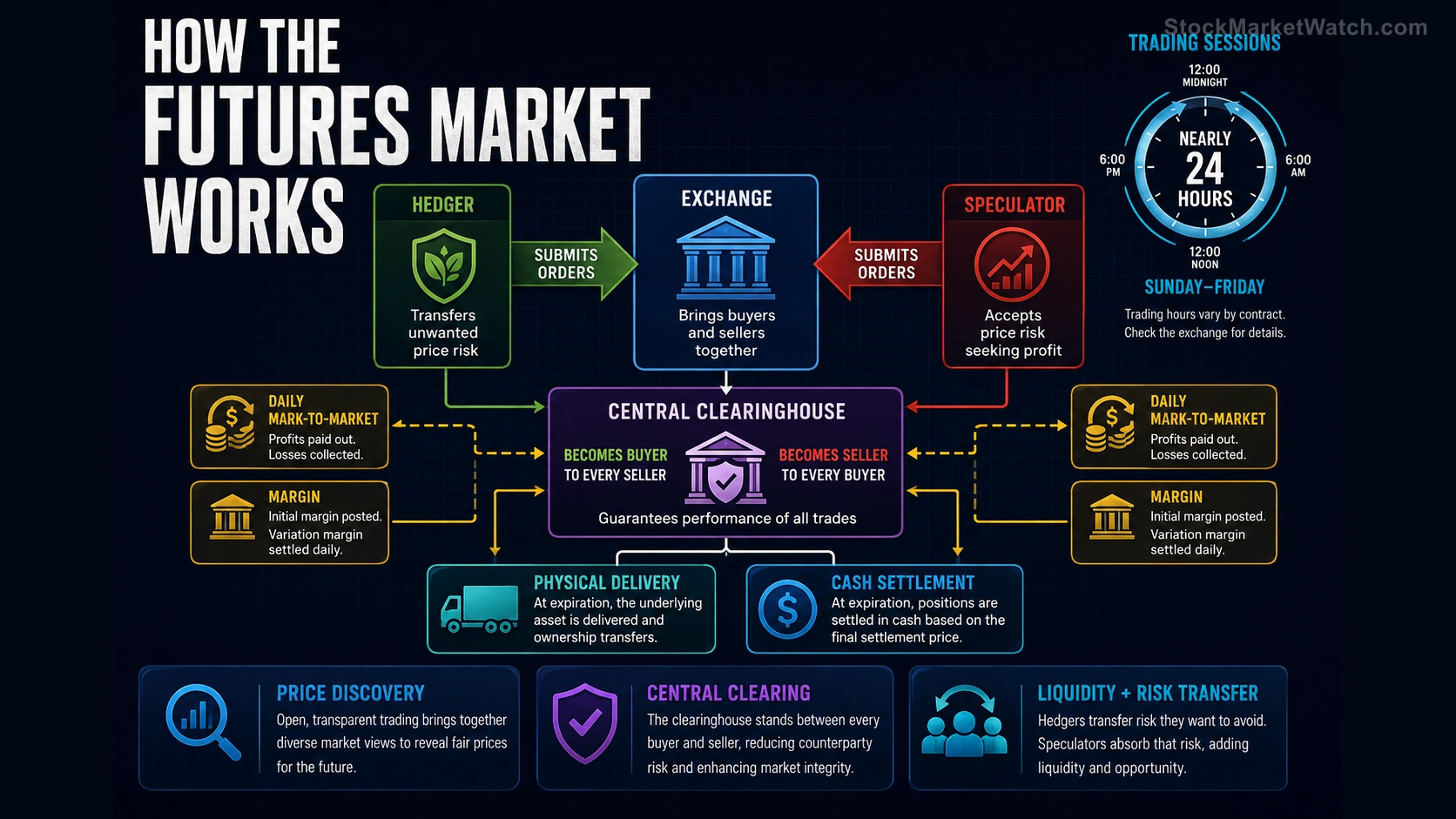
A hedger uses futures to lock a price for something they were already exposed to. The oil producer sells crude futures and knows today what next quarter's barrels will fetch; the airline buys fuel futures and caps its single most volatile cost; the fund manager sells index futures ahead of a nervous stretch instead of dumping an entire portfolio. Notice what the hedger gives up: the favorable surprise. Locking a sale price means forgoing the rally, too. Hedging isn't betting — it's paying (in forgone upside) to stop betting, because the hedger's business was an involuntary bet all along.
Speculators: Paid to Accept It
Risk shed by hedgers has to land somewhere. Speculators — funds, trading firms, individuals — accept it deliberately, holding positions purely for expected profit with no barrel of oil anywhere in their lives. Moralizing about them misses the mechanism: without speculators, the farmer wanting to sell risk would have to wait for a miller wanting the exact opposite hedge at the exact same moment. Speculators are the always-on counterparty, and their competition tightens spreads for everyone. They supply the market's liquidity; in exchange they harvest its risk premium — when they're right.
The Clearinghouse: Why Strangers Can Trade Promises
A contract to pay months from now is only as good as the other side's solvency — and you have no idea who the other side is. The exchange's answer is the clearinghouse: the moment a trade executes, the clearinghouse steps into the middle and becomes the buyer to every seller and the seller to every buyer. Your counterparty is never that anonymous trader; it's the clearinghouse itself, backed by the margin deposits every participant posts and by daily settlement of every account (the machinery of the next lesson). This is why futures markets sailed through crises that shredded private, unstandardized contracts: no one is ever owed more than about a day's price move before accounts square up.
The Clock and the Close
Futures barely sleep: the major contracts trade electronically nearly 24 hours a day, Sunday evening through Friday afternoon. Index futures therefore react to earnings, wars, and overseas sessions all night — which is why U.S. stocks so often "gap" at 9:30: the repricing already happened in the futures market while the stock exchanges were closed. It's the machinery behind every morning's premarket movers and the broad market read on Market Pulse.
Settlement: How Contracts End
Held to expiration, a contract settles per its spec — physical delivery for many commodities (real barrels, real warehouses, almost entirely the province of commercial players) or cash settlement for indexes, where accounts simply true up in dollars. In practice, traders close or roll positions long before expiry; the delivery mechanism's job is mostly to exist, anchoring futures prices to real-world prices as the clock runs out. What happens to your account every single day before any of that — margin, marking to market, and leverage — is where futures get genuinely different: lesson three.