Lesson 4
Risk and Return
Updated Sep 2, 2026 · Reviewed by Terence Scott, founder
- The Law
- No return without risk
- Baseline
- The "risk-free" T-bill rate
- Premium
- Extra return for bearing risk
- Risk Means
- A range of outcomes, not just loss
- Level
- Beginner
On this page
Risk and return are not two features of an investment — they are two views of the same feature. Return is what the market pays you for accepting uncertainty; the uncertainty is the risk. Everything sensible in investing follows from taking that relationship seriously, and most of what's foolish comes from trying to sneak around it.
What Risk Actually Is
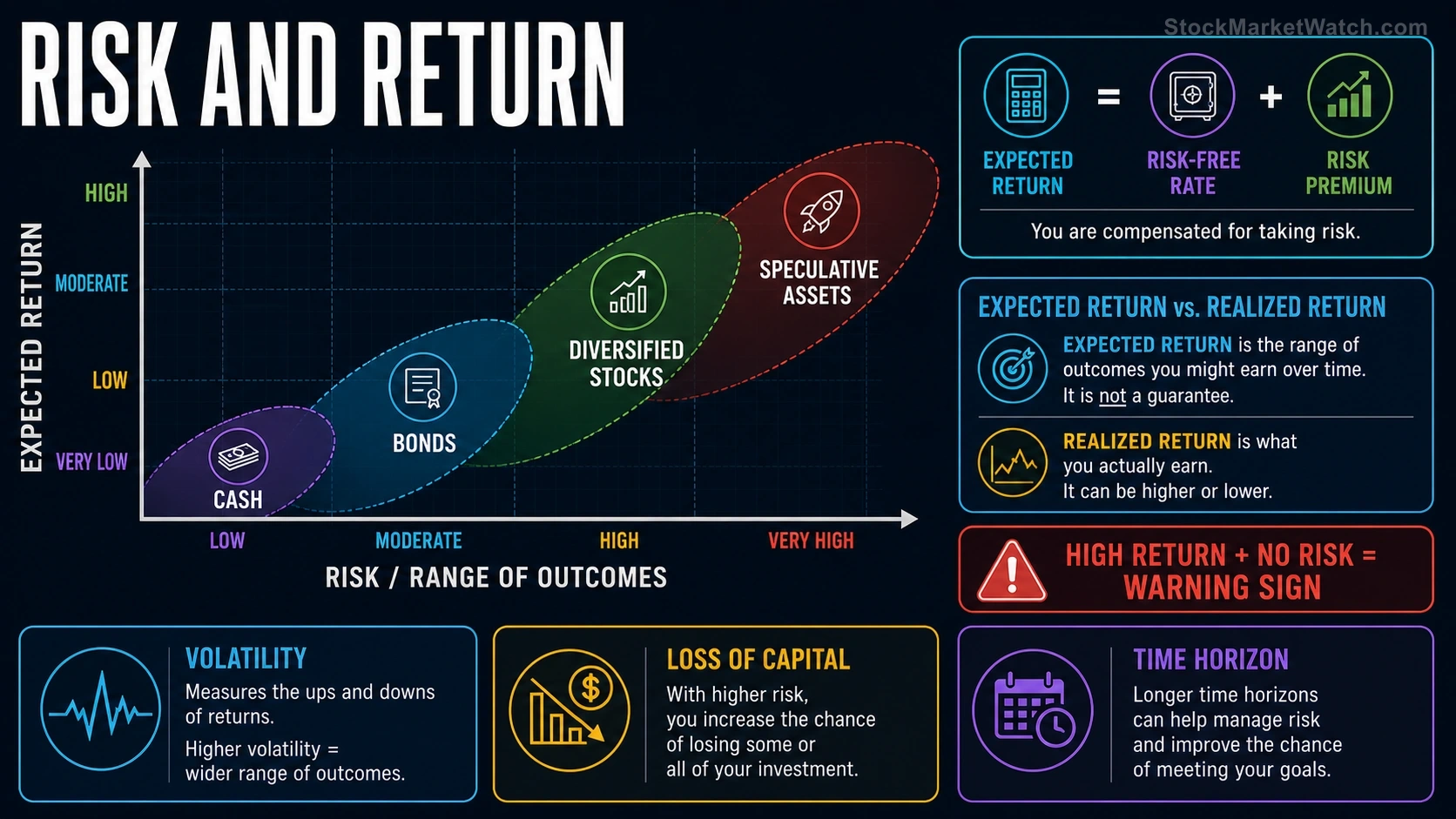
In everyday speech, risk means "the chance of losing money." In markets, it's broader and more useful: risk is the range of possible outcomes. A Treasury bill has one outcome — you get your interest, full stop. A stock has thousands: it could double, halve, drift, or go to zero. That spread of possibilities is the risk, and it cuts both ways — the same width that permits a 40% loss is what permits a 40% gain. This is why "risky" and "bad" are not synonyms. A wide range of outcomes is a problem when your horizon is short and a tolerable feature when it's long.
One distinction inside that range matters more than any other: temporary decline versus permanent loss. A broad market falling 30% and recovering over a few years is volatility — painful, survivable, and historically routine (see bull and bear markets). A single company going bankrupt, or an investor selling out at the bottom, is permanent — the money doesn't come back. Much of the rest of this course is about arranging your affairs so that volatility never gets converted into permanence.
The Risk-Free Baseline
Every return in finance is measured against a common floor: the yield on short-term U.S. Treasury bills, conventionally called the risk-free rate because default is, for practical purposes, off the table. That floor is what you're paid for merely waiting. Everything above it must be earned by bearing some form of risk — and the market prices assets accordingly, as spreads above the floor. When someone quotes you an expected return, the implicit question is always: how far above the risk-free rate, and what am I enduring to collect the difference?
The Risk Premium
The gap between an asset's expected return and the risk-free rate is its risk premium — the wage paid for discomfort. Stocks have historically returned several percentage points a year above Treasuries precisely because holding them means enduring drawdowns, recessions, and years of going nowhere. The premium is not a bonus that comes with stocks; it exists only because those things are hard. An investor who wants equity returns without equity discomfort is asking to be paid a wage without doing the job — the market does not make that trade. Leverage runs the relationship in the other direction: borrowing to invest raises the expected return by widening the range of outcomes, including the catastrophic ones.
The Fraud Detector
The tradeoff's most practical use costs nothing: any offer of high returns with little or no risk is misrepresenting one of the two. Steady 1%-a-month returns in all conditions, "guaranteed" double-digit yields, strategies that "never lose" — each is either concealing risk or fabricating return, and history's famous frauds were spotted years early by people applying exactly this test. It never produces false alarms, because the genuine article does not exist.
Where This Goes
Accepting the tradeoff turns the question from "how do I avoid risk?" — impossible — into "which risks am I paid to take, and how much can I carry?" The next lesson breaks risk into its distinct types, because they are not equally dangerous: some can be nearly eliminated for free, and knowing which is the foundation of everything that follows.