Lesson 9
Dollar-Cost Averaging
Updated Sep 2, 2026 · Reviewed by Terence Scott, founder
- The Rule
- Fixed dollars, fixed schedule
- Math Effect
- Average cost below average price
- Real Benefit
- No timing decisions
- Honest Caveat
- Lump sum usually wins on paper
- Level
- Beginner
Dollar-cost averaging (DCA) is investing a fixed dollar amount on a fixed schedule — say, $200 on the first of every month — regardless of what the market is doing. It is the least glamorous strategy in this course and among the most valuable, because it solves the problem that actually wrecks beginner portfolios: not bad stock selection, but bad timing driven by mood.
The Mechanics
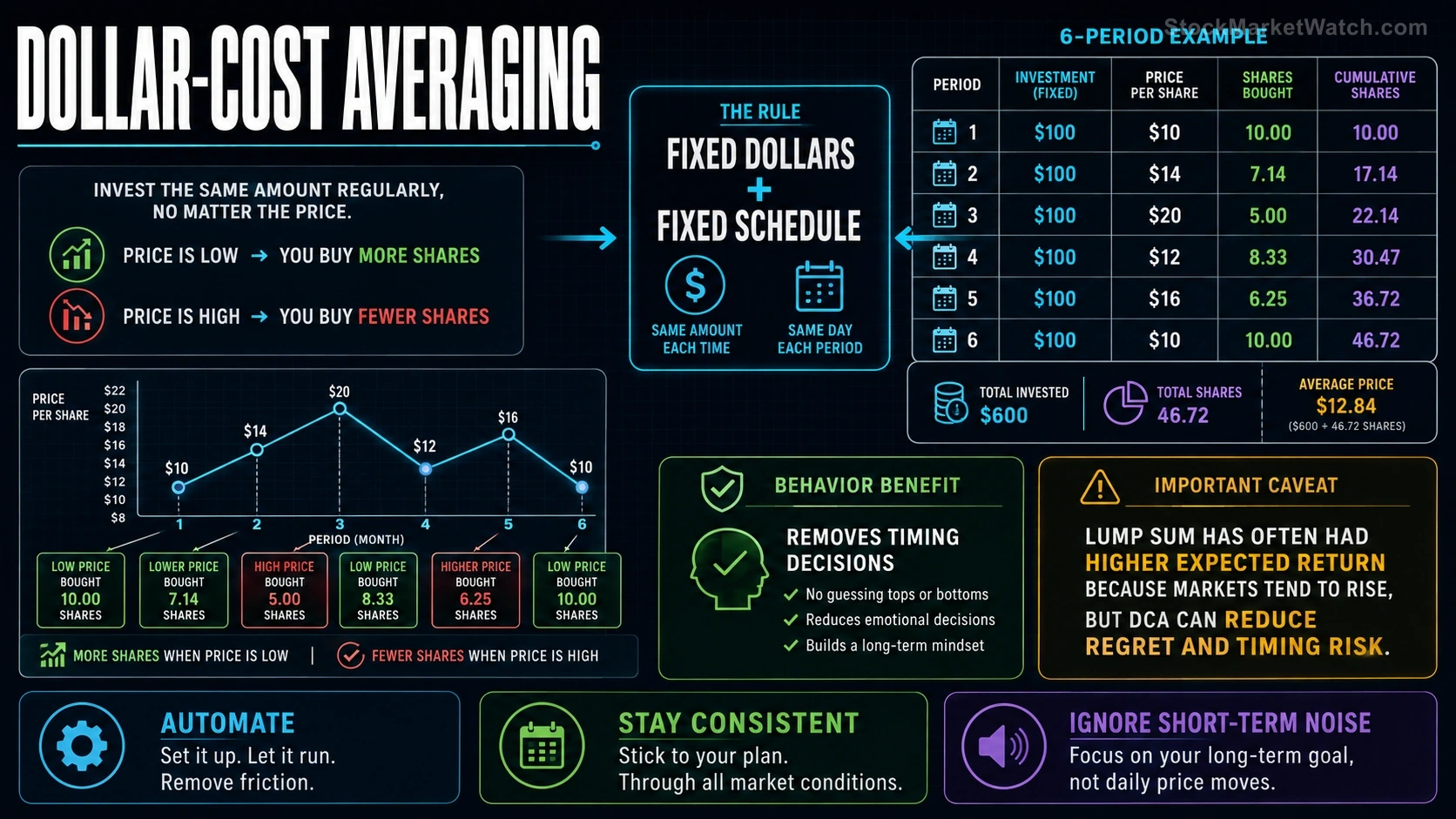
Because the dollar amount is fixed, the share count self-adjusts: the money buys fewer shares when prices are high and more when prices are low. Run $100 a month through a fund that trades at $10, then $5, then back to $10: the three buys purchase 10, 20, and 10 shares — 40 shares for $300, an average cost of $7.50, even though the fund's average price over the period was $8.33. That's the small piece of genuine math magic in DCA: buying a constant dollar amount weights your purchases toward the cheap months automatically, so your average cost per share always comes in at or below the average price per share. Most investors already run this system without naming it — every payroll contribution to a workplace retirement plan is dollar-cost averaging on autopilot.
What It's Really For
The math is nice; the psychology is the point. DCA deletes the question that paralyzes beginners and misleads veterans — is now a good time? — by making "now" irrelevant. There is no waiting for a pullback that never comes, no lump deployed at what turns out to be a peak, no sitting in cash through a recovery out of fear. And critically, the schedule keeps buying through declines, when every instinct argues for stopping — which is precisely when the fixed dollars are quietly accumulating the most shares. The risk-tolerance lesson called this automating the behavior you can't trust yourself to perform under stress; DCA is that advice made concrete. A bear market, to a dollar-cost averager, is functionally a sale on the thing they were going to buy anyway — a reframing that has kept many an investor from converting a routine cycle into a personal catastrophe.
The Honest Caveat
DCA is often oversold as a return-enhancer, and it usually isn't one. If you already hold a lump sum — an inheritance, a bonus — investing it immediately has historically beaten spreading it out over months more often than not, for a mundane reason: markets rise more often than they fall, so the average day spent waiting costs more than it saves. Choosing DCA over a lump sum is buying insurance — paying a modest expected cost to eliminate the scenario of deploying everything the week before a crash, and to guarantee you actually get (and stay) invested. That trade is frequently worth making for temperament reasons. It should just be made knowingly: DCA's honest pitch is better behavior, not better returns. For monthly income being invested as it arrives, the debate evaporates — DCA isn't a choice there, it's simply the only way money you don't have yet can be invested.
Putting It to Work
The implementation is one decision and one automation: pick the amount that survives your budget in a bad month, schedule the transfer and purchase (fractional shares mean any amount works — the mechanics live in how to buy stocks), and stop revisiting it. Combined with an allocation and a rebalancing schedule, this completes the practical machinery of the course. What remains is the theory — starting with a famous, uncomfortable question: if all of this is so well understood, why is the market so hard to beat?