Lesson 3
The Power of Compounding
Updated Sep 2, 2026 · Reviewed by Terence Scott, founder
- Engine
- Returns earning returns
- Rule of 72
- Years to double ≈ 72 ÷ return
- Biggest Input
- Time invested
- Works Against You Via
- Fees & interest
- Level
- Beginner
Compounding is what happens when your returns start earning returns of their own. It is the single most important concept in this course — not because it's clever, but because it's the actual mechanism by which ordinary savers become wealthy, and because its main ingredient is one that anyone reading this early enough has for free: time.
The Mechanism
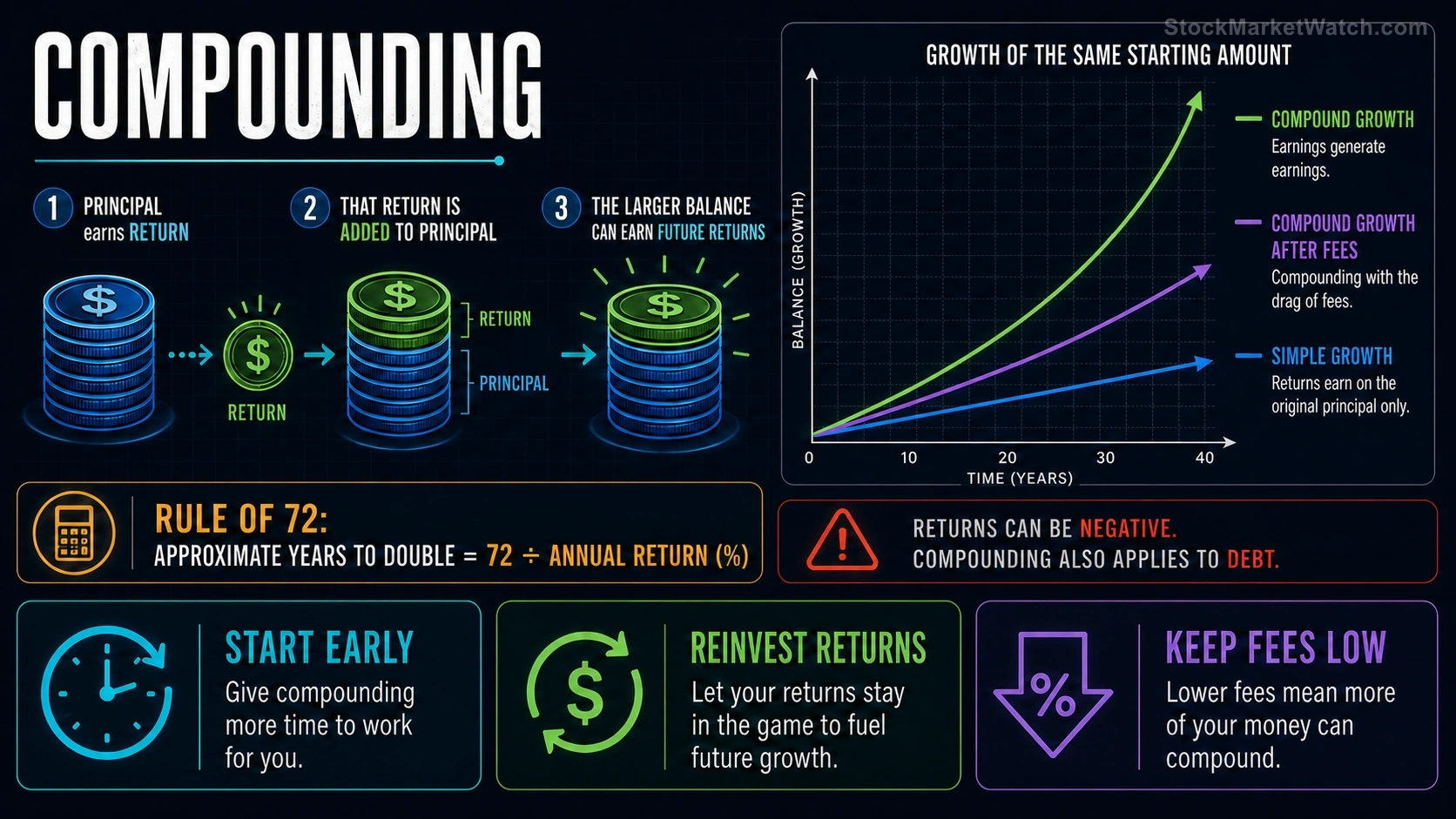
Put $1,000 to work at 10% and you earn $100 the first year. Left alone, the second year's 10% applies to $1,100 — earning $110. Then $121, then $133. The growth of the growth looks trivial at first; that's the trap. Simple interest on that $1,000 would produce $100 a year forever — $3,000 after thirty years. Compounded, the same money becomes roughly $17,400. Nothing changed except that the earnings stayed invested. Compounding is exponential, and human intuition is stubbornly linear — we feel the first years, when little seems to happen, and badly underestimate the later ones, when most of the money actually appears.
The Rule of 72
The mental shortcut: divide 72 by your annual return to get the approximate years needed to double. At 8%, money doubles every ~9 years; at 6%, every 12. The rule's real value is showing what a horizon is worth in doublings. Nine years is one double; thirty-six years is four — and four doublings turn one dollar into sixteen. This is why a modest sum invested at 25 routinely ends up worth more than a much larger sum invested at 45: the early money simply has more doublings left in it. In investing, time is not money — time is a multiplier on money.
Feeding the Engine
Compounding only works on money that stays in. Three habits do most of the feeding: reinvest dividends automatically rather than spending them (over long periods, reinvested dividends account for a remarkable share of the stock market's total return — the mechanics live in the income investing lesson); keep contributing on a schedule, which the dollar-cost averaging lesson covers; and avoid interrupting the process — every panicked sale and every "temporary" withdrawal restarts a clock whose later years were the valuable ones.
The Dark Side
The same math runs in reverse, and just as relentlessly. An annual fund fee of 1% sounds negligible; compounded over decades it quietly consumes a substantial slice of the final sum, which is precisely why low-cost index funds win by default. Debt compounds against you the same way — credit-card balances most brutally, and margin loans in their own fashion, since interest accrues daily on borrowed positions whether they're working or not. A useful audit of any financial arrangement: work out which direction the compounding runs, and for whom.
What This Buys You
Internalizing compounding changes behavior more than any other lesson here: it makes starting now urgent even with small amounts, makes low fees a hard requirement rather than a preference, and makes patience a quantifiable asset instead of a virtue. What it cannot do is remove the fluctuations along the way — the doublings only arrive if you can hold through the down years. What that requires of you is the subject of the next stretch of the course, beginning with risk and return.