Lesson 11
Modern Portfolio Theory and CAPM
Updated Sep 2, 2026 · Reviewed by Terence Scott, founder
- Founder
- Harry Markowitz (1952)
- Insight
- Portfolio risk ≠ sum of parts
- Tool
- The efficient frontier
- CAPM Adds
- Beta prices risk
- Level
- Intermediate
On this page
In 1952, a 25-year-old graduate student named Harry Markowitz published a short paper that eventually won a Nobel Prize and quietly rebuilt the entire industry: "Portfolio Selection." Its core insight sounds obvious now only because it won so completely — an investment should be judged not on its own risk and return, but on what it does to the portfolio it joins. This lesson closes the course with modern portfolio theory (MPT) and its offspring, the capital asset pricing model (CAPM): the mathematics underneath everything the earlier lessons taught in words.
Markowitz's Move
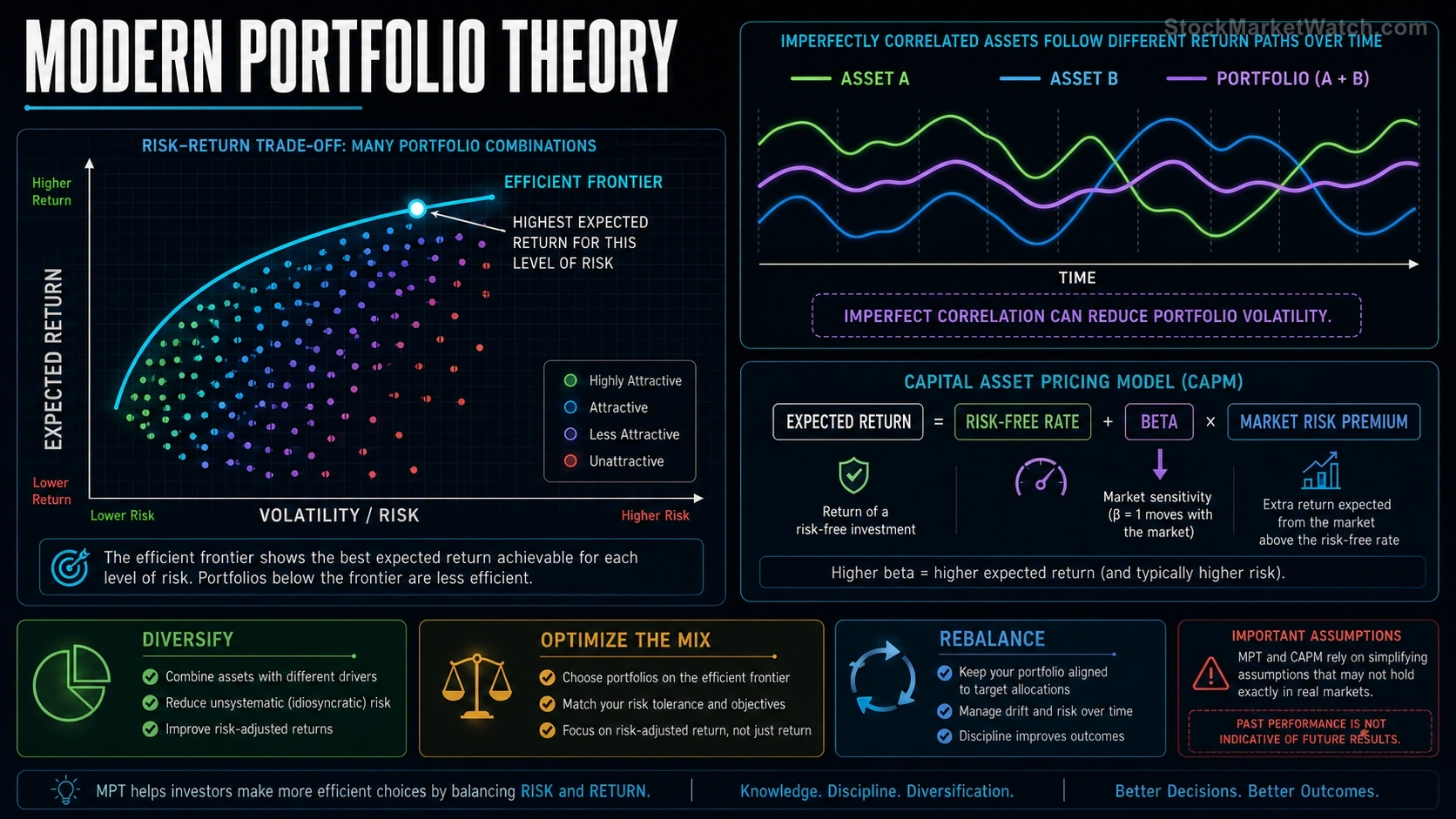
Before Markowitz, a portfolio was a list — pick good securities, and the collection takes care of itself. He showed the collection is the actual object: portfolio return is just the weighted average of its parts, but portfolio risk is not. It depends on how the parts move together — correlation — and whenever they're imperfectly correlated, the portfolio's volatility comes out below the average of its holdings'. Risk genuinely cancels. This is diversification's free lunch stated as a theorem, and it produces a striking corollary: adding a volatile asset can lower a portfolio's risk, if it zigs when the rest zags. Nothing is risky or safe in isolation — only in context.
The Efficient Frontier
Chart every possible portfolio by risk and expected return, and the possibilities fill a region with a hard upper-left edge — the efficient frontier: the portfolios delivering the most return per unit of risk. Anything below the frontier is objectively wasteful (more risk than its return requires); nothing above it exists. The "optimal portfolio" of the theory is simply the frontier point matching your risk tolerance — the math doesn't pick a portfolio for you, it eliminates the dominated ones, then hands the last decision back to the same inputs this course keeps returning to: horizon and temperament.
CAPM and Beta
William Sharpe (Nobel, alongside Markowitz) pushed the logic one step: if diversification is free, the market only pays for risk that survives it — the systematic kind. CAPM prices it with one number, beta: how much a stock moves relative to the whole market. Beta 1.0 moves with the market; 1.5 amplifies it (rising and falling half again as hard); 0.5 dampens it. The model's formula prices any asset in one line: expected return = the risk-free rate, plus beta times the market's risk premium — the same building blocks as lesson four, now assembled. You'll meet beta constantly in stock research; what it's telling you is how much market risk a holding imports into your portfolio, and CAPM's blunt claim is that this is the only risk you're paid for.
Where the Theory Creaks
The machinery is honest; its inputs are the weak point. Correlations are estimated from the past and shift — most cruelly in crashes, when they converge just as diversification is needed most. Expected returns are guesses dressed in decimals. Beta compresses all risk into wiggle-vs-market, ignoring what value investors actually fear (permanent loss from overpaying), and the anomalies from the last lesson are, formally, decades of evidence that beta alone doesn't fully price returns. Use MPT the way professionals do: as the reason diversification and allocation work — not as a machine that outputs certainty.
Course Complete
Eleven lessons, one arc: investing puts money to work (1–3), risk is the price and must be sized to you (4–6), diversification and allocation manage what can be managed (7–9), and the theory explains why the boring version of all this is so hard to beat (10–11). The frameworks for going further — picking individual stocks with eyes open — live in the stock-picking course; the toolbox for owning whole markets at once lives at our ETF center. Wherever you go next, the fundamentals in this course are the part that never goes out of date.