Lesson 2
Value Investing
Updated Sep 2, 2026 · Reviewed by Terence Scott, founder
- Core Idea
- Price below intrinsic value
- Key Metrics
- Low P/E, P/B, high FCF yield
- Safety Mechanism
- Margin of safety
- Main Hazard
- Value traps
- Level
- Intermediate
On this page
Value investing is the strategy of buying stocks for less than the underlying business is worth, on the theory that markets regularly misprice things in both directions — and that buying the underpriced ones with a cushion for error is the most reliable edge available to a patient investor. It is the oldest codified stock-picking discipline, formalized by Benjamin Graham in the 1930s and carried into legend by his student Warren Buffett.
The Core Logic
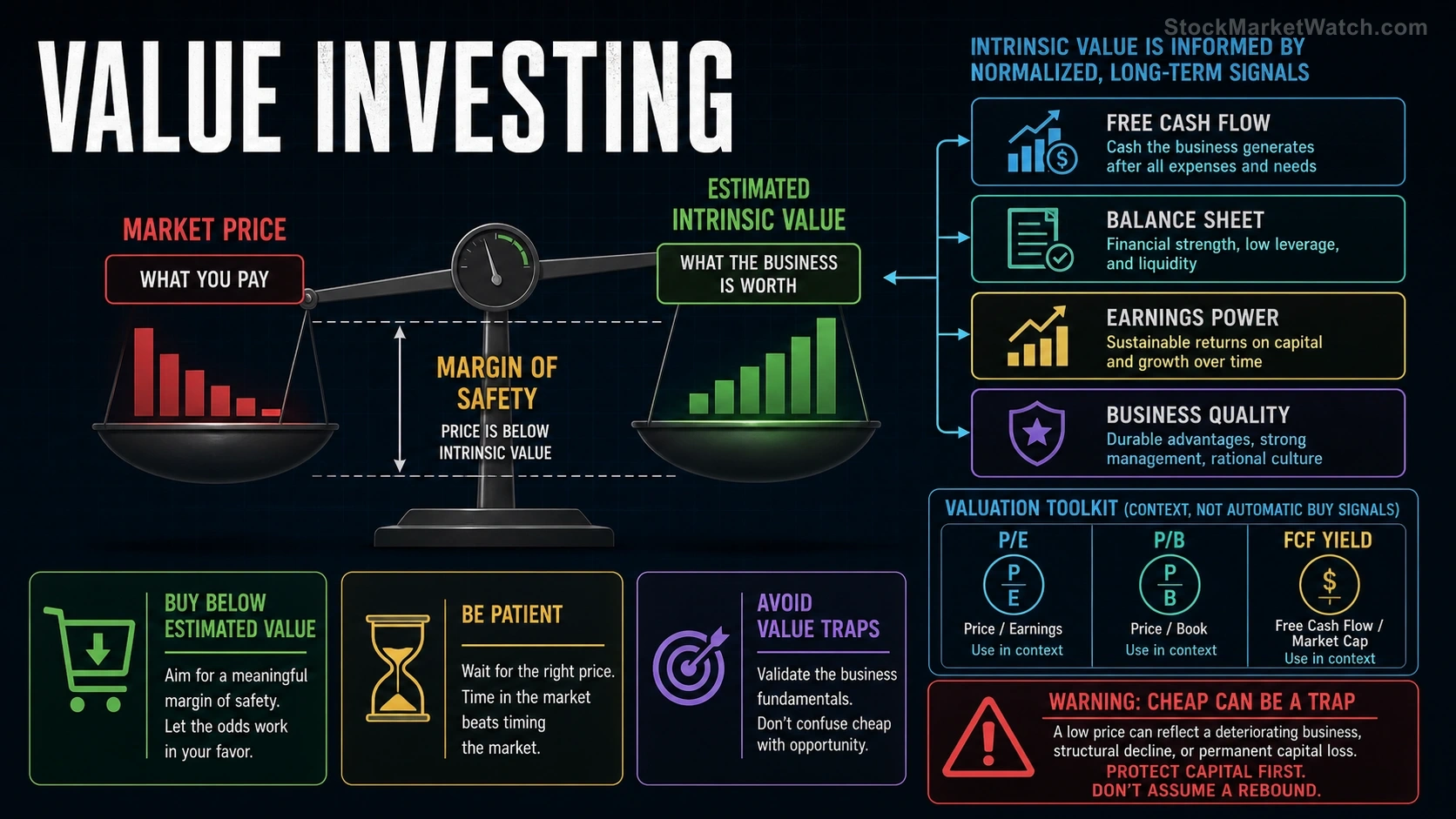
Every stock has two values: the price the market quotes today, and the intrinsic worth of the business behind it — the thing fundamental analysis estimates. Most of the time they track each other loosely. But markets overreact: bad quarters, scary headlines, and unfashionable industries push prices below any sober estimate of worth. The value investor's job is to recognize those moments, buy, and wait for the gap to close. Graham's metaphor remains the best one written: in the short run the market is a voting machine, in the long run a weighing machine — the value investor buys from emotional voters and sells to the scale.
Margin of Safety
The concept that makes value investing a discipline rather than a hunch: never pay intrinsic value — pay meaningfully less, so that if your analysis is wrong (it often will be), the discount absorbs the error. An investor who estimates a business is worth $50 a share and pays $35 has built a 30% cushion against their own overconfidence. Margin of safety is risk management done before the purchase, and it's why serious value investors spend most of their time saying no.
What the Screen Looks Like
- Low P/E relative to the market, the industry, and the company's own history
- Low P/B — classically Graham's territory, still most useful for financials and asset-heavy names
- High free-cash-flow yield — the modern favorite: lots of genuine cash per dollar of price
- Solid balance sheet — low debt, real interest coverage; cheap and fragile is a different strategy called gambling
- Often: a dividend — cash returned while you wait, and covered properly in the income investing lesson
Academic research has long documented a historical "value premium" — portfolios of statistically cheap stocks outperforming expensive ones over long horizons — though it arrives in streaks, including painful multi-year stretches of underperformance. That streakiness isn't a bug in the data; it's the psychological price that keeps the discount rack stocked.
Value Traps: The Strategy's Signature Injury
Some stocks are cheap because the market is wrong. Others are cheap because the market is right — the business is genuinely deteriorating, and today's low multiple is tomorrow's fair one. That's a value trap, and telling the two apart is the entire skill:
- Falling revenue with a falling multiple — cheapness that keeps making itself cheaper
- Structural decline — an industry being replaced doesn't mean-revert (ask the newspaper investors of 2008)
- Debt plus cyclicality — cheap cyclicals at peak earnings are the classic optical illusion: the P/E looks lowest exactly when earnings are about to fall
- No catalyst, no cash return — a discount with no mechanism to close can stay a discount for a decade
The working defense: demand both cheapness and business quality — durable demand, real cash flow, a balance sheet that buys time. "Wonderful companies at fair prices," Buffett's amendment to Graham, is the version that survived contact with the modern market.
Who the Strategy Fits
Value investing rewards patience, contrarian comfort, and accounting literacy — and punishes the need for quick feedback, since positions frequently look wrong for months before looking right. Its natural temperament is the investor who finds buying what others are dumping satisfying rather than terrifying. If watching a holding rise 40% in a quarter is what excites you, the growth lesson is next and will feel like home — value's payoff arrives on a slower clock.
Running It Live
Our stock screens filter the market by P/E, dividend yield and the other value staples, and each candidate's research page carries the financials for the trap-checking work above. Screen for cheap, then investigate why it's cheap — the screen finds candidates; the second question finds investments.