Lesson 1
Fundamental Analysis
Updated Sep 2, 2026 · Reviewed by Terence Scott, founder
- Core Question
- What is the business worth?
- Quantitative
- Statements & ratios
- Qualitative
- Moat, management, industry
- Output
- Estimate of intrinsic value
- Level
- Beginner+
On this page
Fundamental analysis is the study of a business to estimate what its stock is actually worth — its intrinsic value — independent of what the market happens to be charging today. Every strategy in this course is fundamental analysis wearing different priorities: value hunts discounts to intrinsic worth, growth hunts businesses compounding it fastest, income hunts the cash it throws off. This first lesson covers the shared toolkit: the numbers, and the questions behind the numbers.
The Quantitative Half: Three Statements
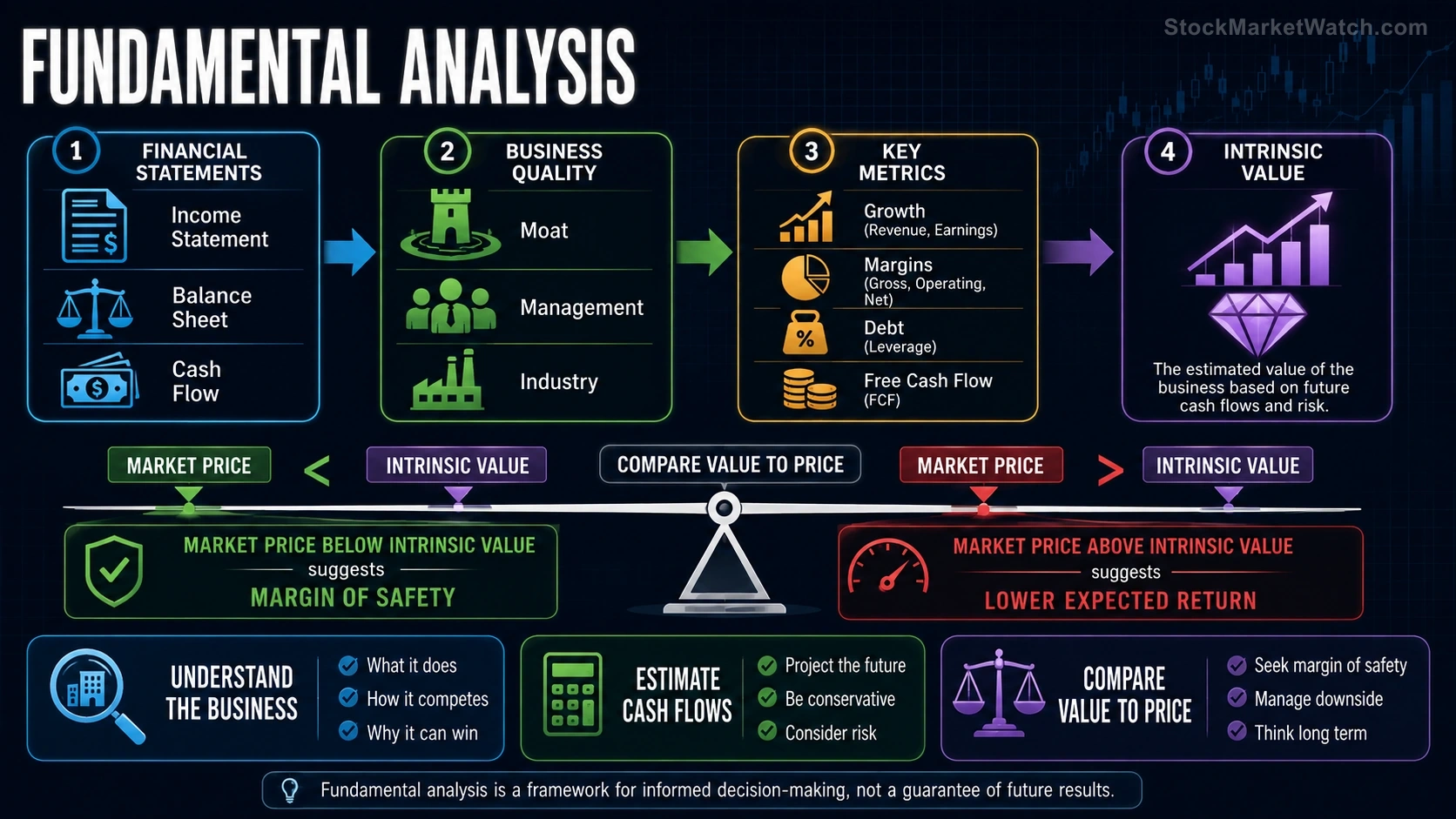
- The income statement — what the company earned over a period: revenue at the top, then costs peeled away until net income remains. The trend matters more than any single year: growing revenue with stable or expanding margins is the basic fingerprint of a healthy business.
- The balance sheet — what it owns and owes at a moment in time. The key reading is resilience: how much debt sits against how much equity, and whether cash and near-cash could cover trouble. Leverage amplifies everything — including failure — exactly as it does for investors on margin.
- The cash flow statement — the one that's hardest to dress up. Earnings involve accounting judgment; cash either arrived or it didn't. Free cash flow — operating cash flow minus capital spending — is what's genuinely left for dividends, buybacks, debt paydown, or growth, and many professionals treat it as the truest single number in the whole filing.
The Ratios That Compress Them
Ratios turn raw statements into comparable measures. The core set:
- P/E (price ÷ earnings per share) — the price of a dollar of profit; the market's expectations dial, introduced in the basics course.
- P/B (price ÷ book value) — price against net accounting assets; most meaningful for banks and asset-heavy businesses.
- ROE (net income ÷ shareholder equity) — how hard the owners' capital works. A durably high ROE without heavy debt is one of quality's clearest signatures.
- Margins (gross, operating, net) — what fraction of each sales dollar survives each layer of cost; direction over time is the tell.
- Debt-to-equity and interest coverage — how much of the enterprise is borrowed, and how comfortably profits cover the interest.
Two disciplines make ratios honest: compare within industries (software and steel live on different planets), and compare across time (a ratio far from a company's own history demands an explanation).
The Qualitative Half: What Numbers Can't Say
Financials describe the past; the price you pay is for the future — and the future depends on questions with no cells in a spreadsheet:
- The moat. What stops competitors from taking this profit? Brands, network effects, switching costs, scale, patents — durable advantages are rare, and businesses without them watch high margins get competed away.
- Management. Do they allocate capital sensibly — reinvesting at high returns, buying back stock when cheap — and do their incentives and their candor in past shareholder letters inspire trust?
- The industry. A mediocre company in a growing industry often beats a great one in a dying industry. Tailwinds and headwinds compound just like returns do.
From Analysis to a Decision
The output of all this is a judgment: what the business is roughly worth, held against what it costs. Professionals formalize that with valuation models; a beginner can get most of the benefit from a simpler discipline — write down why the stock should be worth more than today's price, in three sentences, before buying. If the case leans on "it's been going up," that's not fundamental analysis; the strategies in the rest of this course each supply a sturdier template. Note what fundamental analysis is not: a timing tool. It answers "what and why," while technical analysis addresses "when" — many investors use them together for exactly that reason.
Doing It on This Site
Every ticker's research page carries the raw material — financial statements, valuation ratios, earnings history — and our stock screens filter the whole market by the fundamental measures above, which is how the abstract toolkit becomes a Saturday-morning shortlist. The next five lessons turn it into strategy, starting with the oldest discipline of them all: value investing.