Lesson 6
The CAN SLIM Method
Updated Sep 2, 2026 · Reviewed by Terence Scott, founder
- Creator
- William O'Neil (IBD)
- Style
- Growth + momentum + timing
- Signature Rules
- New highs, RS leadership, 7-8% stop-loss
- Letter Count
- 7 criteria
- Level
- Intermediate+
On this page
CAN SLIM is the most systematized strategy in this course: seven criteria, one per letter, developed by William O'Neil from his study of the biggest winning stocks of the prior century, and taught for decades through his newspaper, Investor's Business Daily. It fuses growth investing with momentum and — unusually among stock-picking systems — an explicit market-timing component. It is also the course's clearest bridge between fundamental and technical analysis, using each for what it does best.
The Seven Letters
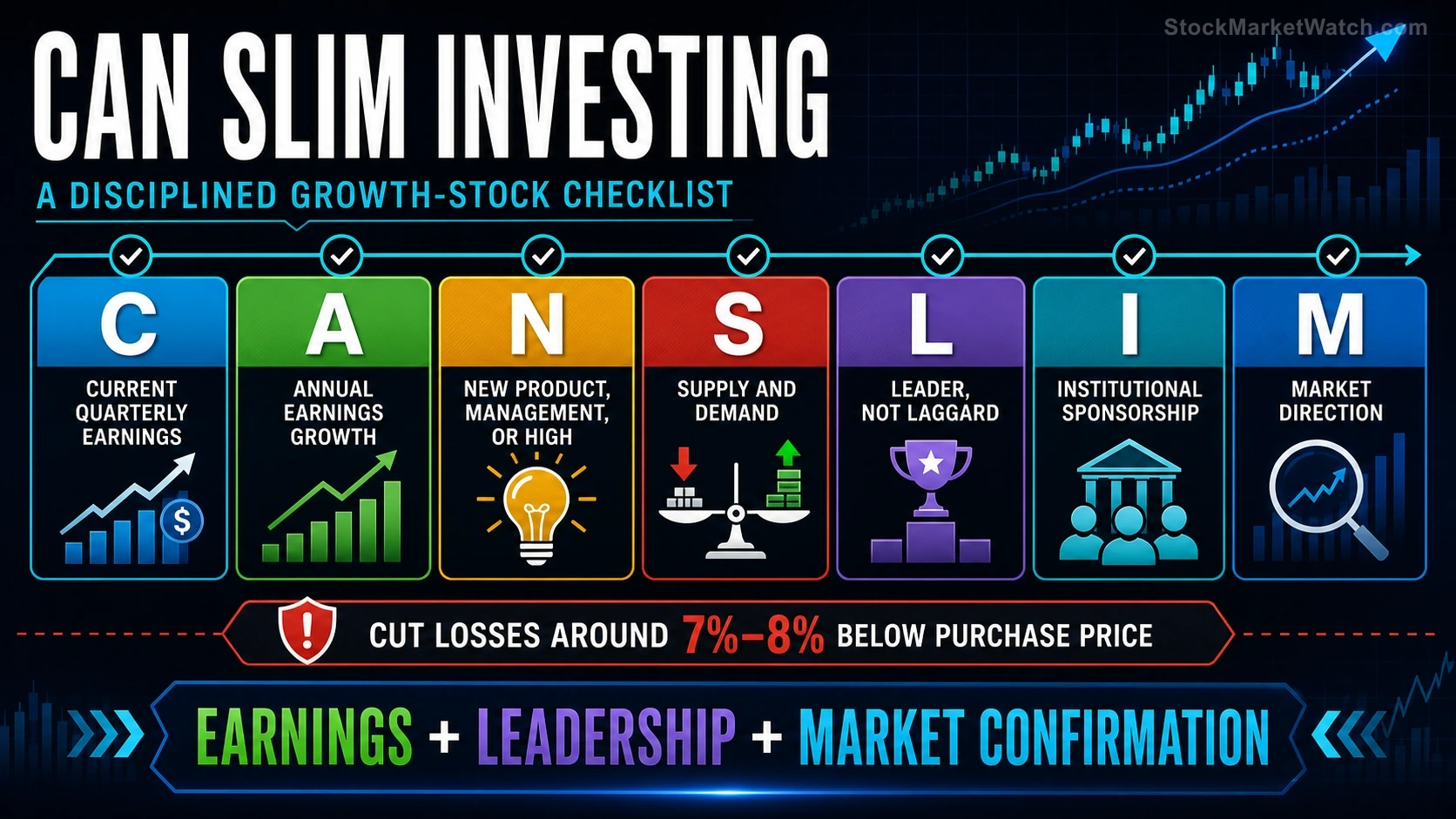
- C — Current quarterly earnings. Big acceleration in the most recent quarters; O'Neil looked for EPS growth of 25%+ versus the same quarter a year ago, and the biggest winners often showed far more.
- A — Annual earnings growth. The quarter isn't a fluke: meaningful compound earnings growth (25%+ was the benchmark) across the last several years, with solid return on equity.
- N — New. Something new driving the move — a product, management change, industry shift — and, controversially for beginners, a new price high. O'Neil's data showed big winners tend to launch from fresh highs, not from bargain bins: "buy high, sell higher."
- S — Supply and demand. Favor smaller floats and watch volume: breakouts on heavy volume show institutions reaching; price rises on thin volume are unsponsored.
- L — Leader, not laggard. Buy the #1 or #2 stock in a leading industry group, measured by relative strength — how the stock performs versus the whole market. O'Neil's RS Rating percentile is the same concept our technicals system computes as its RS Rating; leaders rank 80+.
- I — Institutional sponsorship. Some — increasing fund ownership confirms the story; but not saturation, since a stock every institution already owns has run out of big buyers.
- M — Market direction. The filter that surprises stock-pickers: don't fight a bear market. Since most stocks follow the general market, CAN SLIM buys only when the broad trend is confirmed up — the cycle-reading skill from the basics course, systematized.
The Technical Half
Entries come from chart bases — consolidation patterns from which leaders break out on expanding volume. O'Neil's signature base is the cup with handle, and the buy point is the breakout through the handle's high. Our signal scans track the raw materials daily: 52-week highs (the N), relative-strength leaders (the L), and volume-confirmed breakouts (the S).
The Selling Rules — the System's Real Spine
CAN SLIM is at least as much a selling discipline as a buying one, and this is what most self-described practitioners skip:
- Cut every loss at 7–8% below the buy point. No exceptions, no averaging down. The math behind the dogma: small losses are recoverable, and the system's returns come from a few big winners running while many small losers are amputated early.
- Hold winners past the itch to take small profits — the target is the occasional 100%+ leader, which pays for every 7% stop.
- Respect the M on the way out too — deteriorating market breadth and failed breakouts cluster before corrections.
Honest Assessment
Strengths: it's a complete system — selection, entry, exit, and market filter — which removes most of the improvisation that ruins beginners; and its core observations (earnings acceleration, leadership, new highs) are backed by O'Neil's long historical study of winning stocks. Costs: it's high-maintenance (weekly at minimum), it generates taxes and trading friction, whipsaw markets stop you out repeatedly, and buying new highs is psychologically brutal for anyone with value instincts. It is a trading-flavored investing system — closer in spirit to our trading strategies section than anything else in this course — and it rewards exactly the temperament that can follow rules when they feel wrong.
Running It Live
The scan stack maps letter-for-letter: 52-week-high breakouts and RS leaders for N and L, volume signals for S, and the Market Pulse dashboard for M. The earnings letters (C and A) come from each candidate's research page. Final lesson of the course: the simplest system ever to attract serious money — the Dogs of the Dow.