Lesson 8
Bull and Bear Markets
Updated Sep 2, 2026 · Reviewed by Terence Scott, founder
- Bear Market
- -20% from a peak
- Correction
- -10% to -20%
- Historical Pattern
- Bulls run years, bears run months
- Biggest Risk
- Selling the bottom
- Level
- Beginner
On this page
The market's oldest mascots: bulls attack thrusting upward, bears swipe downward — so a rising market is a bull market and a falling one a bear market. Behind the folklore sit real definitions, a well-documented cycle, and the single most expensive behavioral mistake in retail investing. This closing lesson of the basics course covers all three.
The Official Thresholds
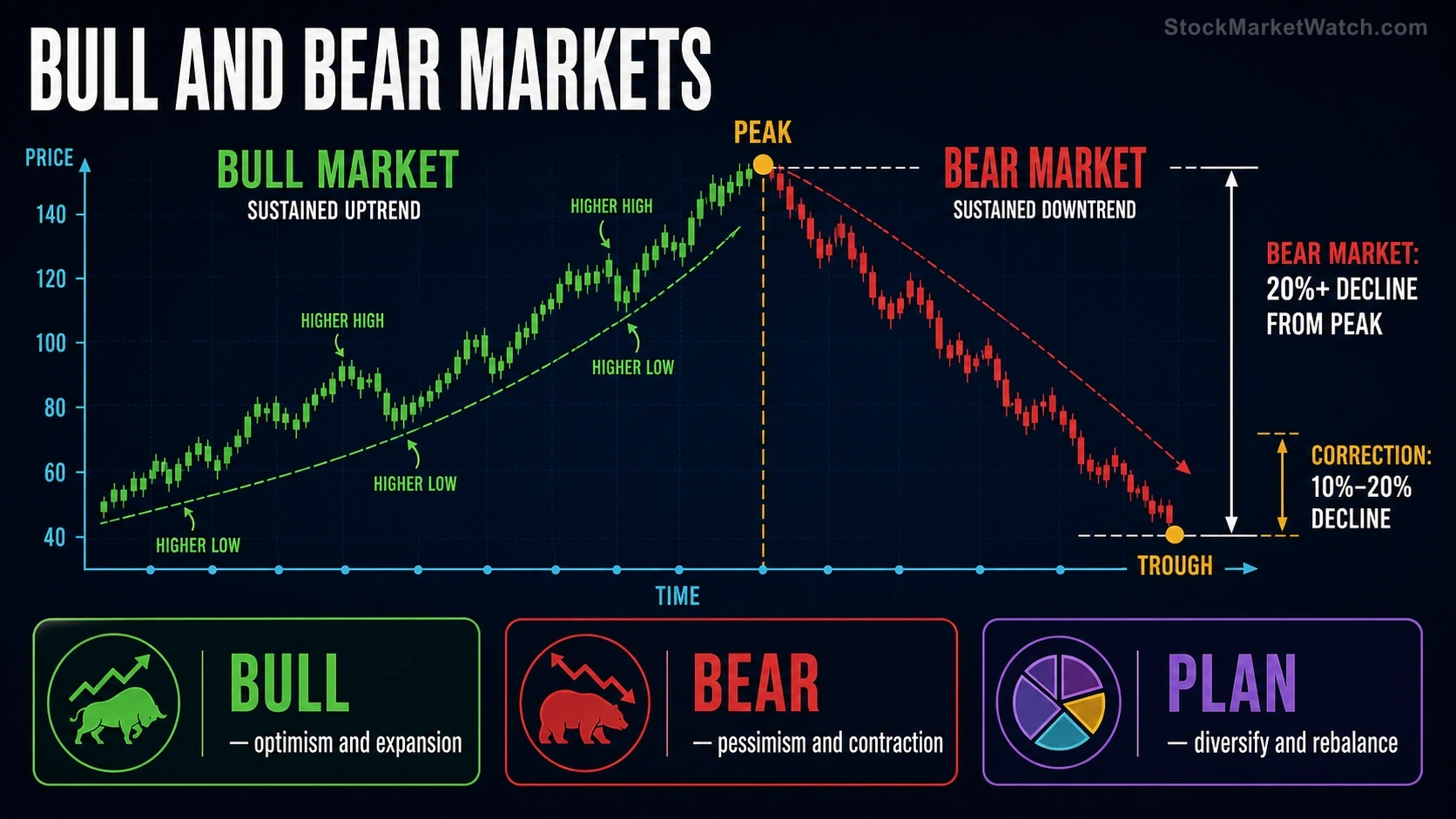
- Bear market: a decline of 20% or more from a recent peak in a major index.
- Correction: a decline of 10% to 20% — routine, roughly an annual event historically, and usually resolved without becoming a bear.
- Bull market: the advancing phase, conventionally dated from a bear-market low once prices have risen 20% off it.
- Crash: no official definition — the word for when a large decline happens fast.
The 20% lines are conventions, not physics — nothing changes at -19.9% — but they give everyone a shared vocabulary, and the labels themselves move sentiment when headlines start using them.
The Shape of the Cycle
The pattern across a century of U.S. market history is asymmetric in a way beginners should internalize:
- Bull markets grind; bear markets strike. Advances typically run for years and compound quietly. Declines are compressed — steep, violent, and emotionally loud. The market's worst single days and its best single days cluster together, inside bear phases.
- The net direction has been up. Every bear market in U.S. history has eventually been followed by new highs — the timing unknowable in advance, the direction so far unbroken. That's the statistical foundation under long-term investing.
- Nobody rings a bell. Tops form while headlines are euphoric; bottoms form while they're apocalyptic. Both are only obvious in hindsight, which is precisely why the strategies that require identifying them in real time have such a poor record.
What Actually Ends Bull Markets
Not old age. Historically the recurring killers are recessions, aggressive interest-rate tightening (the rates lever from lesson 4), bursting valuation bubbles, and genuine shocks. Under the surface, tops often announce themselves through narrowing participation — the index still rising while most of its member stocks quietly roll over. That's measurable: it's exactly what breadth tools like the advance-decline line exist to catch, and our Market Pulse dashboard tracks it live.
The Behavioral Trap
The classic retail round trip: confidence builds through the bull's later years → maximum buying near the top → panic selling in the bear's final plunge → sitting in cash through the recovery's explosive early gains → buying back in higher. Every leg feels rational at the time. It converts the market's long-run upward drift into personal losses, and avoiding it is worth more than nearly any stock-selection skill.
The defenses are structural, not motivational: invest only money without a deadline (lesson 5), diversify so no single blowup forces action, automate steady buying so declines are accumulation instead of terror, and decide sell-rules in advance. For those inclined to do something in downturns, history's answer is that the something which works is continuing to buy.
Bear-Market Survival Notes
- Corrections are the price of admission — a 10% drawdown is a recurring feature, not a malfunction.
- Bear-market rallies are ferocious — sharp multi-week bounces inside ongoing declines fool everyone repeatedly; it's why "the bottom" gets called a dozen times before it happens.
- Quality gets marked down with everything else — indiscriminate selling is what creates the bargains the next bull is built on.
- Your time horizon is the asset — a 25-year-old's bear market is a sale; a retiree's is a sequencing risk. Same market, different exposure — which is what portfolio construction (the fundamentals course, next) is actually about.
Course Complete — Where Next
You now hold the full basic toolkit: what a stock is, how it trades, what moves it, how to buy one, and how to read the quote, the chart, and the cycle. Three natural continuations, in rough order: the Investing Fundamentals course for risk, diversification and portfolio thinking; the stock-picking strategies course when you're ready to choose individual names; and the daily practice of watching real markets with informed eyes — the movers, the market pulse, and the nightly digest that summarizes it all.