Lesson 5
How to Buy Stocks
Updated Sep 2, 2026 · Reviewed by Terence Scott, founder
- Commissions
- $0 at major brokers
- Minimum
- None (fractional shares)
- Key Choice
- Market vs limit order
- Protection
- SIPC to $500k
- Level
- Beginner
On this page
Buying a stock in 2026 takes about as long as ordering takeout: commissions at every major U.S. broker are $0, fractional shares mean any budget clears the bar, and account opening is a same-day phone task. The mechanics being easy is exactly why the judgment matters — this lesson walks the practical sequence and flags the handful of decisions that actually deserve thought.
Step 1: Open a Brokerage Account
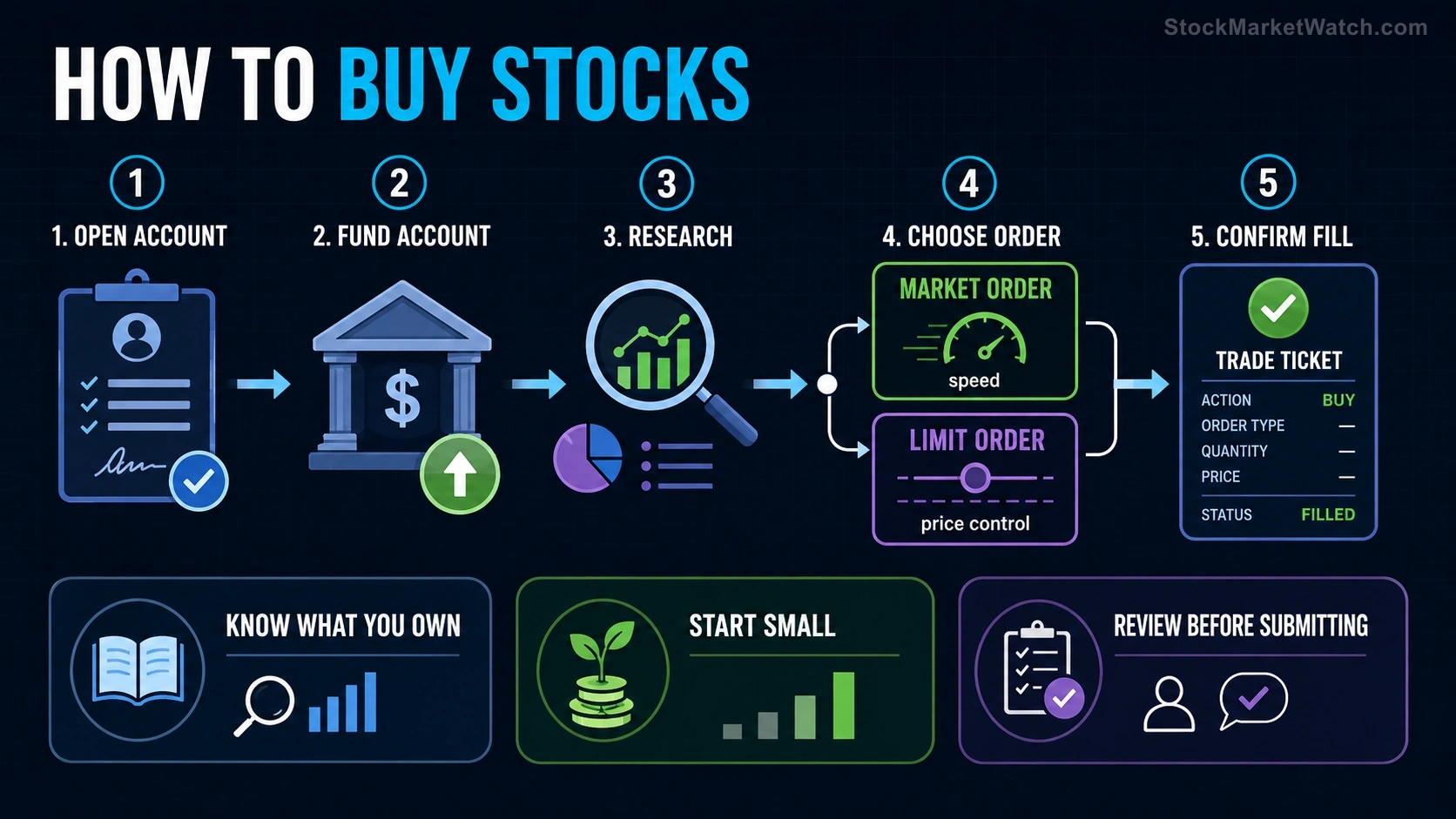
A brokerage account is to investments what a checking account is to cash. Opening one online takes minutes — identity details, employment info (a regulatory formality), and a linked bank account. Two decisions come up during signup:
- Account type. A standard taxable brokerage account has no contribution limits and no withdrawal restrictions. Retirement accounts (IRA, Roth IRA) carry major tax advantages in exchange for annual limits and early-withdrawal rules. Many investors sensibly run both; which to prioritize is a tax question beyond this course's scope.
- Cash vs. margin. A cash account spends only the money you deposit. A margin account can borrow against your holdings. Beginners should start with cash — borrowing to invest is a separate skill with separate risks, covered honestly in the margin trading course when you're ready.
On safety: brokerage accounts carry SIPC protection up to $500,000, which covers you if the broker fails. It does not — and nothing does — cover your investments losing value.
Step 2: Fund It
Link a bank account and transfer. ACH transfers are free and typically available for trading quickly at major brokers, even while formally settling in the background. Start with an amount that is genuinely surplus — the classic rule that money needed within a few years doesn't belong in stocks exists because being forced to sell during a downturn converts a temporary decline into a permanent loss.
Step 3: Know What You're Buying First
The research habit is the difference between investing and guessing, and it doesn't need to be heavy on day one: what does the company sell, is it growing, is it profitable, and what are you paying for that (the P/E from last lesson)? Our stock screens sort the market by these basics, and every ticker's research page carries its financials, valuation, and technical picture. Many beginners' genuinely best first purchase is not a single stock at all but a broad index ETF — one purchase, hundreds of companies — covered fully in the ETF course in this section.
Step 4: The Order Ticket
The one screen with real decisions on it. You'll enter the ticker, the amount (shares or dollars — fractional shares mean $50 buys $50 of almost anything), and the order type:
- Market order — "fill me now at the best available price." In liquid large caps during market hours, it fills instantly within a penny or two of the quote. Fine for most beginner-scale trades in major names.
- Limit order — "fill me only at my price or better." A buy limit at $98 executes only at $98 or lower. This is the right default whenever the stock is volatile, thinly traded, it's the first minutes after the open, or the market is closed (never queue a market order overnight — it fills at whatever the open brings, and gaps are real).
- Stop orders — instructions that trigger when price crosses a level, mostly used to manage exits. Useful later; not needed for a first buy.
The practical rule: market orders buy immediacy, limit orders buy price certainty. In a calm, liquid stock the difference is pennies; everywhere else, use the limit.
Step 5: After the Fill
You'll own the shares instantly (settlement finalizes next day, per lesson 3). Then comes the part nobody warns you about: the urge to check the price hourly. Resist it by deciding before buying what would make you sell — a change in the business, a better opportunity, a rebalance — so that ordinary volatility isn't constantly auditioning as a reason. Track your positions in one place (our portfolio tracker is free) rather than by refreshing quotes.
The Beginner Mistakes, Compressed
- Going all-in on one name immediately — concentration is a choice to make deliberately later, not a default.
- Market orders in thin stocks — the spread quietly taxes every careless fill.
- Investing money with a deadline — rent money and tuition have no business in an auction.
- Confusing activity with progress — trading a lot feels like doing something; for most investors, buying steadily and rarely selling wins.
- Skipping the dividend setting — turn on automatic dividend reinvestment (DRIP) unless you have a reason not to; compounding is the whole game.
Next: the numbers you'll stare at every day from now on — how to read a stock quote.