Lesson 4
What Moves Stock Prices
Updated Sep 2, 2026 · Reviewed by Terence Scott, founder
- Immediate Cause
- Supply & demand
- Long-Run Driver
- Earnings
- Big Macro Lever
- Interest rates
- Wildcard
- Sentiment & expectations
- Level
- Beginner
On this page
The literal answer is one sentence: a stock's price changes because the balance of buying and selling pressure changes. Every tick is just the auction from the previous lesson finding a new equilibrium. The useful question is one layer deeper — what changes the balance? — and the honest answer depends on the time horizon you're asking about.
The Long Run: Earnings Do the Driving
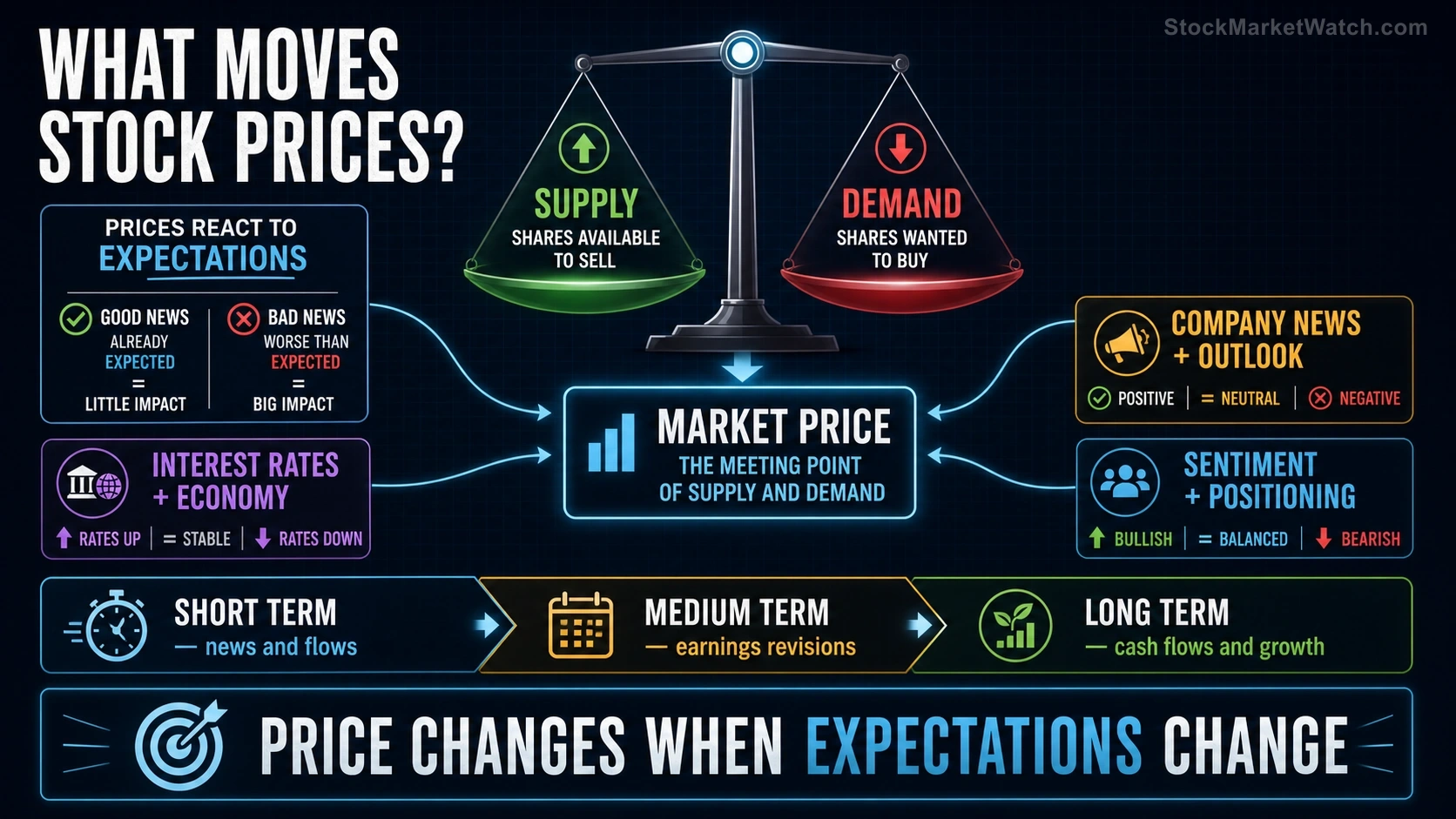
Over years, stock prices follow business results with remarkable fidelity. A company that compounds its earnings tends to see its share price compound too; one whose profits decay watches its price decay with them. The mechanism is valuation: investors are buying a claim on future profits, so the price gravitates toward some multiple of what the business earns — the familiar P/E ratio is exactly that multiple, read off the market.
This is the anchor worth internalizing before everything else in this lesson: in the short run prices vote on stories, but in the long run they weigh earnings. Every other driver below is mostly about the journey, not the destination.
The Medium Run: Expectations, Not Results
Here's the twist that confuses every beginner at least once: a company reports record profits and the stock falls. The market prices the future, so today's price already contains a forecast — and price moves on the gap between results and expectations, not on results alone. Record earnings that fall short of what was priced in are a disappointment; a smaller-than-feared loss is a rally.
This is why earnings season moves markets so violently: four times a year, forecasts collide with reality, in public, after hours. Guidance — what management says about next quarter — frequently matters more than the quarter being reported, because it repoints the forecast that the price is built on.
The Macro Layer: Rates, Inflation, and the Economy
- Interest rates are the heaviest single macro input. Rates are the price of money and the yardstick every investment is measured against: when safe bonds yield more, future profits are worth less today, and the stocks priced most heavily on distant earnings — growth names especially — feel it most. Federal Reserve decisions move the entire market because they move this yardstick.
- Inflation works partly through rates and partly through costs and consumer behavior.
- The economic cycle lifts and sinks cyclical businesses' actual earnings — housing, autos, banks, travel — while barely touching defensives.
- Sector and industry currents — an oil-price surge, a chip shortage, a regulatory shift — move whole groups at once, which is why a stock can fall on a day its company announced nothing.
The Short Run: Sentiment, Positioning, and Mechanics
Day to day, prices move on things that have little to do with business value: fear and greed cycles, momentum chasing, index fund flows, options hedging, tax-loss selling, and the forced buying of short squeezes. None of it changes what a company earns; all of it changes today's balance of buyers and sellers. Benjamin Graham's line remains the best one-sentence summary in finance: in the short run the market is a voting machine, in the long run a weighing machine.
One Event, Three Lenses
Put the layers together with an example. A retailer reports earnings: profits up 10% (long-run lens: good business), but guidance comes in below forecasts (expectations lens: disappointment — stock gaps down 8% after hours), and the drop triggers momentum selling the next morning before dip-buyers step in at a support level (short-run lens: mechanics). All three lenses are "the market" — they're just operating on different clocks. Most bad investing decisions come from reading a short-run move with a long-run lens or vice versa.
Watching It Happen
The best education is watching these forces work in real time. The daily movers list is a live catalog of expectation gaps — nearly every name on it moved because reality beat or missed a forecast. The premarket gappers show the overnight repricing raw, before the session smooths it. And the Market Pulse dashboard shows the macro layer: breadth, sectors, and whether a move is one stock's story or the whole market's.
Next: enough theory — how to actually buy a stock, from opening an account to your first filled order.