Lesson 1
What Is a Stock?
Updated Sep 2, 2026 · Reviewed by Terence Scott, founder
- Key Concept
- Ownership share
- You Get
- Claim on earnings & assets, voting rights
- Ways to Profit
- Price appreciation + dividends
- Max Loss
- Amount invested
- Level
- Beginner
On this page
A stock is a share of ownership in a company. Buy one share of a business and you own a sliver of everything it is — its brand, its buildings, its patents, its profits. That's the entire idea, and it is worth sitting with for a moment, because most beginner mistakes come from forgetting it: a stock is not a lottery ticket, a video-game token, or a line on a chart. It is a legal claim on a real business.
Ownership, Sliced Small
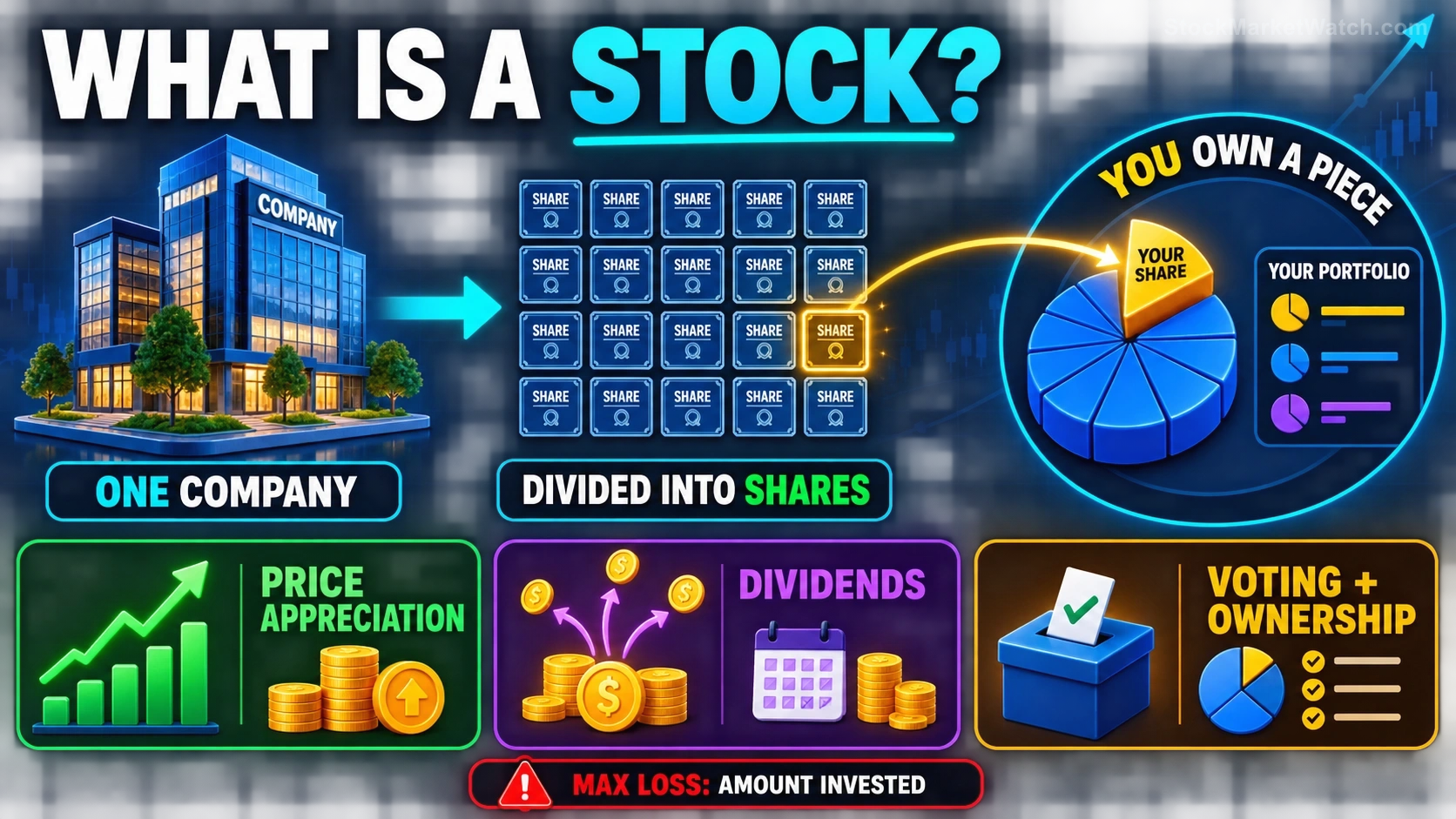
Companies divide their ownership into identical units called shares. A company with 1 billion shares outstanding has cut itself into a billion equal pieces; own 1,000 of them and you own one-millionth of the company. The market price of one share times the total share count gives the company's market capitalization — what the market says the whole business is worth.
Ownership comes with rights. Common shareholders can typically vote on directors and major corporate decisions (one vote per share), receive dividends when the company pays them, and hold a residual claim on the company's assets — meaning if the business were wound down, shareholders are paid after lenders and bondholders. That ordering matters: shareholders take more risk than lenders, and the reward for that risk is that shareholders own all the upside.
Why Companies Sell Stock at All
Businesses need capital to grow — to build factories, hire engineers, enter new markets. They can borrow it (debt), or they can sell pieces of ownership (equity). Selling stock raises money the company never has to repay and carries no interest bill; the cost is that the founders own less of the business. When a private company first sells shares to the public, that's an initial public offering (IPO) — after which the shares trade freely between investors on an exchange, which is where you come in.
A detail that surprises many beginners: when you buy a share of a public company, your money goes to the seller of the share, not to the company. The company received its money at the IPO (or later offerings). Daily trading is investors exchanging ownership among themselves at continuously negotiated prices.
How Shareholders Actually Make Money
- Price appreciation. If the business grows its earnings — or the market becomes more optimistic about them — the shares tend to command a higher price. Sell for more than you paid, and the difference is a capital gain.
- Dividends. Mature companies often pay out part of their profits in cash, typically quarterly. A stock trading at $100 that pays $3 per year in dividends has a 3% dividend yield. Reinvested dividends historically account for a large share of the stock market's long-run total return.
Both flow from the same source: the business earning money. Over years, share prices track business performance far more faithfully than day-to-day headlines suggest — which is why "know what you own" is the oldest advice in investing and still the best.
The Risk Side
Two properties define stock risk, one comforting and one not:
- Limited liability. The most you can lose buying a stock is what you paid. Shareholders are never on the hook for a company's debts — if the business fails, your shares can go to zero, but nobody comes after your house.
- No guarantees of any kind. Dividends can be cut. Prices can fall 50% and stay down for years. Individual companies can and do go bankrupt, wiping shareholders out entirely — bondholders and lenders get paid first from whatever remains, and there is rarely anything left. This is why the later lessons in this course spend so much time on what moves prices and why diversification exists.
Stock vs. Everything Else
A quick orientation of where stocks sit among the major asset types: bonds are loans — you're the lender, collecting interest, with no ownership and (normally) no upside beyond repayment. Cash and money-market funds are safety with modest yield. Funds and ETFs are baskets that hold many stocks or bonds at once — most beginners' first purchase, and covered in their own course later in this section. Stocks are the growth engine of the lineup: the highest long-run historical returns of the major liquid asset classes, paid for with the largest swings along the way.
Seeing It Live
Everything above is visible on any quote page on this site: the price the market currently puts on one slice of ownership, the market cap it implies for the whole business, the dividend yield if any, and the day's trading. Pull up any name on the stock quotes page and find those numbers — the next lessons will make each one meaningful. Next: the types of stocks, because not all shares are created equal.