Lesson 2
Types of Stocks
Updated Sep 2, 2026 · Reviewed by Terence Scott, founder
- Main Split
- Common vs Preferred
- Size Tiers
- Large / Mid / Small / Micro cap
- Style Labels
- Growth, Value, Income, Blue Chip
- Level
- Beginner
On this page
"Stock" is one word covering several meaningfully different instruments, and the labels investors attach to them — common, preferred, large-cap, growth, value — each answer a different question. This lesson sorts the vocabulary into three clean layers: the legal type of share, the size of the company, and the style of the investment.
Layer 1: Common vs. Preferred
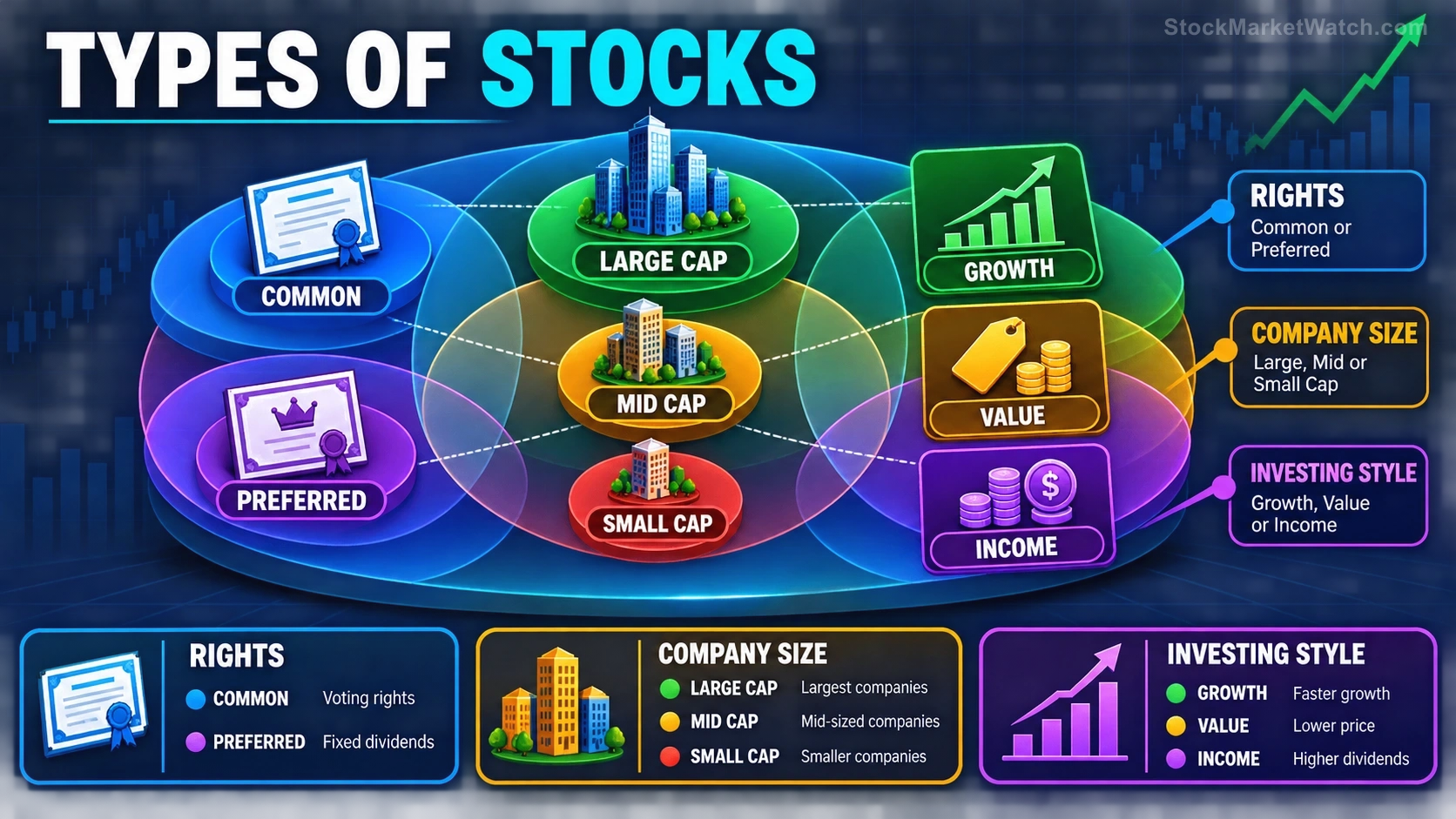
Common stock is what nearly everyone means by "stock" and what the rest of this course assumes. Common shareholders vote, participate fully in the company's growth, and stand last in line if things go wrong — maximum upside, maximum risk.
Preferred stock is a hybrid that behaves more like a bond wearing a stock costume. Preferred shareholders typically receive a fixed dividend that must be paid before common shareholders get anything, stand ahead of common (but behind lenders) in a liquidation, and usually give up voting rights and most price upside in exchange. Companies — banks especially — issue preferreds to raise capital without diluting voting control. For a beginner they're a niche: income-focused instruments priced off interest rates as much as business results.
Layer 2: Share Classes
Some companies split their common stock into classes with different voting power. Alphabet trades as both GOOGL (Class A, one vote) and GOOG (Class C, no votes) at nearly identical prices; Berkshire Hathaway's BRK.A and BRK.B differ in price by a factor of about 1,500 while representing the same business. Founders use multi-class structures to keep control while selling economics. For most investors the practical impact is small — but always check which class you're buying when a company lists more than one ticker.
Layer 3: Size — the Market-Cap Tiers
Market capitalization (share price × shares outstanding) sorts the market into tiers, and the tiers behave differently:
- Large cap (roughly $10B and up) — the S&P 500 universe: established businesses, deep liquidity, heavy analyst coverage. The megacaps at the top now dominate index weightings.
- Mid cap (~$2–10B) — established but still growing; historically a sweet spot of the risk/return tradeoff.
- Small cap (~$250M–2B) — younger, more domestic, more volatile, less covered — which cuts both ways: more risk, more chances for the market to misprice.
- Micro cap and below — thin trading, minimal disclosure scrutiny in the OTC portion, and the natural habitat of manipulation schemes. Beginners have no business here, and the next lesson explains the venue differences that make it so.
Layer 4: Style Labels
These aren't legal categories — they're descriptions of why someone owns the stock, and the same company can migrate between them over its life:
- Growth stocks — priced for rapid expansion: high revenue growth, often thin or no current profits, high valuation multiples. Payoff comes from the future arriving on schedule; the risk is what happens when it doesn't.
- Value stocks — priced cheaply relative to current earnings, assets or cash flow, usually because something about the story is unloved. The bet is that the pessimism is overdone.
- Income (dividend) stocks — mature cash generators owned primarily for their payout: utilities, consumer staples, REITs. Steadier, rate-sensitive, slower.
- Blue chips — an informal badge for large, dominant, financially sturdy franchises with long operating histories.
- Cyclicals vs. defensives — whether the business rides the economy (autos, airlines, banks) or ignores it (groceries, electricity). Knowing which you own explains a lot of price behavior in macro-driven markets.
Each style has entire selection frameworks built around it — value, growth, and income investing each get a dedicated lesson in the stock-picking course.
Why the Categories Matter
Because they set expectations. A small-cap growth stock swinging 6% in a day is behaving normally; a utility doing the same is an event. A portfolio that's accidentally all one type — all megacap growth, say — is far less diversified than its holder believes, a problem the fundamentals course takes up properly. And the market rotates: leadership passes between growth and value, large and small, in multi-year cycles that reward knowing which bucket you're actually holding.
You can see the tiers and styles live on our stock screens — filter by market cap, dividend yield, or performance and watch the categories separate. Next: how stocks actually trade — exchanges, brokers, and what happens in the seconds after you tap Buy.