Lesson 3
How Stocks Trade
Updated Sep 2, 2026 · Reviewed by Terence Scott, founder
- Main Venues
- NYSE, Nasdaq, OTC
- Key Concept
- Bid-ask spread
- Regular Hours
- 9:30-4:00 ET
- Settlement
- T+1
- Level
- Beginner
On this page
When you tap Buy, your order joins a continuous, global auction that matches buyers and sellers in fractions of a second. You don't need to know the plumbing to use it — but knowing the basics explains the numbers on every quote screen, why prices gap overnight, and why some stocks are safe to trade casually while others quietly cost you money on every transaction.
Exchanges: The Organized Auctions
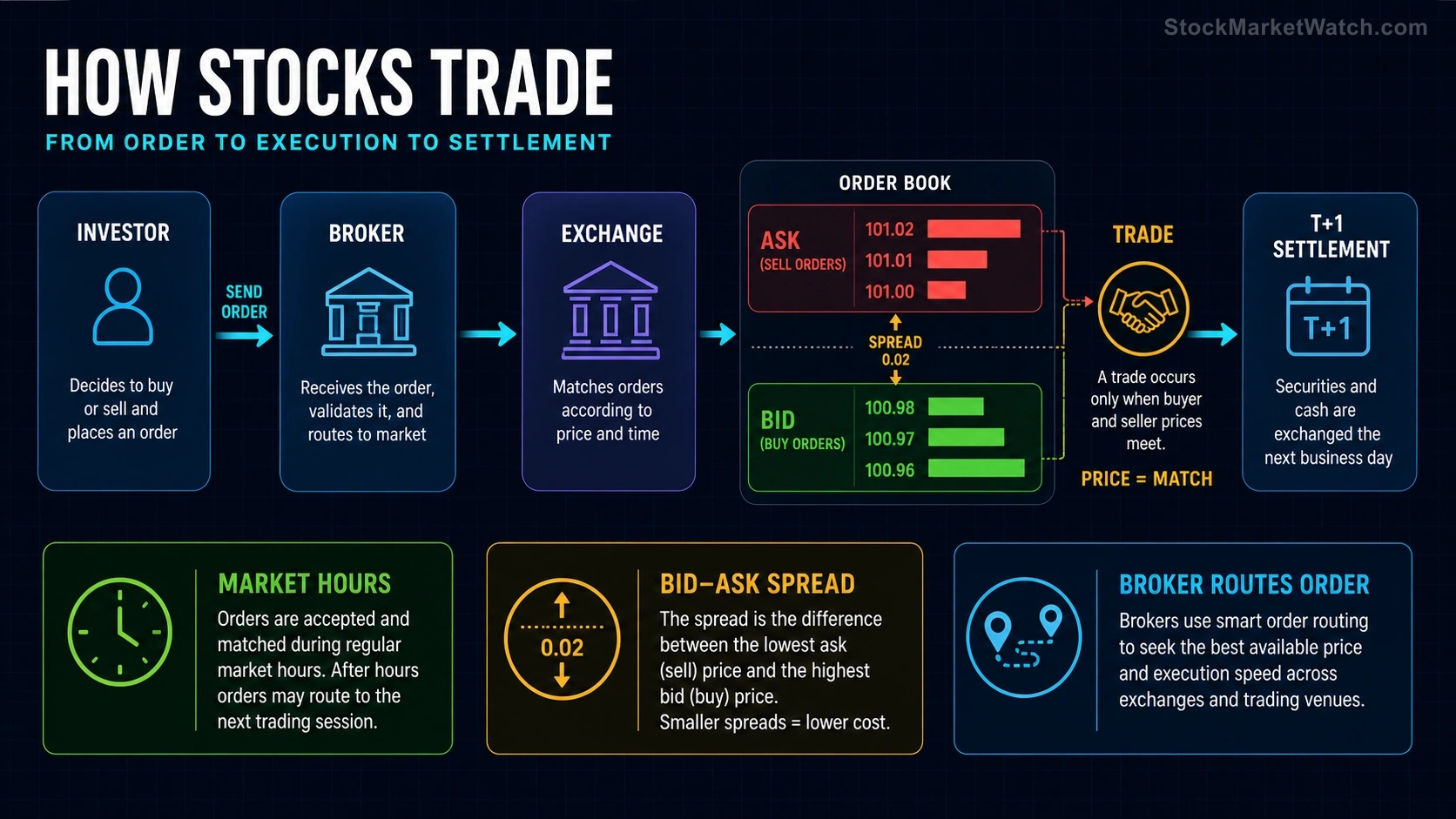
Most U.S. stocks list on one of two exchanges. The New York Stock Exchange (NYSE) is the traditional home of industrial and blue-chip names; the Nasdaq, fully electronic from birth, lists most of the technology sector. For practical purposes the two work the same way today: electronic order books that continuously match the highest price buyers will pay against the lowest price sellers will accept.
Listing on an exchange means meeting standards — minimum size, governance rules, regular audited financial reporting. That vetting is invisible right up until you look at what trades without it.
OTC: The Unorganized Everything Else
Stocks that don't meet exchange standards trade over-the-counter (OTC) — a dealer network rather than a central auction. Some OTC names are legitimate (large foreign companies cross-trading in the U.S.); much of it is micro-cap territory with minimal disclosure, wide spreads, and thin volume. Nearly every pump-and-dump scheme in market history has lived here, because thin, dark markets are where prices are easiest to push. Beginner rule: if it only trades OTC, it isn't a beginner stock.
The Bid, the Ask, and the Spread
Every stock has two prices at every moment: the bid (the highest price anyone is currently willing to pay) and the ask (the lowest price anyone will sell for). The gap between them is the spread — and it is the true cost of trading, surviving in a world of zero commissions.
In a heavily traded large cap the spread is typically a penny or two on a price in the hundreds of dollars — effectively free. In a thin small cap it can be several percent, meaning you're down several percent the instant you buy at the ask. Volume and spread are the two numbers that tell you whether a stock is cheap to trade, and both sit on every quote page — lesson 6 reads them in detail.
Your Broker's Role
Individuals can't send orders to an exchange directly — a broker does it for you, and today does it for $0 commission on stocks and ETFs. Behind the scenes your order may route to an exchange or to a wholesale market maker (a practice called payment for order flow that helps fund those zero commissions); either way, brokers must by regulation seek the best reasonably available price. For a long-term investor the routing details matter far less than the spread and your own order type — the subject of lesson 5.
Market Hours — and the Edges Around Them
The regular U.S. session runs 9:30 AM to 4:00 PM Eastern, Monday through Friday. Around it sit the premarket (from as early as 4:00 AM) and after-hours (to 8:00 PM) sessions, where trading is electronic, thinner, and wider-spread. This is when most earnings reports land, which is why stocks "gap" — a company reports at 4:05 PM, the price reprices in after-hours, and the next morning's open lands far from yesterday's close.
Our premarket movers page shows this repricing live every morning — the biggest gappers before the bell — and the after-hours movers catch the earnings reactions the moment they start.
Settlement: When You Actually Own It
Trades execute instantly but settle — legally transfer shares and cash — one business day later, known as T+1 (shortened from T+2 in May 2024). In practice your broker handles all of it and you can generally sell what you just bought without waiting. The place it bites beginners is trading rapidly in a cash account with unsettled funds, which can trigger temporary restrictions. Nothing about T+1 changes buy-and-hold investing at all.
What This Means Practically
- Liquidity is a feature you should pay for — by preferring it. Exchange-listed names with real volume cost pennies to trade; thin names cost percent.
- Prices are a negotiation, not a fact. The "price" on a quote is just the last match; the bid and ask are the actual market.
- Overnight is when surprises happen. News lands while the market is closed; gaps are normal, and stop orders don't protect against them (a nuance that matters enormously in the margin course).
Next: what actually moves stock prices — the forces behind all this matching.