Lesson 7
Dogs of the Dow
Updated Sep 2, 2026 · Reviewed by Terence Scott, founder
- Universe
- 30 Dow stocks
- Rule
- Buy the 10 highest yields, rebalance annually
- Time Cost
- Minutes per year
- Variant
- Small Dogs (5 of the 10)
- Level
- Beginner
On this page
The Dogs of the Dow is the simplest complete strategy in this course, popularized by Michael O'Higgins in the early 1990s: once a year, buy equal amounts of the ten highest-yielding stocks in the Dow Jones Industrial Average, hold for a year, then repeat. Total ongoing effort: one afternoon annually. It closes the course deliberately — after six lessons of frameworks demanding real judgment, the Dogs show what a fully mechanical strategy looks like, and what that mechanization buys and costs.
The Logic Under the Simplicity
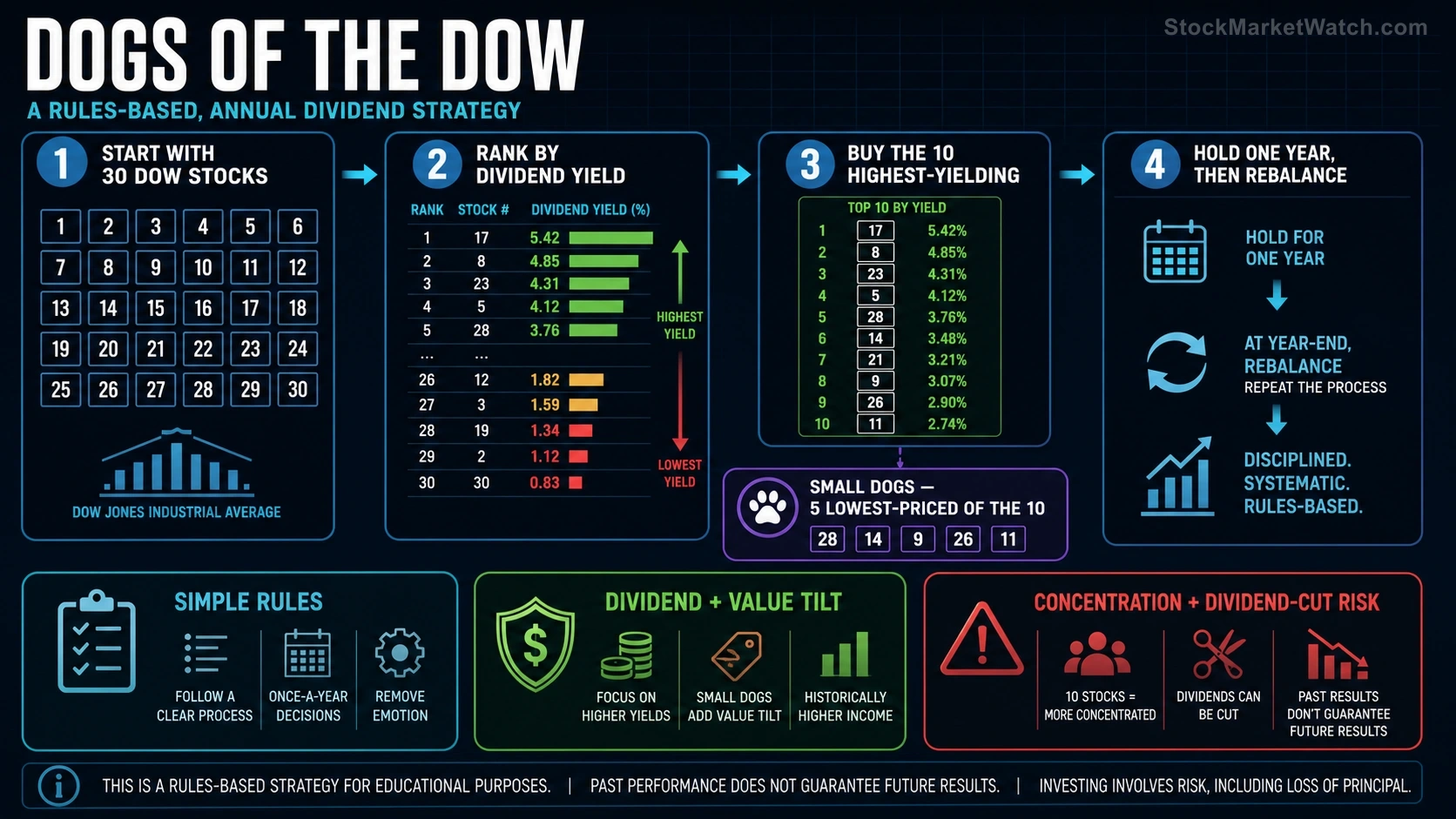
The strategy is value investing compressed into one proxy. Within the Dow — 30 giant, established companies — a high dividend yield usually means the price has lagged (yield rises as price falls, per the income lesson). So the ten highest yielders are, roughly, the Dow's ten most out-of-favor names. The bet: blue chips of this caliber tend to mean-revert rather than die, so systematically buying the unloved ones harvests recoveries — while collecting above-average dividends during the wait.
Every piece of the design does work: the Dow-only universe is the quality screen (an index committee already selected durable franchises — the strategy free-rides on it); the yield sort is the value screen; the annual rebalance is the sell discipline, automatically rotating out of recovered names and into newly unloved ones; and the calendar is the emotion killer — no decisions between rebalances, nothing to panic-sell.
The Mechanics, Precisely
- At year-end (any consistent annual date works), rank the 30 Dow stocks by dividend yield.
- Buy the top ten in equal dollar amounts — equal weighting matters; it's part of the contrarian tilt.
- Hold twelve months, collecting dividends.
- Re-rank, and trade only the differences. Turnover is typically a handful of names.
The Small Dogs variant (O'Higgins' "Puppies"): from the ten Dogs, hold only the five lowest-priced. Historically this concentrated version amplified both the wins and the losses — a sharper bet on the same idea.
The Record, Honestly
The Dogs' long-run record is genuinely respectable — roughly tracking to modestly beating the Dow across multi-decade stretches, with above-market income throughout — but the year-by-year record is streaky, and the strategy's failures are instructive. Its worst moments come when high yield stops meaning "unloved" and starts meaning "in genuine trouble": in the 2008–09 financial crisis, the yield sort loaded the portfolio with banks whose dividends were about to be eliminated — the yield trap from the income lesson, executed mechanically at scale. A rules-based strategy inherits the blind spots of its rule. The honest framing: the Dogs are a disciplined, low-effort tilt with a real logic — not a market-beating machine, and not risk-free because the names are famous.
What It Teaches Beyond Itself
- Discipline can be outsourced to rules. The strategy's real edge isn't the yield sort — it's that its follower never panic-sells in October or chases in January. Compare that against the behavioral trap in the cycle lesson.
- Every screen is a proxy, and proxies fail at the edges. Yield-as-value works until the dividend itself is the fiction.
- Simplicity is a feature with a price. Ten minutes a year buys freedom from judgment — and forfeits the ability to exercise any when the rule is obviously wrong.
Running It Live
The current Dow roster, prices and dividend data live on our Dow Jones page — everything the annual ranking needs. Course complete: from the analytical toolkit through judgment-heavy frameworks to a fully mechanical one. The natural next step is the portfolio layer — how much in stock-picking at all, versus the diversified core it should orbit — which is the Investing Fundamentals course.