Lesson 5
Income Investing
Updated Sep 2, 2026 · Reviewed by Terence Scott, founder
- Core Idea
- Get paid to hold
- Key Metrics
- Yield, payout ratio, dividend growth
- Danger Sign
- Yield far above peers
- Rate Sensitivity
- High
- Level
- Intermediate
On this page
Income investing selects stocks primarily for the cash they pay out: dividends, arriving quarter after quarter, regardless of what the share price did that month. It's the strategy for investors who want their portfolio to produce something spendable — retirees classically, but also anyone who prefers returns they can see land in the account over returns that exist only until the next drawdown.
The Core Logic
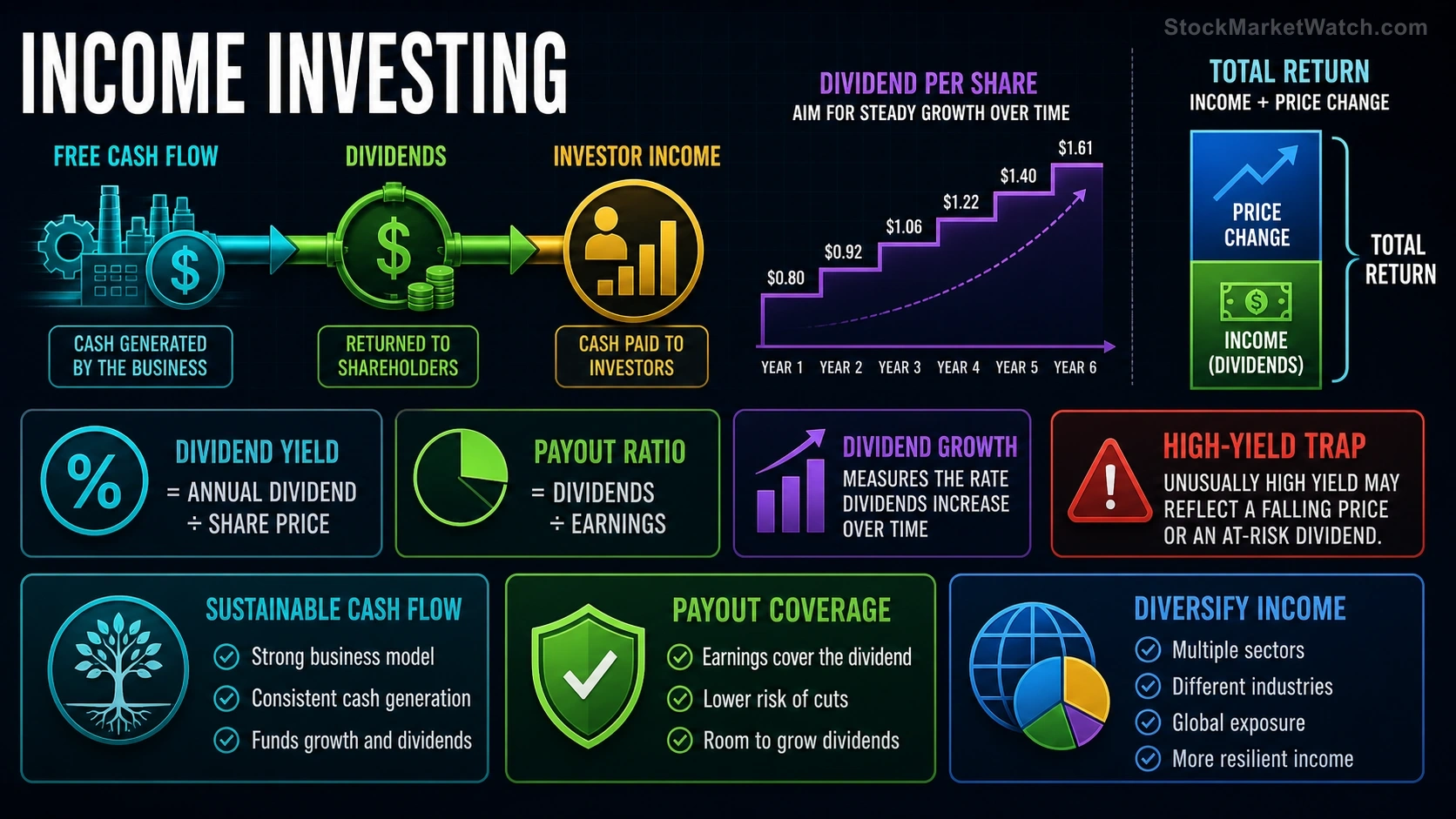
Dividends convert business success into investor cash on a schedule. That does three quiet, powerful things: it pays you to be patient (holding through volatility is easier with cash arriving), it disciplines management (companies committed to a dividend can't casually torch cash on empires), and historically, reinvested dividends have contributed a major share of the stock market's total long-run return — the part of performance that never depends on selling to someone at a higher price.
The Three Numbers That Matter
- Dividend yield — annual dividend ÷ price, from the quote lesson. The headline number, and the least trustworthy of the three alone.
- Payout ratio — dividends ÷ earnings (or better, ÷ free cash flow). It measures sustainability: a company paying out 40% of earnings has room for bad years and raises; one paying 95% is a cut waiting for a catalyst. Norms vary by sector — utilities run high, tech runs low, and REITs run high by design (they're legally required to distribute most of their taxable income, which is also why their yields look different from everything else).
- Dividend growth — the underrated one. A 2% yield growing 10% annually overtakes a static 4% yield within a decade, and the growth itself is evidence of a healthy business. The market's institutional shorthand for this trait: the Dividend Aristocrats, S&P 500 companies with 25+ consecutive years of increases — a list that's survived recessions precisely because raising the dividend annually forces a certain corporate discipline.
The Yield Trap
The strategy's signature injury, and the mirror image of value's trap: an unusually high yield is usually a warning, not a gift. Yield = dividend ÷ price, so a collapsing price manufactures a spectacular yield right up until the dividend is cut — at which point the income investor loses the income and holds the capital loss. The tells:
- Yield far above the company's own history and its sector's norm
- Payout ratio near or above 100% of earnings or free cash flow
- Deteriorating revenue — dividends are paid out of tomorrow's earnings, not yesterday's reputation
- Rising debt funding the payout — borrowing to pay shareholders is a countdown, not a strategy
The discipline: buy the business that produces the dividend, not the dividend. Every check from the fundamental analysis lesson applies double when the payout is the point.
Structural Things to Know
- Rates compete with you. When Treasury yields rise, dividend stocks lose relative appeal and often reprice down — income portfolios carry interest-rate sensitivity that growth portfolios don't, a mechanism covered in the basics course.
- The ex-dividend date decides who's paid — buy on or after it, and that quarter's payment belongs to the seller.
- Taxes differ by account. Qualified dividends get favorable rates in taxable accounts; REIT distributions mostly don't — one reason income strategies often live happiest inside retirement accounts.
- DRIP while accumulating. Automatic dividend reinvestment compounds the machine; switch to cash collection when you actually need the income.
Who the Strategy Fits
Income investing fits investors drawing on their portfolios, temperaments that need visible progress to stay invested, and anyone building the defensive wing of a broader allocation. Its tradeoff is ceiling: dividend payers are mature by nature, and an income-heavy portfolio will lag in growth-led markets. Many investors treat it as a sleeve rather than the whole strategy — the portfolio-construction question the fundamentals course takes up.
Running It Live
Our screens filter by dividend yield across the market — start there, then apply the payout-ratio and growth checks to everything the yield sort surfaces, in exactly that order. The two lessons that remain cover the course's most systematized strategies: CAN SLIM and the Dogs of the Dow.