Lesson 4
GARP Investing
Updated Sep 2, 2026 · Reviewed by Terence Scott, founder
- Core Idea
- Growth, but not at any price
- Signature Metric
- PEG ratio ≈ 1 or less
- Popularized By
- Peter Lynch
- Blends
- Value discipline + growth upside
- Level
- Intermediate
On this page
GARP — Growth At a Reasonable Price — is the deliberate middle path between the two lessons before it: hunt for genuinely growing businesses like a growth investor, but refuse to pay fantasy multiples for them, like a value investor. Its most famous practitioner was Peter Lynch, who ran Fidelity's Magellan fund to legendary returns in the 1980s buying exactly this: good growth, sensibly priced.
The Core Logic
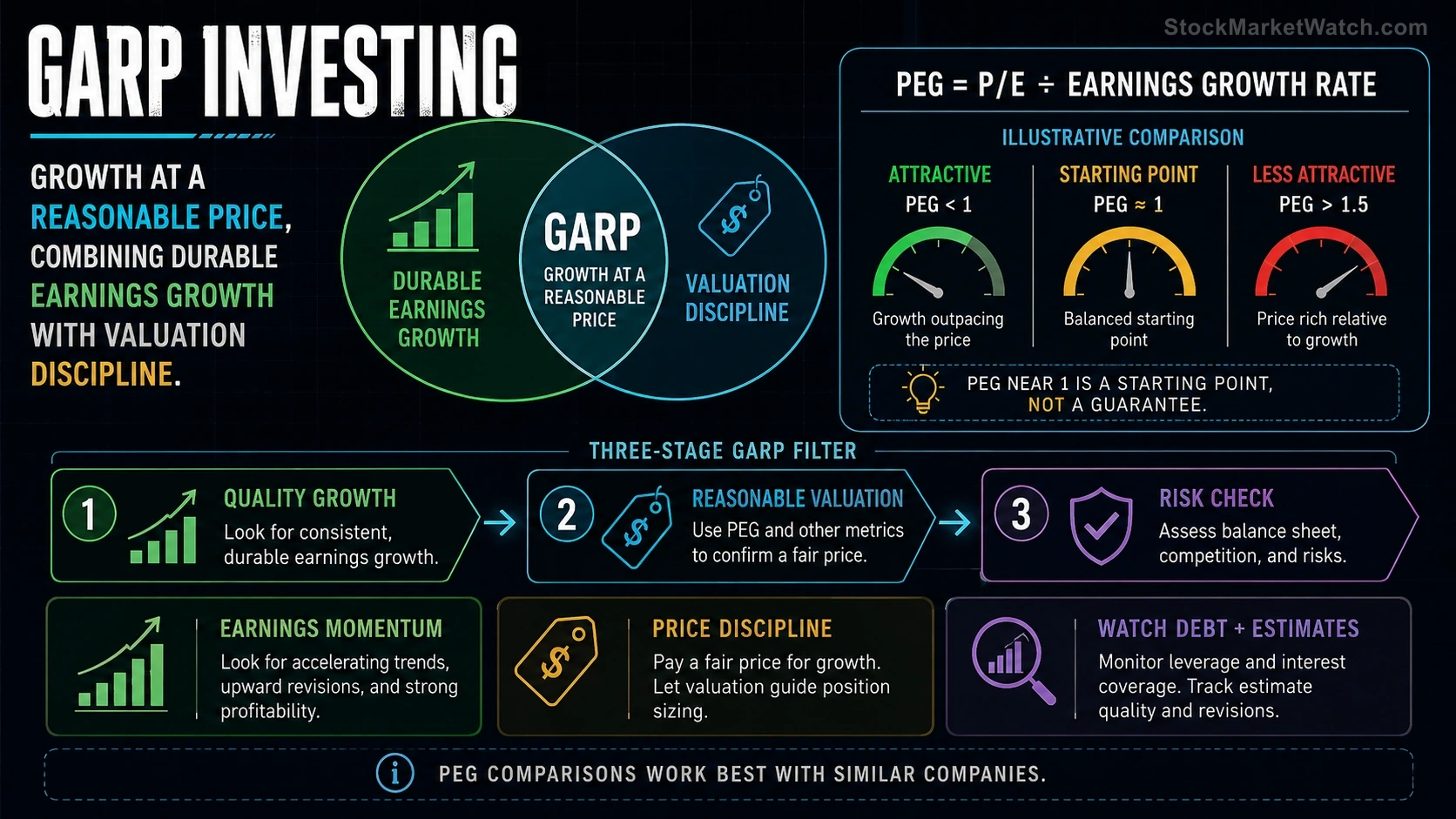
Pure value's weakness is the trap — cheap companies that deserve it. Pure growth's weakness is the multiple — great companies priced beyond perfection. GARP's claim is that the sweet spot between them is systematically underpriced: solid growers that are too boring for momentum money and too expensive-looking for deep value money. The strategy accepts it will never own the most spectacular winners at their spectacular phase (someone else pays 80× earnings for those) in exchange for avoiding both of the neighboring strategies' signature disasters.
The PEG Ratio
GARP's anchor metric, popularized by Lynch: PEG = P/E ÷ annual earnings growth rate. A company at 30× earnings growing 30% a year has a PEG of 1.0; at 30× growing 10%, a PEG of 3.0. The rule-of-thumb reading:
- PEG around 1 or below — growth priced reasonably; the classic GARP hunting ground
- PEG well above 2 — paying substantially ahead of demonstrated growth
And the honest caveats, because PEG is a screen, not a verdict: the growth rate in the denominator is a forecast (garbage in, garbage out); the ratio treats 10% growth at 10× as identical to 40% growth at 40× (the latter is far riskier and often far better); and it ignores debt, cash flow quality, and everything else lesson 1 exists to check. Lynch himself paired the number with relentless business-level research — the ratio was the doorman, not the decision.
What the Full GARP Screen Looks Like
- Earnings growth in the credible middle — roughly 10–25% a year, sustained. Fast enough to compound; slow enough to be durable. (Lynch was openly suspicious of very high growth rates — they attract competition and rarely last.)
- PEG near 1 or lower, using conservative growth estimates
- Quality checks from the value playbook — real free cash flow, sane debt, honest ROE
- A business you can explain — Lynch's most quoted filter: if you can't describe why the company wins in a couple of sentences, you don't own a thesis, you own a ticker
How GARP Fails
- The forecast was the flaw. A PEG of 0.9 built on a growth estimate that doesn't materialize was never actually cheap. Deceleration hurts GARP holdings too — just from lower altitudes than pure growth.
- Averaging into mediocrity. The middle path can degrade into owning companies that are neither cheap enough nor good enough — moderate numbers across the board can describe balance, or blandness. The quality checks are what separate them.
- Streak envy. In raging bull markets GARP lags pure growth, sometimes badly; in deep value rallies it lags value. The strategy's advantage is compounding through full cycles — measured against either neighbor's best year, it always looks second-best.
Who the Strategy Fits
GARP is arguably the most natural home for a thoughtful individual investor: it requires neither value's contrarian pain tolerance nor growth's drawdown stomach, it disciplines both enthusiasm and bargain-hunting with one ratio, and its research load — understand the business, sanity-check the price — matches what a diligent amateur can genuinely do. If this course had a default recommendation for someone picking their first framework, this lesson is it.
Running It Live
Screen for the intersection: real growth and restrained multiples, using our stock screens, then apply the PEG arithmetic to the shortlist by hand — it takes seconds per name and forces you to look up the growth forecast, which is half the diligence already. Next, the strategy that flips the whole orientation from growth to cash: income investing.