Cup and Handle Pattern
Updated Aug 26, 2026 · Reviewed by Terence Scott, founder
- Signal
- Bullish
- Reliability
- High
- Volume Confirmation
- Required
- Market Conditions
- Works best in trending markets
On this page
Cup and Handle is a bullish continuation pattern popularized by William O'Neil that forms in two phases: a rounded, U-shaped base (the cup) followed by a shorter, shallower pullback (the handle) before price breaks out to new highs. The cup represents an extended base-building period, while the handle is a final shakeout before the stock resumes its prior uptrend.
What Is a Cup and Handle?
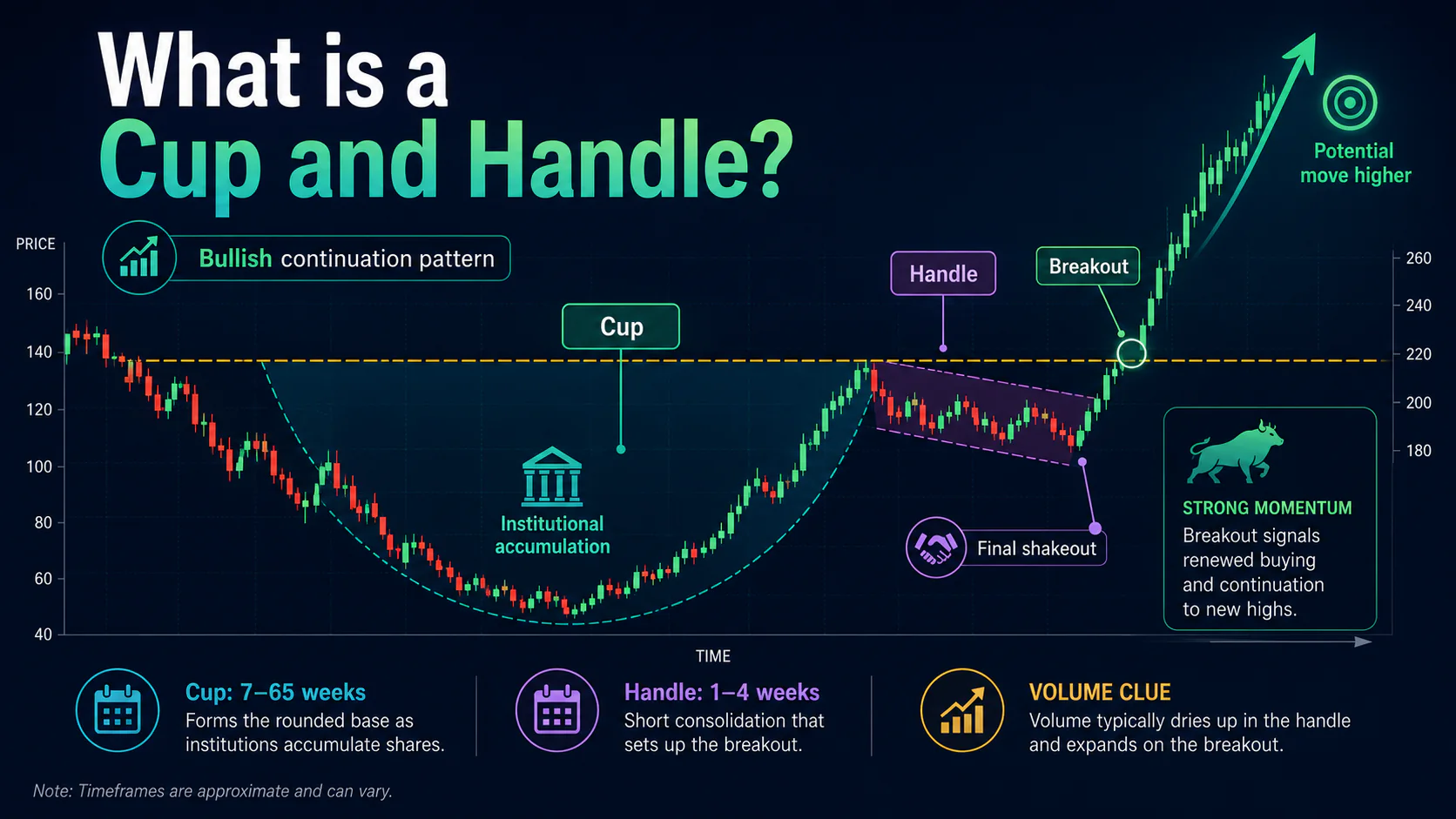
The cup should be U-shaped rather than a sharp V — a gradual rounding that reflects an orderly base-building process rather than a panic decline and snap-back. Under O'Neil's original criteria, the cup typically takes 7 to 65 weeks to form and retraces roughly 12% to 33% from the prior high, with deeper retracements more common during broader bear markets. The handle that follows is smaller: it usually lasts 1 to 4 weeks, drifts sideways to slightly down on lighter volume, and ideally pulls back only 8% to 12% from the cup's high. A well-formed handle stays in the upper half of the cup and holds above the 10-week moving average — a handle that drops into the lower half of the cup or well below that average is a weaker, less reliable setup.
Key Uses
- Continuation Confirmation: Signals a resumption of the prior uptrend after a base-building pause
- Base Identification: Helps spot accumulation phases before a breakout
- Defined Entries and Stops: The handle high (the buy point) and cup low give clear entry and risk levels
- Target Calculation: Cup depth gives a measured-move target from the breakout
Anatomy of the Pattern
The Cup: An initial decline from a prior high, a rounded base that consolidates for an extended period, and a recovery back toward the old high. Volume is typically heavier on the initial decline, tapers off at the bottom of the base, and gradually builds again as price climbs the right side of the cup.
The Handle: A short pullback near the old high, ideally confined to the upper half of the cup and above the 10-week moving average. Volume should contract noticeably during this phase — a quiet handle on light volume is the sign of a healthy shakeout of weak holders rather than renewed distribution.
The Buy Point: A small margin above the handle's high. A move through this level on volume clearly above average is the breakout signal.
Volume Confirmation
Volume should be relatively light at the bottom of the cup, build gradually on the right side as the base completes, contract again during the handle, and then expand noticeably on the breakout above the handle high. A breakout on unconvincing volume is a weaker signal and more prone to failing or requiring a retest before continuing.
Pattern Variations
Shallow Cup: A retracement toward the lower end of the 12%-33% range, common in strong bull markets and often associated with underlying strength.
Deep Cup: A retracement toward the upper end of the range (or occasionally beyond it in a bear market), which takes longer to form but reflects a more thorough base-building process.
Cup With a Flat Base: Some cups have a flatter, platform-like bottom rather than a smoothly rounded one; the same depth and duration guidelines still apply.
Double Handle: Occasionally an initial handle fails to produce a breakout and a second handle forms near the same level before the pattern finally resolves. The second attempt should still meet the same depth and volume criteria as a normal handle.
Trading Strategies
Breakout Entry: Wait for a decisive move above the handle high (the buy point) on volume clearly above average, then enter long on the break or a modest pullback to that level. Place a stop below the handle low (tighter) or below the cup low (more conservative). The minimum target is the cup's depth added to the breakout point.
Handle Entry: More experienced traders sometimes enter as the handle forms, provided it's holding in the upper half of the cup on light volume. This offers a tighter stop below the handle low, but the pattern isn't confirmed until the actual breakout occurs.
Retest Entry: After an initial breakout, price sometimes returns to test the old handle-high resistance as new support. A successful retest with supporting volume offers confirmation and a well-defined stop just below that level.
Combining With Other Analysis
A cup that finds support at a major moving average (the 50-day, 100-day, or 200-day are common references) adds confluence to the base, and the handle holding above the rising 10-week average is itself a bullish sign under O'Neil's methodology. The RSI resetting to a more neutral reading during the cup, followed by a push into strength on the breakout, can help confirm the pattern. Fibonacci retracements of the prior advance are sometimes used to sanity-check the cup's depth against typical retracement zones.
Failed Pattern Recognition
A handle deeper than roughly 15% or one that drops into the lower half of the cup is a warning sign of a weaker setup. A breakout that immediately reverses back below the handle low, or one that occurs on unconvincing volume, should be treated with caution — failed cup-and-handle setups often indicate distribution rather than accumulation, and it's worth reassessing the broader trend and fundamentals before re-entering.
Common Mistakes
Accepting a V-shaped cup: A sharp spike-and-recover low is not a valid cup; the base needs a rounded, extended shape.
Ignoring handle placement: Trading handles that form in the lower half of the cup or well below the 10-week moving average, both signs of a weaker base.
Skipping the volume check: Entering a breakout without confirming that volume expanded meaningfully above the recent average.
Entering too early: Buying before the handle high is actually cleared, rather than waiting for the confirmed buy point.
Cup and Handle vs. Other Patterns
Vs. Double Bottom: A Double Bottom has two distinct lows with an intervening high, while a Cup and Handle has a single rounded base followed by a smaller handle consolidation near the old high.
Vs. Ascending Triangle: An Ascending Triangle is defined by rising support against flat resistance, generally over a shorter period, with no separate handle phase.
Vs. Bull Flag: A Bull Flag is a much shorter consolidation (days to a couple of weeks) within a strong trend, without the extended base-building that defines the cup.
FAQs
How reliable is the Cup and Handle pattern?
It tends to work best when the cup is properly U-shaped, the handle stays in the upper half of the cup above the 10-week moving average, and the breakout comes on clearly expanding volume. As with any chart pattern, meeting all the structural criteria matters more than the shape alone.
What makes a valid Cup and Handle formation?
A U-shaped cup (never V-shaped) retracing roughly 12%-33%, a handle lasting about 1-4 weeks that pulls back around 8%-12% and stays in the cup's upper half above the 10-week moving average, and a breakout above the handle high on volume clearly above average.
How do you calculate price targets?
Measure the cup's depth from high to low, then add that distance to the breakout point above the handle high. That's the minimum measured-move target.
Can Cup and Handle patterns fail?
Yes, typically due to weak breakout volume, a handle that's too deep or forms in the lower half of the cup, or broader market weakness. A failure can indicate distribution rather than accumulation.
What's the ideal volume pattern?
Volume should be lighter at the base of the cup, build on the right side, contract further during the handle, and then expand clearly on the breakout.
When is the best time to enter?
Conservative traders wait for a volume-confirmed breakout above the handle high; more active traders sometimes buy during a well-formed handle, with a stop below the handle low either way.
Conclusion
Cup and Handle is one of the better-documented continuation patterns because O'Neil's criteria give it clear, testable structure: cup depth, handle depth, handle placement relative to the 10-week moving average, and a specific buy point. A cup and handle that meets those criteria — and breaks out on genuinely expanding volume — gives traders a well-defined setup for participating in the resumption of an established uptrend.