Lesson 2
Types of Investments
Updated Sep 2, 2026 · Reviewed by Terence Scott, founder
- Core Classes
- Stocks, bonds, cash
- Wrappers
- Mutual funds & ETFs
- Alternatives
- REITs, gold, crypto
- The Pattern
- Return climbs with risk
- Level
- Beginner
On this page
Every investment you will ever be offered is a variation on a short menu. There are three core asset classes — stocks, bonds, and cash — plus wrappers that package them and a shelf of alternatives around the edges. Knowing the menu matters because each class occupies a different rung on the same ladder: as you climb toward higher expected returns, certainty falls away beneath you. This lesson walks the rungs in order.
Cash and Cash Equivalents
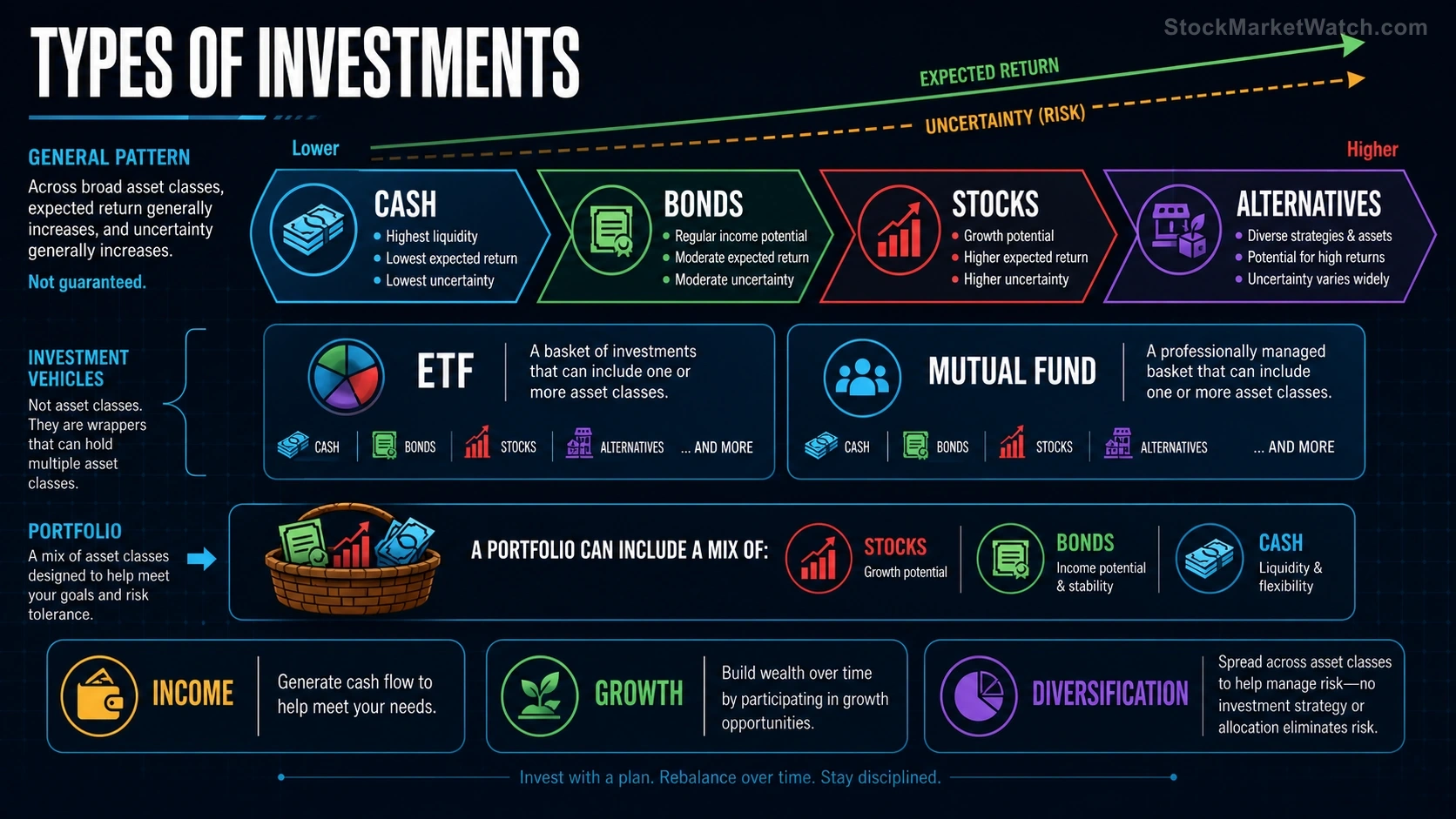
The bottom rung: savings accounts, money-market funds, certificates of deposit, and Treasury bills. The return is modest and the value doesn't fluctuate — a dollar in stays a dollar (plus interest). This is where emergency funds and near-term money live. Its one real risk is the quiet one: over long periods, cash returns have barely kept pace with inflation, which is why "all cash" is not the safe portfolio it feels like.
Bonds: You're the Lender
A bond is a loan you make — to a government or a company — in exchange for scheduled interest payments and your money back at maturity. Bondholders stand in line ahead of stockholders if things go wrong, so bonds are steadier than stocks, but the expected return is lower for exactly that reason. Bonds carry their own risks worth knowing: the issuer can default (credit risk), and when interest rates rise, existing bonds lose market value because their old rates look stingy (interest-rate risk). U.S. Treasuries anchor the "safe" end; corporate and high-yield bonds trade more return for more risk, edging up the ladder toward stocks.
Stocks: You're the Owner
A stock is a share of ownership in a business — a claim on its profits, with no promises attached. No scheduled payments, no maturity date, no guarantee: just whatever the business becomes. That open-endedness is why stocks occupy the top rung among the core classes — the highest long-run returns of the three, paid for with the widest swings along the way. Within the class, the ladder continues: established dividend payers sit lower, unprofitable small companies higher, and strategies for choosing among them fill an entire course of their own.
Funds: The Wrappers
Most investors don't buy these building blocks one at a time — they buy funds, which pool money to hold dozens or thousands of securities in one purchase. Mutual funds price once daily; exchange-traded funds (ETFs) trade all day like stocks and have become the default wrapper for new investors. The crucial point: a fund's risk is the risk of what's inside it. A Treasury-bond ETF sits low on the ladder, an emerging-markets stock ETF sits high, and the wrapper itself adds almost nothing but convenience and a small fee.
The Alternatives Shelf
Real estate (often via REITs — companies that own property and trade like stocks), gold and other commodities, and cryptocurrency round out the menu. Each has a genuine role and a genuine catch: REITs pay income but swing like stocks; gold produces nothing and simply sits, which makes its price entirely a matter of what others will pay; crypto has produced both spectacular gains and drawdowns severe enough to qualify as the ladder's exposed top rung. Treat alternatives as seasoning, not the meal — especially while the core portfolio is still being built.
Reading the Ladder
The pattern to internalize: nothing on this menu offers more return without demanding more risk — when something appears to, the risk is hidden, not absent. How the classes combine into a portfolio is where this course ends up; the next lesson covers the force that makes the climb worthwhile at all: compounding.