Lesson 5
The Types of Investment Risk
Updated Sep 2, 2026 · Reviewed by Terence Scott, founder
- The Big Split
- Systematic vs company-specific
- Diversifiable
- Business & sector risk
- Not Diversifiable
- Market risk
- Quiet Killers
- Inflation & concentration
- Level
- Beginner
On this page
"Risk" in the singular is too blunt an instrument to manage anything with. Investment risk comes in distinct types with different causes and — crucially — different remedies. One division towers over all the others, so we start there.
The Split That Matters: Systematic vs. Specific
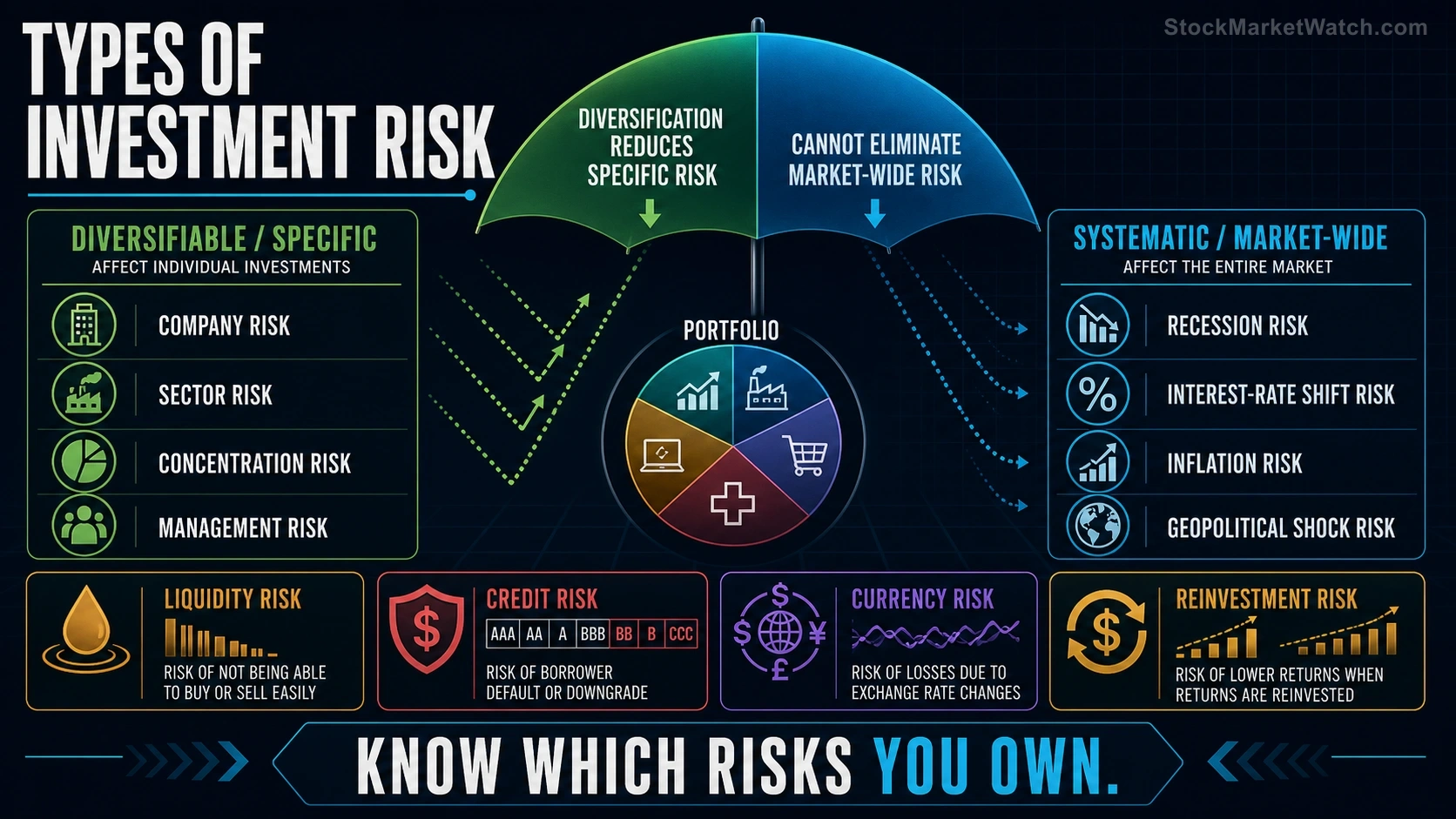
Systematic risk (market risk) is exposure to forces that move essentially everything at once — recessions, rate shocks, panics, wars. When the tide goes out, it goes out on every boat; owning more boats doesn't help. Unsystematic risk (company-specific risk) is exposure to what can go wrong with one holding: a failed product, a fraud, a lost lawsuit, a bad CEO. The reason this split matters more than any list: specific risk can be nearly eliminated, for free, by diversification — while systematic risk cannot be diversified away at all, only sized to your capacity to endure it. That asymmetry is the organizing insight of portfolio management, and the market prices it accordingly: you are paid a premium for bearing systematic risk, and paid nothing extra for concentrating in one company, because you could have removed that risk for free.
The Specific Risks
Business risk — the company itself underperforms: demand fades, competition wins, management stumbles. This is the risk that fundamental analysis tries to assess and diversification neutralizes. Sector risk is its bigger sibling: an entire industry impaired at once — energy in an oil glut, banks in a credit crisis — which punishes portfolios that were "diversified" across ten stocks in one industry. Concentration risk is the meta-version: too much of your wealth in any single anything. Its most common disguise is employer stock, where a company failure can take your salary and your portfolio in the same event.
The Market-Wide Risks
Market risk — broad declines that drag down good and bad companies alike; the price of admission for the equity risk premium. Interest-rate risk — rising rates mechanically lower the value of existing bonds and weigh on stocks (especially growth stocks) by raising the bar every investment must clear; the transmission into prices is covered in what moves stock prices. Inflation risk — the erosion of purchasing power, dangerous precisely because it doesn't feel like losing: cash and long-term bonds are most exposed, which is how the "safest" portfolios quietly fail over decades.
The Situational Risks
Liquidity risk — not being able to sell quickly at a fair price. Irrelevant for large-cap stocks and broad funds; very real for thinly traded small caps, and one reason the illiquid corners of the market must offer higher returns to attract anyone. Currency risk — for foreign holdings, returns arrive filtered through exchange rates, which can add or subtract meaningfully in either direction.
The Risk in the Mirror
The most damaging risk on this page holds no asset at all: behavioral risk — the tendency to sell in panics, chase what just rose, and abandon plans at the worst moments. Every other risk here merely widens the range of outcomes; this one systematically selects the bad ones. It's also the only risk you can manage directly rather than merely dilute, which is why the next lesson is about measuring your own tolerance honestly — followed by the tool that deletes the entire specific-risk column, diversification.