Lesson 1
What Is Investing?
Updated Sep 2, 2026 · Reviewed by Terence Scott, founder
- Core Idea
- Money that earns money
- Vs Saving
- Growth vs certainty
- Vs Trading
- Years, not minutes
- The Forcing Issue
- Inflation
- Level
- Beginner
On this page
Investing is committing money today to something expected to be worth more later — putting money to work so it earns more money, instead of sitting idle. That definition sounds almost too simple to need a lesson, but nearly every investing mistake traces back to blurring it with two neighbors that look similar and behave completely differently: saving and trading. This opening lesson draws the boundaries.
Why Invest at All
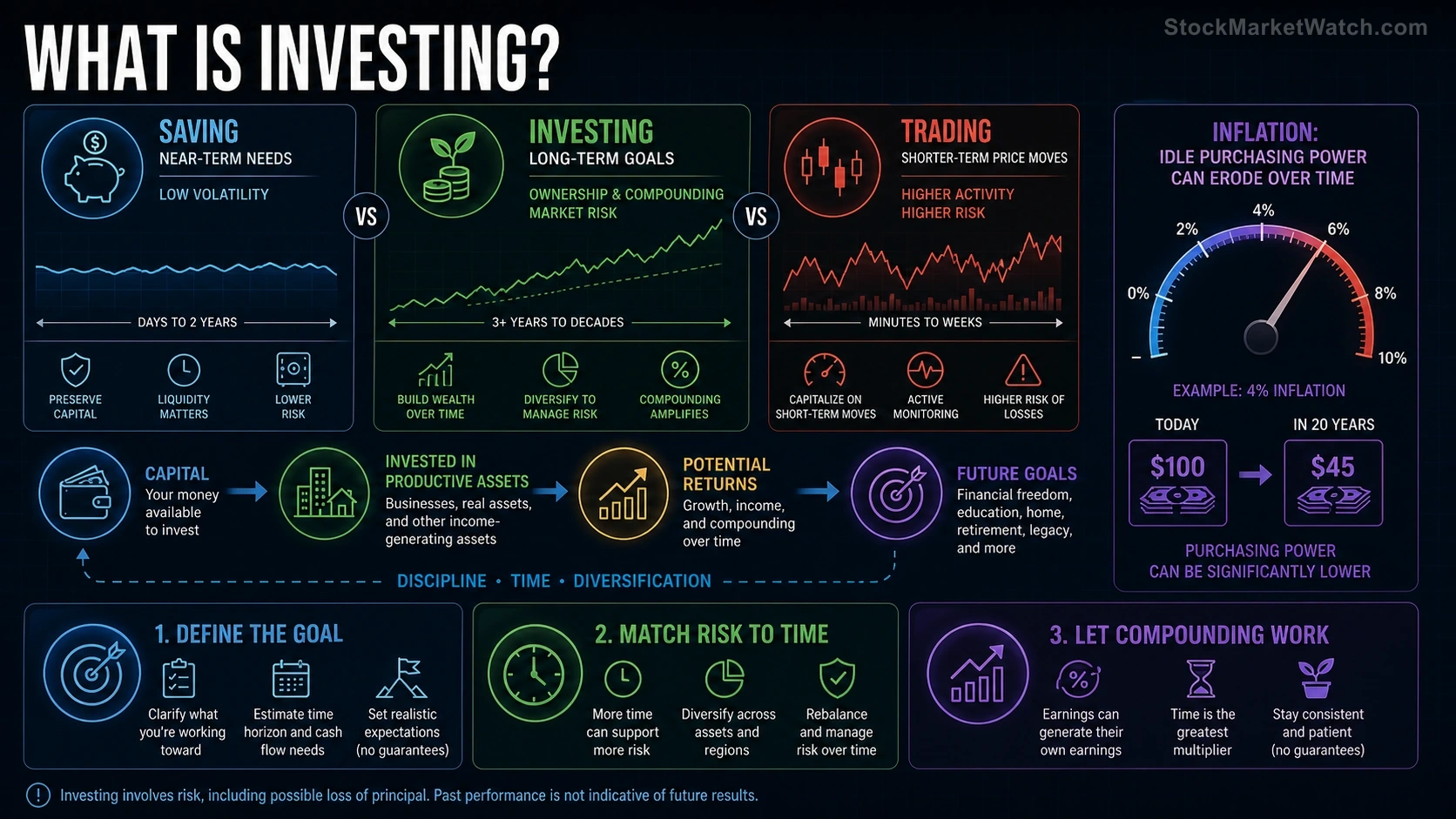
The unavoidable reason is inflation. Prices rise most years, which means cash quietly loses purchasing power while it sits still — money under the mattress is not "safe," it's shrinking on a schedule. Investing is the defense: owning assets whose value and income can grow at least as fast as prices do. The offensive reason is stronger. A share of stock is a claim on a real business — its profits, its growth, its dividends — and over long periods, U.S. stocks have returned on the order of 10% a year on average (roughly 7% after inflation). No savings account has ever come close, because a savings account lends your money out; a stock puts you on the ownership side of the economy.
Investing vs. Saving
Saving is storing money with certainty: a bank account, a money-market fund, a Treasury bill. You accept a low return in exchange for knowing the money will be there, in full, on short notice. Investing deliberately gives up that certainty — values fluctuate, sometimes sharply — in exchange for a higher expected return over time. Both are essential, and the order matters: an emergency fund in savings comes first, precisely so that a bad month never forces you to sell investments at a bad price. Money you'll need within a couple of years belongs in savings; money with a horizon of five years or more can afford the fluctuations that investing requires you to sit through.
Investing vs. Trading
Trading buys the same assets with a different goal: profiting from price movement over days or weeks, rather than business results over years. The distinction isn't snobbery — it's mechanics. An investor's return ultimately comes from what the business earns; a trader's return comes from what the next buyer pays, which is a faster, harder, more competitive game with its own disciplines (we cover them honestly in the trading strategies section). The costliest confusion in markets is doing one while believing you're doing the other — buying a stock "for the long term" and panic-selling it three weeks later is trading, badly, by accident.
The Tradeoff You Can't Escape
Everything in this course rests on one relationship: return is compensation for risk. Higher expected returns are offered only where outcomes are less certain — that's why they're offered at all. The next several lessons take this apart carefully; for now, the practical version is a fraud detector: any pitch promising high returns with no risk is lying about one of the two.
The Good News
Starting has never been cheaper or simpler. Commissions at major brokers are $0, fractional shares mean you can begin with $10 rather than $10,000, and a single index fund buys a slice of hundreds of companies at once. The mechanics of opening an account and placing an order are covered in How to Buy Stocks. What can't be bought cheaply is the understanding of what you own and why — which is what the next ten lessons are for, starting with the menu of things you can actually invest in.