Lesson 6
Know Your Risk Tolerance
Updated Sep 2, 2026 · Reviewed by Terence Scott, founder
- Two Parts
- Capacity (facts) & tolerance (feelings)
- The Real Test
- A 30% drawdown
- Main Trap
- Loss aversion
- The Output
- Your stock/bond split
- Level
- Beginner
On this page
The previous lessons established that risk is the price of return and that some risks pay you while others don't. This one turns the lens around: how much risk should you take? The answer has two components that investors chronically confuse — one is arithmetic, the other is temperament — and getting either one wrong produces the same expensive result.
Risk Capacity: The Arithmetic
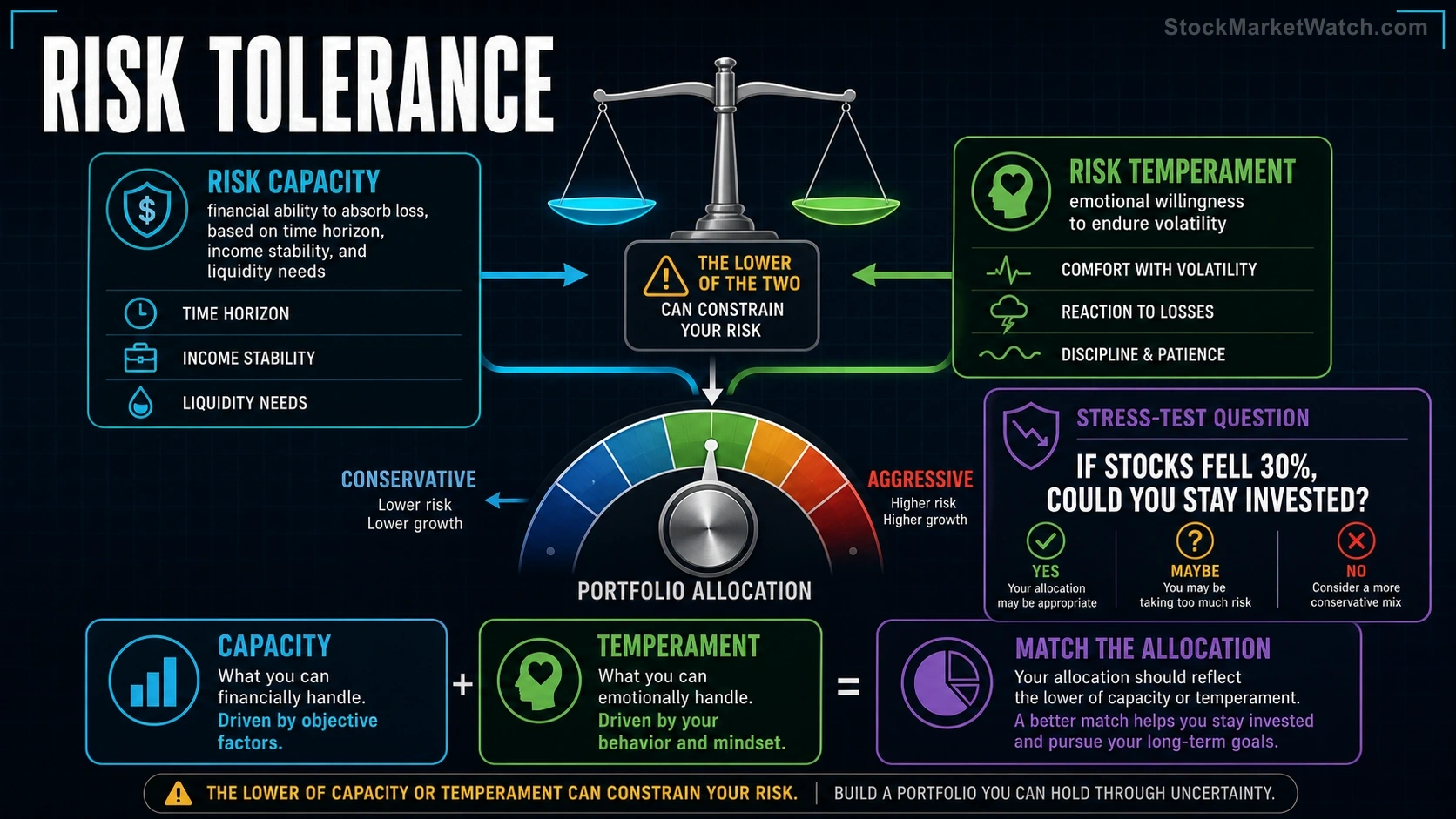
Capacity is how much risk your circumstances can objectively absorb, and it's mostly a function of four things. Time horizon: money needed in three years cannot ride out a bear market that might take five to recover; money needed in thirty can shrug off several. Income stability: a tenured professor can carry more portfolio risk than a commissioned salesperson with identical savings, because a downturn is less likely to force selling. Obligations: dependents, mortgages, and known future expenses all reduce capacity. Reserves: an emergency fund is what stands between a surprise bill and a forced sale of stocks at the worst possible moment. Capacity questions have actual answers — you can compute them, and no feeling of confidence changes them.
Risk Tolerance: The Temperament
Tolerance is how much fluctuation you can endure without abandoning the plan — and it can only truly be measured in a falling market. The standard test is a question: if your portfolio fell 30% over six months, with headlines insisting worse is coming, would you buy more, hold, or sell? Almost everyone answers "buy more" in a bull market. Actual bear markets reveal that many of those same investors sell — and selling at the bottom is the precise mechanism by which temporary decline becomes permanent loss. The culprit is loss aversion: losses are felt roughly twice as intensely as equivalent gains, which is why a portfolio that's down grabs the mind in a way a portfolio that's up never does.
The Contradiction Problem
The classic failure isn't choosing a wrong number — it's professing one number and living another. The investor who calls themselves aggressive at the top and turns conservative at the bottom gets the worst of both: full exposure to the decline, then none of the recovery. A century of market cycles says declines are survivable; the record of individual investors says the panic response frequently isn't. An allocation you can actually hold through a crash is worth more than a theoretically superior one you'll abandon mid-fall — the abandoned plan's returns belong to someone else.
Closing the Gap
When tolerance falls short of capacity, three fixes work with your temperament instead of against it. Take less risk than your capacity allows — a portfolio 10% less aggressive that you hold beats an optimal one you flee. Automate the behavior: scheduled contributions that continue through declines (the machinery of dollar-cost averaging) remove the decision at exactly the moment judgment is worst. Pre-commit to rules — decided calmly in advance, followed mechanically under stress; the same principle that powers rules-based strategies like the Dogs of the Dow applies to an ordinary rebalancing schedule.
What the Answer Is For
Capacity and tolerance aren't trivia about yourself — they are the two inputs to the most consequential decision in this course: how to divide money among stocks, bonds, and cash. Before setting that split, one more tool needs introducing — the free one that removes an entire category of risk: diversification.