Lesson 7
Diversification
Updated Sep 2, 2026 · Reviewed by Terence Scott, founder
- Nickname
- The only free lunch
- Mechanism
- Imperfect correlation
- Eliminates
- Company-specific risk
- Limit
- Panics correlate
- Shortcut
- One broad index fund
- Level
- Beginner
On this page
Diversification is the only technique in investing that reduces risk without reducing expected return — which is why economists, a profession allergic to free lunches, make an exception for this one. The idea is ancient ("don't put all your eggs in one basket"), but why it works, how much is enough, and where it stops working are understood far less well than the proverb.
Why It Works: Imperfect Correlation
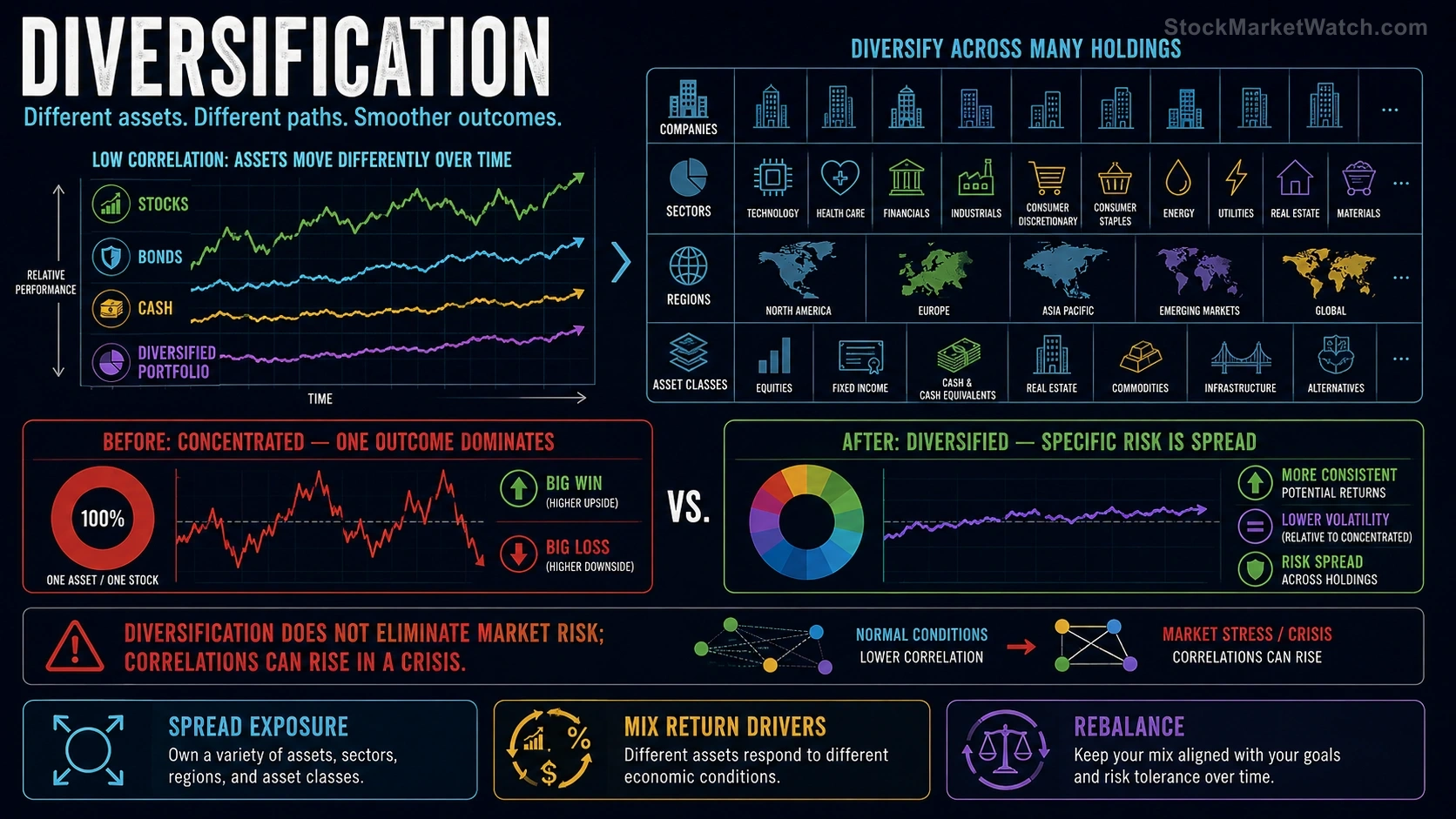
The engine is not owning many things — it's owning things that don't move together. When holdings are imperfectly correlated, their individual stumbles partially cancel: the airline's bad fuel year is the oil producer's good one; the exporter's weak quarter offsets the importer's strong one. Each holding is individually just as volatile as before, but the portfolio's swings are smaller than the average of its parts — risk genuinely destroyed, not merely relocated. And what's destroyed is precisely the company-specific risk from the last lesson: any single company's fraud, failed product, or bankruptcy becomes a scratch instead of a wound. Because that risk can be eliminated freely, the market pays no premium for bearing it — making a concentrated portfolio uncompensated risk, the kind you carry without being paid.
How Much Is Enough
The benefit arrives fast and then flattens. Going from one stock to ten removes a large share of specific risk; by a few dozen holdings spread across industries, most of what can be diversified away is gone, and additional names mostly add paperwork. The spread matters more than the count — ten stocks in ten sectors diversify; thirty tech stocks do not, as every concentrated-sector crash re-teaches. Real diversification works along several dimensions at once: across companies, across sectors, across company sizes, across geographies, and — most powerfully — across asset classes, because bonds' indifference to most of what frightens stocks is exactly the imperfect correlation the engine needs.
The Modern Shortcut
What once required wealth and a full-service broker now costs one trade: a single broad index ETF holds hundreds of companies across every sector — see what's actually inside SPY for a concrete look at instant diversification. A total-market fund plus a bond fund achieves, in two positions, what the theory asks for. This is also the honest baseline for stock pickers: since diversification is free, choosing to concentrate is only rational where you genuinely know something — the bar that the stock-picking course is honest about.
Where the Free Lunch Ends
Three limits keep diversification from being magic. It cannot touch market risk — in 2008 and March 2020, correlations converged toward one and nearly everything fell together; diversification softened the blow but stopped none of it. Owning the whole market still means owning the market's crashes. It averages away brilliance too: a thousand-stock portfolio can't be ruined by one bankruptcy or made by one ten-bagger. That trade — extraordinary outcomes exchanged for reliable ones — is precisely the point, but it is a trade. It can be faked: holding five S&P 500 funds is one bet wearing five costumes ("di-worsification"). Look through wrappers to what's actually underneath.
From Principle to Portfolio
Diversification says spread the risk; it doesn't say how much risk to hold in the first place. Combining this tool with your answer from the risk-tolerance lesson is the next lesson's job: asset allocation — the decision that shapes your outcome more than any security you'll ever select.