Lesson 10
The Efficient Market Hypothesis
Updated Sep 2, 2026 · Reviewed by Terence Scott, founder
- Author
- Eugene Fama (1970)
- Claim
- Prices reflect known information
- Forms
- Weak, semi-strong, strong
- Sibling Idea
- The random walk
- Level
- Intermediate
The efficient market hypothesis (EMH) is the most consequential idea in modern finance and the most argued-about. Formalized by Eugene Fama in 1970, its claim is simple: market prices already reflect available information. If true, the price is never "wrong" in any way you can systematically exploit — millions of informed, motivated participants have already traded every insight into the price before you arrive. The uncomfortable implication: consistently beating the market isn't just hard, it's close to structurally impossible.
The Mechanism
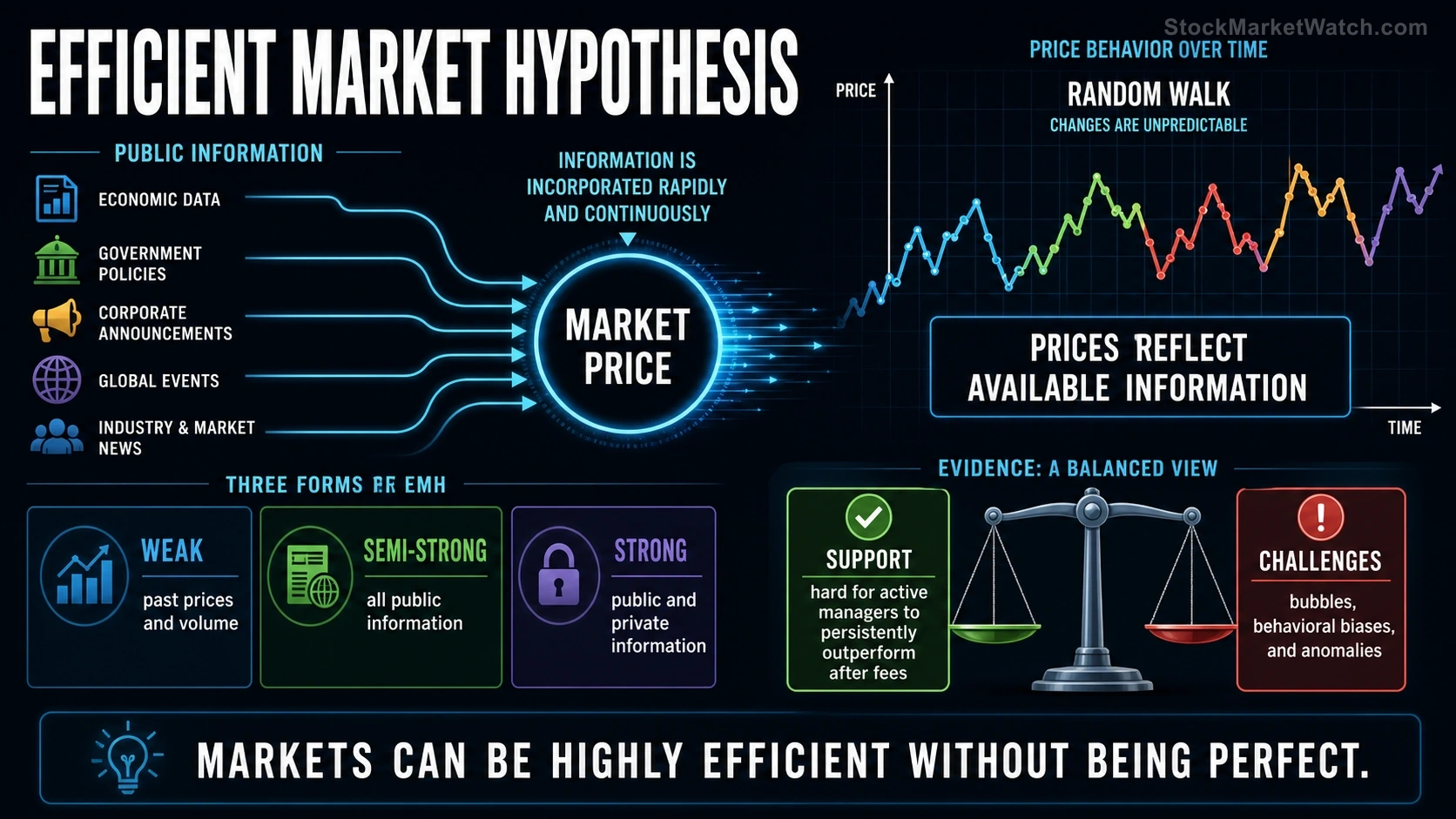
Efficiency isn't a decree — it's the byproduct of competition. Every fund, algorithm, and analyst hunting mispricings corrects them by trading on them: buy the too-cheap stock and the buying raises its price toward fair. The hunt for inefficiency is the very thing that eliminates it. This produces the hypothesis's famous paradox: markets are efficient because so many people don't believe they are. New information still moves prices — that's the system working — but news is by definition unpredictable, which makes the price changes it causes unpredictable too.
The Three Forms
Weak form: past prices and volume are already reflected in today's price — so patterns in old prices can't predict new ones. This is the form aimed squarely at technical analysis. Semi-strong form: all public information — earnings, filings, news — is priced in moments after release, so analyzing public fundamentals can't reliably beat the market either; the target here is stock picking itself. Strong form: even private, inside information is reflected in prices. Almost nobody defends this one — insider-trading laws exist precisely because non-public information does confer an edge.
The Random Walk
EMH's traveling companion, popularized by Burton Malkiel's A Random Walk Down Wall Street: if prices only move on unpredictable news, then price changes themselves follow a random walk — each step independent of the last, like a coin flip. The famous provocation was that a blindfolded monkey throwing darts at the stock listings would match the experts. The serious point underneath: an unpredictable market isn't a malfunctioning one. Randomness in price changes is what a market looks like when it's working.
The Evidence, Both Ways
For: the single most stubborn fact in investing — decade after decade, the large majority of professional fund managers fail to beat simple index funds after costs, and the few who do rarely repeat. If full-time professionals with research budgets can't systematically win, the semi-strong form is at minimum a good approximation. Against: markets produce bubbles and crashes that are hard to call "information processing" — prices doubling and halving with no news to match. Documented anomalies persist: momentum, the long-run outperformance of cheap "value" stocks, small-cap effects. Behavioral economists (Shiller most prominently) showed prices swing far more than fundamentals justify, because the humans setting them are predictably irrational. And practitioners note the market's verdict on Buffett-style records: luck is a strained explanation for sixty years of it. Fama and Shiller — efficiency's architect and its sharpest critic — shared the 2013 Nobel Prize, which tells you how settled the question is.
What to Do With It
EMH doesn't need to be perfectly true to set the right default. If markets are even mostly efficient, then for most people, most of the time, the winning move is the boring machinery of this course: broad diversification, low costs, an allocation held with discipline. Treat efficiency as the null hypothesis — the burden of proof always sits on whoever claims an edge, including you. The final lesson covers the framework that turned these insights into the mathematics running every index and target-date fund: modern portfolio theory and CAPM.