Lesson 8
Asset Allocation
Updated Sep 2, 2026 · Reviewed by Terence Scott, founder
- The Decision
- % stocks / bonds / cash
- Inputs
- Horizon & risk tolerance
- Heuristic
- ~110 minus age in stocks
- Upkeep
- Rebalance on a schedule
- Level
- Beginner
On this page
Asset allocation is the division of a portfolio among the major asset classes — stocks, bonds, and cash. It sounds like a housekeeping detail. It is instead the decision that determines most of how your investing life actually feels and ends: research on portfolio outcomes has long found that the allocation explains the great bulk of a portfolio's behavior over time, dwarfing the contribution of individual security selection. Investors pour hours into which stock and minutes into how much in stocks at all — precisely backwards.
Why the Split Dominates
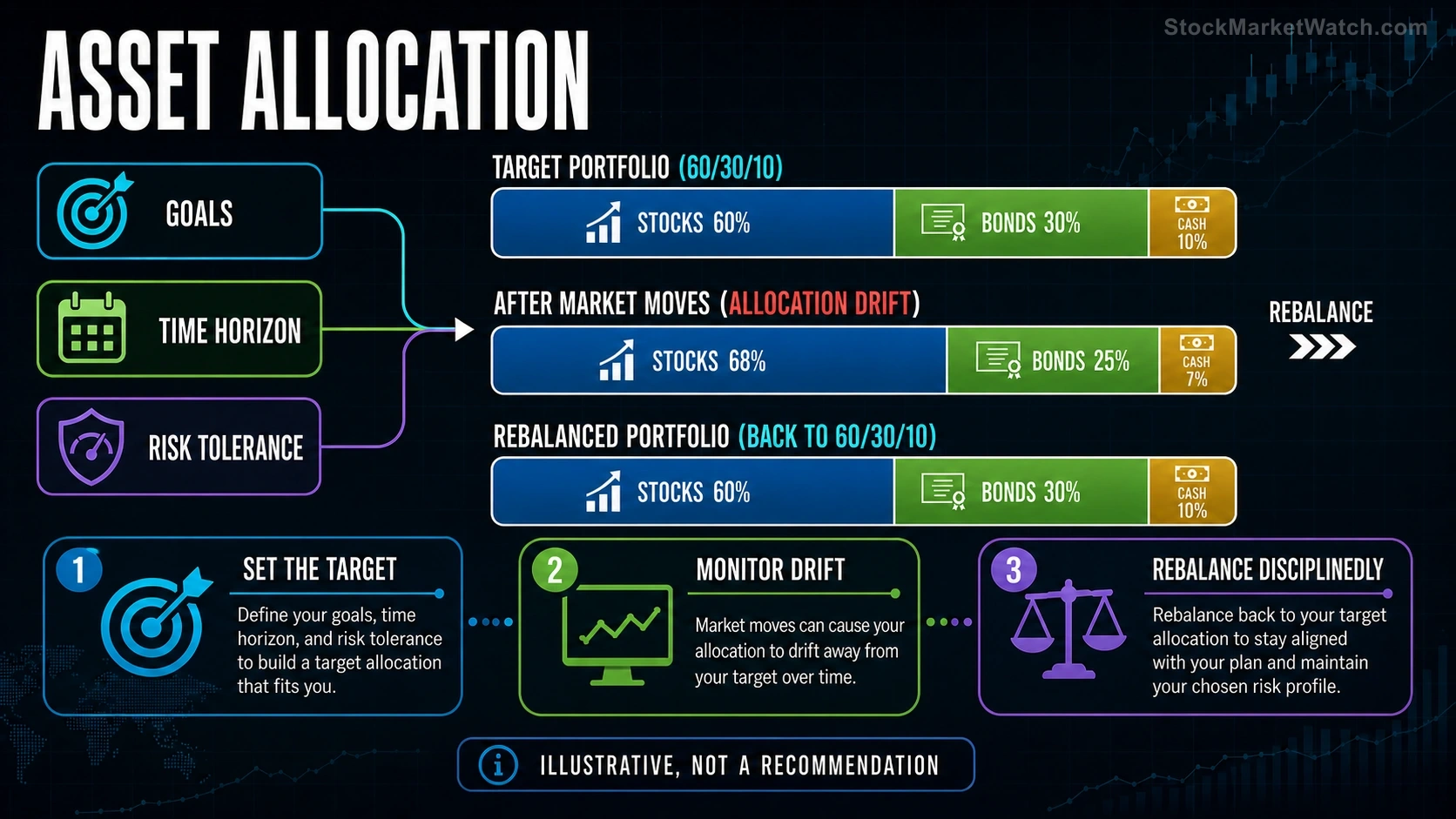
Because the classes behave so differently, the mix sets the character of everything downstream. A 90/10 stock-heavy portfolio and a 30/70 bond-heavy one live in different worlds: the first compounds faster and periodically falls hard; the second grows slower and sleeps better. No amount of clever stock selection inside the 90/10 will make it behave like the 30/70 in a crash — the allocation is the risk decision. Each class has a job: stocks provide the growth (and the drawdowns), bonds provide ballast and income, cash provides certainty for near-term needs. The split simply decides how much of each job gets done.
Setting Yours
The two inputs come straight from the previous lesson: horizon (capacity) and temperament (tolerance). Long horizon + genuine tolerance for declines → stock-heavy; short horizon or demonstrated panic-selling → more ballast. The old heuristic — hold roughly 110 minus your age in stocks — is a defensible starting point, not a law: it encodes the true idea that human capital (future earnings) shrinks with age, so portfolios should de-risk over time. Target-date funds automate exactly this "glide path," making them a reasonable one-decision default for retirement money. The honest rule for tuning: if the last bear market made you sell, your next allocation should be the one that would have let you hold.
Rebalancing: The Maintenance That Pays
Left alone, an allocation drifts — after a strong bull run, a 60/40 quietly becomes 75/25, carrying more risk exactly when markets are most expensive. Rebalancing — selling what grew overweight, buying what fell behind, back to target — is the fix, and it has a property worth savoring: it mechanizes buying low and selling high. No forecast, no feelings; the arithmetic forces you to trim what soared and add to what slumped, which is the opposite of what instinct demands and therefore precisely the discipline worth automating. Once a year, or whenever an asset class drifts more than about five percentage points from target, is plenty; more frequent tinkering mostly generates taxes and costs. In taxable accounts, rebalance gently — direct new contributions toward the underweight class instead of selling winners.
Running It Live
An allocation only works if you can see it: our portfolio tracker shows what your holdings actually sum to — which is often a surprise, since winners quietly concentrate a portfolio that started balanced (the di-worsification check applies here too: five overlapping funds may be one allocation in disguise). Set the split, write it down, rebalance on schedule, and most of portfolio management is — genuinely — done. What remains is the discipline of getting money in on a schedule as well, which is the next lesson: dollar-cost averaging.