Lesson 1
What Are Futures?
Updated Sep 2, 2026 · Reviewed by Terence Scott, founder
- Definition
- Standardized contract for later delivery
- Born
- Chicago grain trade, 1848
- Underlyings
- Commodities, indexes, rates, FX
- Both Directions
- Long and short equally
- Level
- Beginner
On this page
A futures contract is an agreement to buy or sell a specific asset, at a price fixed today, on a set date in the future — standardized down to the last detail and guaranteed by an exchange. Two parties, one price, settlement later: that's the entire instrument. Everything distinctive about futures — the leverage, the hedging power, the round-the-clock quotes on the S&P 500 — grows out of that one deferred handshake.
The Problem Futures Solved
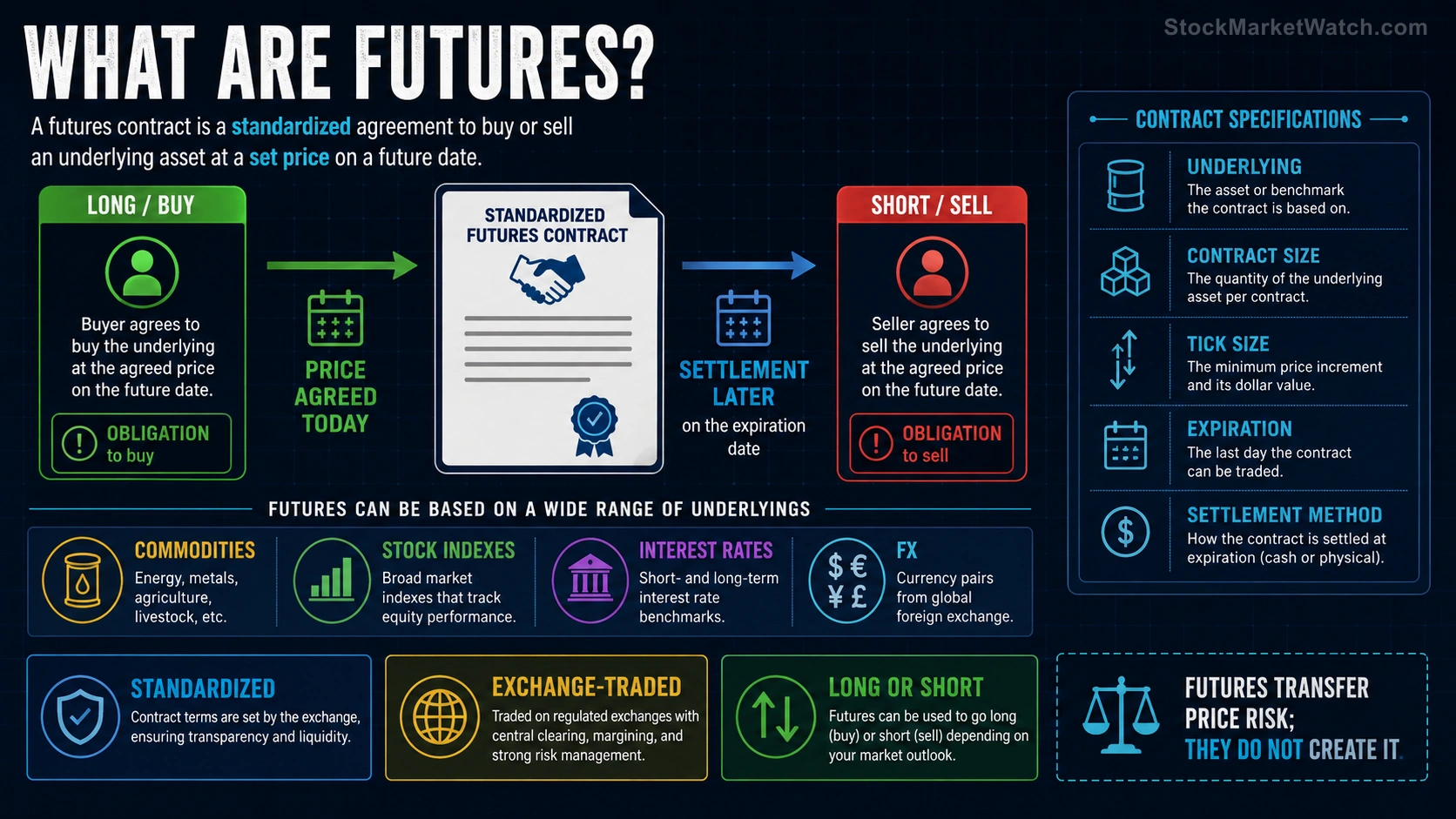
Start where the market started: a wheat farmer in 1840s Illinois. Months before harvest, the farmer's entire year depends on an unknowable price; the miller buying that wheat has the mirror-image problem. Their fix was the forward contract — agree on a price now, deliver later — and both sides sleep better, having traded uncertainty for certainty. Chicago formalized the idea when the Board of Trade opened in 1848, and the crucial innovation followed: standardization. Once contracts specified uniform quantity, quality, and delivery months, they stopped being private IOUs and became interchangeable instruments anyone could buy or sell — tradable promises, with the exchange's clearinghouse standing behind every one. That leap, from a deal between two people to a market in the deals themselves, is the whole invention.
From Grain to Everything
The template proved universal. Energy, metals, and livestock joined the agricultural contracts; currency futures arrived in 1972 when exchange rates began floating; interest-rate futures followed; and in 1982 came the contract that now touches every investor's morning — stock index futures, which settle in cash rather than deliverable bushels. Later came right-sized versions for individuals: the E-mini S&P 500 in 1997 and micro-sized contracts in 2019, small enough for serious retail traders to use sanely. Today's futures market is where the world sets its working prices for oil, gold, grain, rates, and equity indexes — mostly before your local market even opens.
What "Standardized" Means in Practice
Every contract's specification fixes the underlying and contract size (one contract = a defined quantity — barrels, ounces, or dollars-times-index), the tick (minimum price increment, each tick worth a fixed dollar amount), the expiration months available, and the settlement method — physical delivery for many commodities, cash settlement for indexes. The only thing two traders ever negotiate is price. Everything else was decided by the exchange before either of them arrived, which is precisely what makes the market deep and liquid.
How Futures Differ From Stocks
Four differences do most of the work. Obligation: a future commits both sides — unlike an option, which gives its buyer a right without an obligation. Expiration: stocks can be held for decades; every futures position has a built-in end date. Symmetry: selling short is as routine as buying long — no borrowing shares, no locate, just a sell order (contrast with how stocks trade). Zero-sum: a stock can enrich every holder as the business grows; in futures, every dollar won is a dollar lost by the opposite side of the same contract. That last one reframes the game entirely — futures don't generate returns, they transfer them.
Up Next
A market of tradable promises only works if someone guarantees the promises and someone shows up to take the other side. Who those parties are — hedgers, speculators, and the clearinghouse between them — is the next lesson.