Lesson 3
Futures Margin and Leverage
Updated Sep 2, 2026 · Reviewed by Terence Scott, founder
- Margin Type
- Performance bond, not a loan
- Daily Ritual
- Marked to market
- Leverage
- Often 10-20x notional
- The Call
- Top up or be liquidated
- Level
- Intermediate
On this page
"Margin" is the most dangerous word in futures — not because the concept is dangerous, but because it means something completely different from the stock-market term you may already know, and confusing the two has emptied real accounts. This lesson is the one to read twice.
A Bond, Not a Loan
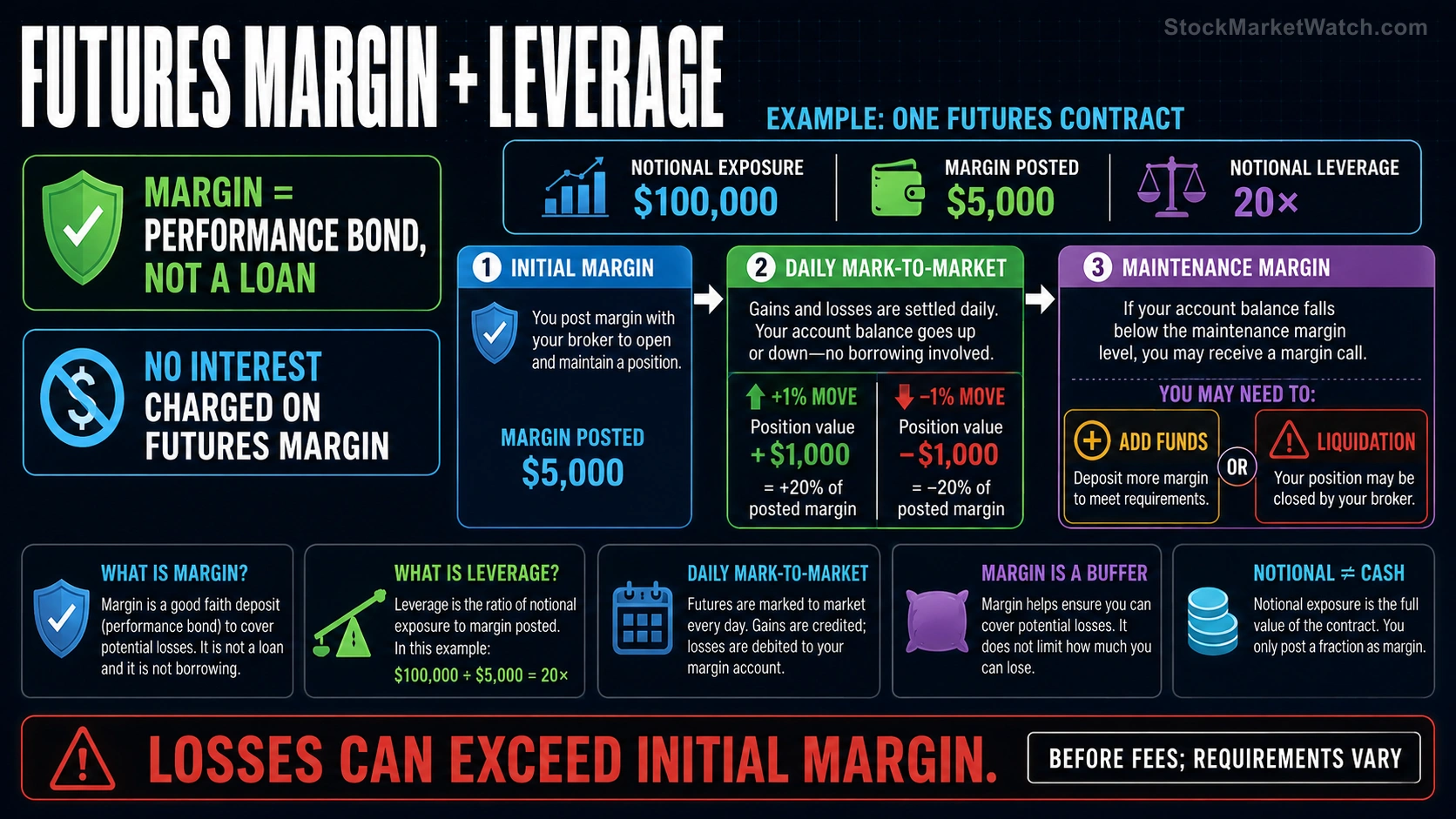
In stocks, buying on margin means borrowing money from your broker to buy more shares — a loan, with interest, secured by the position. Futures margin is nothing of the kind. You aren't buying the underlying at all — a futures position is a promise about later, so there's nothing to finance. Instead, both sides post a performance bond: a good-faith deposit, set by the exchange, proving you can cover the position's likely daily swings. No loan, no interest, and — the startling part — the deposit is a small fraction of the contract's full value, typically in the mid-single-digit percent range. The rest of this lesson is about what that fraction implies.
Marking to Market: Settling Up Every Day
Here is the mechanism that makes the whole system safe — and makes futures feel so different to hold. Every trading day, the clearinghouse marks every position to the day's settlement price and moves real cash: the day's losers are debited, the day's winners credited, immediately. There are no paper losses in futures. A stockholder can ignore a bad month; a futures trader's account bleeds actual dollars the same evening. This daily true-up is why the clearinghouse can guarantee millions of contracts between strangers — no participant is ever in the hole for more than about one day's move before the ledger clears.
Initial, Maintenance, and the Call
Two thresholds govern the account. Initial margin is the deposit required to open a position. Maintenance margin is a lower floor beneath it — and when daily losses drain your balance below that floor, the margin call arrives: restore the account to the initial level promptly, or the broker closes the position for you, at the market's price, not yours. The mechanics rhyme with the stock version, but faster and stricter: settlement is daily, markets run nearly around the clock, and brokers' liquidation engines are automated. Nobody phones first anymore.
The Leverage Arithmetic
Post a few percent to control the whole contract and you've built leverage of roughly ten-to-twenty times — which means the underlying's small moves become your account's large ones. A 1% move in the index is, on 20x leverage, a 20% move in the margin you posted; a 5% adverse move approaches wipeout — and beyond, because losses aren't capped at your deposit. The position's losses are yours in full; the margin was merely the down payment on them. Symmetrically, this is why futures attract professionals: capital efficiency (hedging a portfolio while posting only a sliver of its value) and precision. Leverage isn't the instrument's flaw — it's the product. The flaw is in sizing positions by margin required ("I can afford three contracts") instead of by notional exposure and worst-case move, which is the risk-and-return lesson applied with real consequences.
What This Buys You
Once the machinery clicks, futures stop being mysterious: the deposit is a bond, the daily debit is the safety system doing its job, and the leverage is a dial you set through position size — micro contracts exist precisely so the dial can be set low. How positions are actually put on, managed, and rolled is the finale: trading futures.