Lesson 4
Trading Futures
Updated Sep 2, 2026 · Reviewed by Terence Scott, founder
- Directions
- Long and short, equally easy
- Core Uses
- Speculation, hedging, spreads
- Housekeeping
- Roll before expiry
- Right-Sizing
- Micro contracts
- Level
- Intermediate
On this page
The final lesson assembles the course into practice: the ways futures positions are actually used, the housekeeping every position requires, and the honest question of whether you should trade them at all. None of it is complicated once the earlier machinery is understood — and all of it punishes anyone who skipped ahead.
Long and Short, Symmetrically
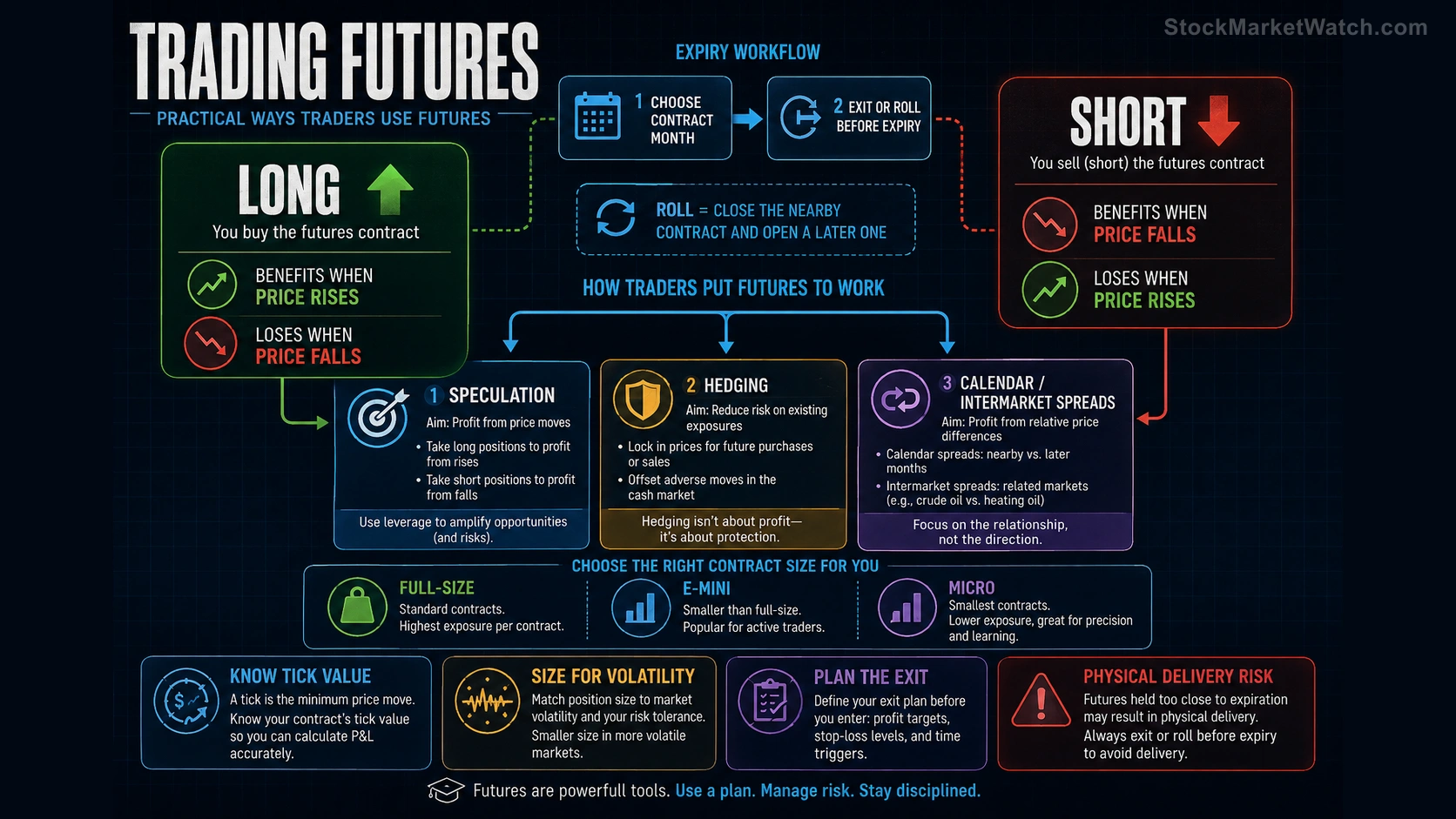
Buy a contract and you profit as the price rises; sell one first and you profit as it falls. That's the entire mechanic. There is no borrowing shares, no locate, no short-sale tickets — a short futures position is just a sell order, structurally identical to a long. This symmetry is one of the instrument's genuine advantages: expressing a bearish view in stocks is operationally clumsy; in futures it's Tuesday. The discipline requirements, however, are also symmetric — an adverse move debits your account nightly in either direction, per the margin lesson.
The Three Jobs a Position Can Do
Directional speculation — most retail activity: a leveraged view on the index, crude, or gold, held minutes to weeks. Everything in the trading-strategies section about entries, stops, and sizing applies here with the volume turned up. Hedging — the original job: an investor sitting on a large stock portfolio can sell index futures to neutralize market exposure through a rough patch, without selling a single share or triggering a taxable event. Spreads — the professional's habitat: long one contract, short a related one (different months, or related markets), betting on the gap rather than the direction. Spreads dampen outright risk and are a deep world of their own; know they exist, and that they're where much of the market's real volume lives.
The Housekeeping: Months and Rolling
Every position lives in a specific contract month, and liquidity concentrates in the nearest one — the front month. As expiration approaches, activity migrates to the next month, and traders roll: close the expiring contract, open the next, in one spread transaction. Miss the roll and the contract settles per its spec — cash-settled for indexes, but a delivery process for physical commodities that no retail trader wants to star in. Set the calendar reminder; rolling is routine, forgetting it is a story you tell once.
Right-Sizing: The Micro Revolution
The historically fatal retail mistake was contract size — full-size contracts force enormous exposure as the minimum bet. Micro contracts (one-tenth of the E-mini size) fixed this: the leverage dial finally turns down far enough for a small account to trade with survivable risk per position and room to be wrong several times. If you trade futures at all, starting micro isn't timidity — it's the only sizing consistent with everything the risk-tolerance lesson established.
Who Should — and Shouldn't
The honest close: futures are a trading instrument. Expiring, leveraged, daily-settled contracts have no role in a beginner's long-term portfolio — the investing courses build that machine, and it doesn't need this one. Futures earn their place for disciplined traders who need leverage, short exposure, or hedging precision, and who size by notional value rather than margin minimums. And for everyone else, the course still pays its way every single morning: overnight index futures are why stocks gap at the open — the mechanism behind the premarket movers board — and now you know exactly how that machine works.