Lesson 2
How ETFs Work
Updated Sep 2, 2026 · Reviewed by Terence Scott, founder
- Key Mechanism
- Creation & redemption
- Who Runs It
- Authorized participants
- Result
- Price hugs NAV
- Bonus
- In-kind = tax efficiency
- Level
- Beginner
On this page
An ETF's price is set by supply and demand on an exchange, like any stock. Its holdings have their own independently fluctuating value. So what stops the two from drifting apart — the fund trading at $110 while its basket is worth $100? The answer is the most elegant piece of plumbing in modern finance, and understanding it explains nearly everything else that makes ETFs attractive.
Creation and Redemption
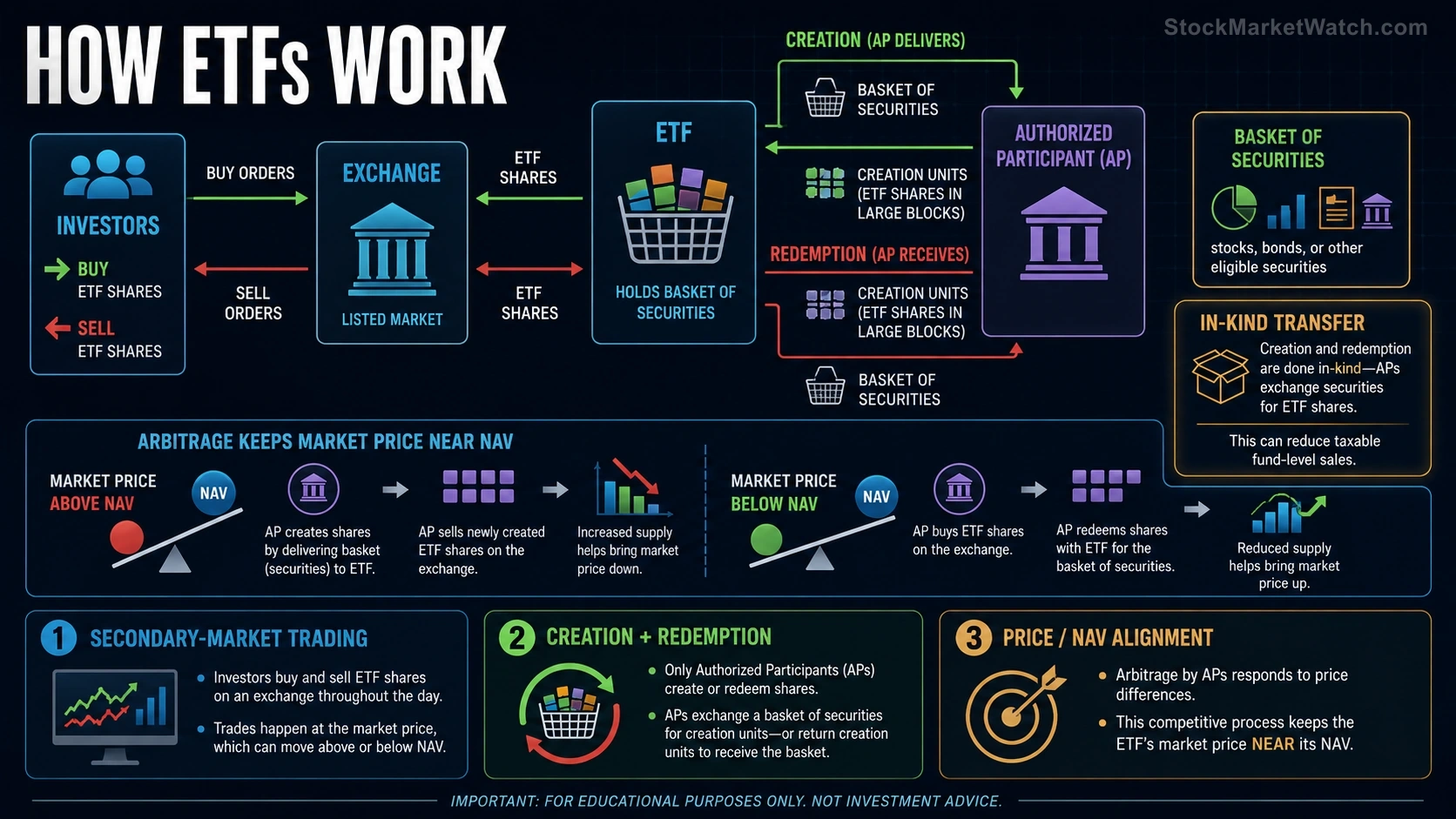
ETF shares aren't fixed in number. Large institutions called authorized participants (APs) can create new shares by delivering the actual basket of underlying securities to the fund, receiving freshly minted ETF shares in return — or redeem in reverse, handing shares back and receiving the basket. Both swaps happen at the basket's true value, and they turn any price gap into an arbitrage machine. ETF trading above its basket? An AP buys the underlying stocks, swaps them for new ETF shares, sells those shares at the premium — pocketing the difference while the extra supply pushes the price back down. Trading below? Run it backwards. The APs aren't public servants; they're profit-seekers whose profit-seeking is the enforcement mechanism. The result: for liquid ETFs, market price and underlying value rarely part by more than a few hundredths of a percent.
What Falls Out of the Machinery
Transparency. The mechanism requires APs to know the basket, so most ETFs publish complete holdings daily — a level of disclosure mutual funds (quarterly, delayed) never offered. It's the same disclosure that powers our holdings pages, where you can see exactly what any tracked fund owns right now.
Tax efficiency. The swaps are in-kind — securities exchanged for shares, not sales for cash — and in-kind transfers don't realize taxable capital gains. When a mutual fund's investors leave, the fund sells holdings and distributes the resulting gains to everyone who stayed; an ETF meets redemptions by handing out securities (typically its lowest-cost tax lots) without a sale. Broad-market ETFs routinely go years distributing no capital gains at all — in a taxable account, that deferral quietly compounds in your favor.
Cost. Index-tracking ETFs don't employ stock pickers, and the AP mechanism outsources most trading to arbitrageurs. Rock-bottom expense ratios are the visible result.
Where the Plumbing Creaks
Honesty requires the caveats. Spreads: you buy at the ask and sell at the bid; for giant funds the gap is a penny, for niche ones it's real money — limit orders are the sensible habit. Premiums and discounts: in stressed or closed markets (bond funds during a panic, international funds while their home exchange sleeps) price can deviate from stale basket values — less a malfunction than the ETF publishing a live opinion the underlying market can't. Tracking error: fees and implementation friction mean a fund lags its index slightly; comparing that lag against the expense ratio is a quick quality check. None of these change the long-term picture; all of them occasionally surprise people who didn't know the machinery.
Why This Lesson Matters
Everything ETFs are praised for — tight tracking, daily transparency, tax deferral, low cost — is a consequence of one mechanism, not a list of marketing promises. When you can explain why the price hugs the basket, you can also predict when it won't, and neither state will rattle you. Next: the argument the ETF made unavoidable — active versus passive investing.