Lesson 1
What Is an ETF?
Updated Sep 2, 2026 · Reviewed by Terence Scott, founder
- Definition
- A fund that trades like a stock
- First US ETF
- SPY (1993)
- Scale Today
- Trillions in assets
- Core Appeal
- Diversification in one trade
- Level
- Beginner
An exchange-traded fund (ETF) is a pooled investment that holds a basket of securities — hundreds of stocks, or bonds, or gold bars — and divides ownership of that basket into shares that trade on a stock exchange, all day, exactly like a stock. That one sentence contains the entire invention: the diversification of a fund, delivered with the convenience of a share.
The Basket Idea
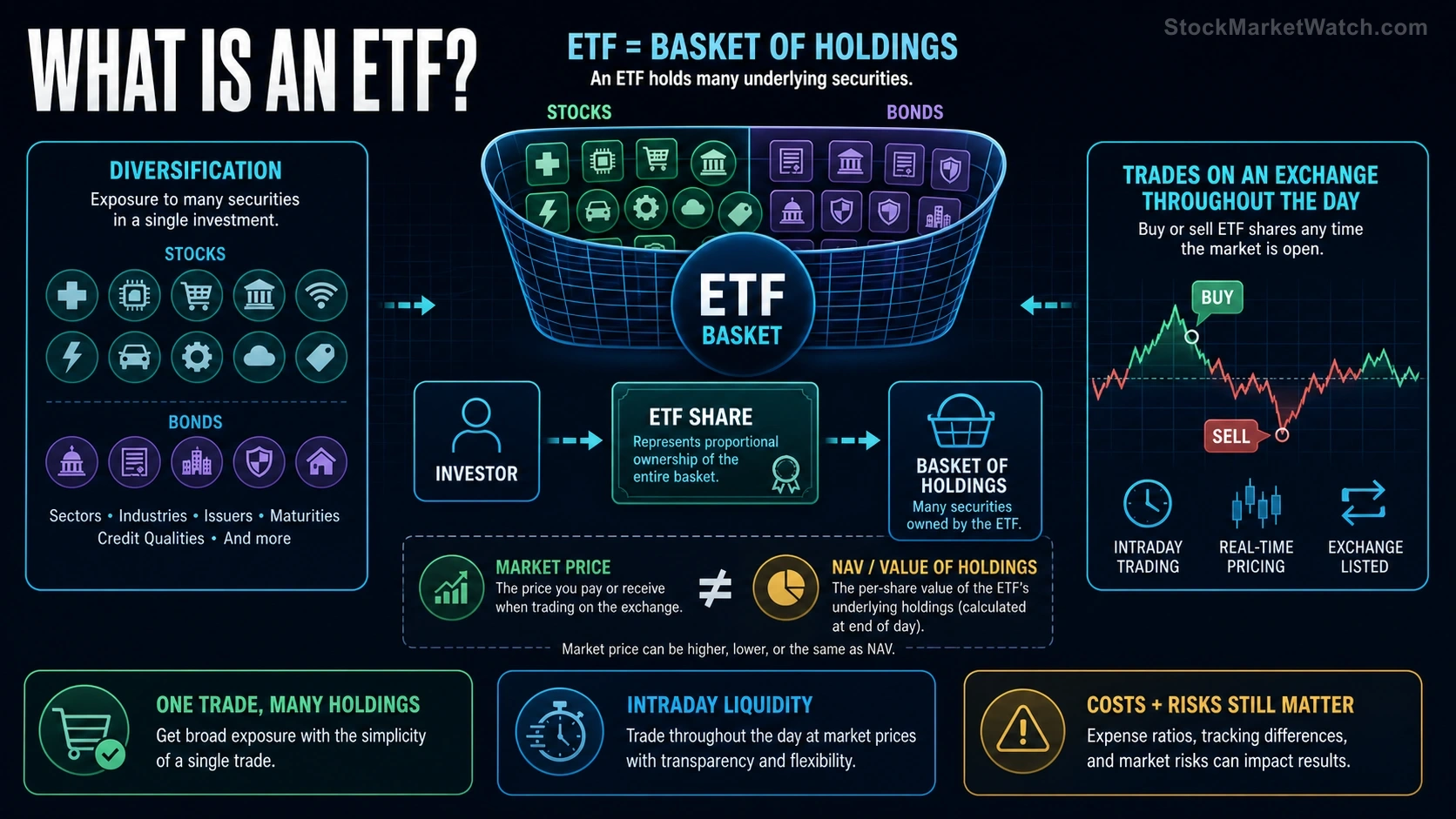
Buy one share of a broad S&P 500 ETF and you own a proportional sliver of five hundred companies at once — every sector, in one trade, for the price of a single share (or less, with fractional investing). The diversification lesson explained why spreading across many imperfectly correlated holdings is the one free lunch in investing; the ETF is that lesson made purchasable. What was once the privilege of the wealthy — a professionally assembled, broadly diversified portfolio — became something anyone can buy before lunch. And the basket can be almost anything: the whole U.S. market, one sector, another country's stocks, Treasury bonds, gold. If it can be indexed, someone has wrapped it.
Trades Like a Stock
The "exchange-traded" half is what separates ETFs from their mutual-fund ancestors. A mutual fund transacts once per day, after the close, at that day's computed net asset value — place an order at 10 a.m. and you'll get an unknown price at 4 p.m. An ETF has a live, quoted price all session: you can see it, limit-order it, and own it in seconds through any broker, with no account minimums beyond the share price and, at nearly every major broker today, no commission. This flexibility matters less for buy-and-hold investors than day-to-day traders — but the transparency of an always-visible price, and the freedom to act on it, changed how funds feel to own.
Where ETFs Came From
The first ETFs appeared in the early 1990s, and the one that mattered launched in January 1993: the SPDR S&P 500 ETF — ticker SPY — which simply held the S&P 500 and let anyone trade the whole U.S. large-cap market as one symbol. It remains among the most heavily traded securities on earth, and you can inspect its full modern anatomy on our SPY page. Growth from that single fund was slow, then unstoppable: a few billion dollars in the 1990s, then an explosion through the 2000s and 2010s as investors absorbed the evidence on costs, until today U.S. ETFs hold trillions of dollars across thousands of funds. Along the way the ETF displaced the mutual fund as the default wrapper for new money — a quiet revolution conducted entirely in plumbing.
Why They Won
Four properties, each covered in this course: cheap — broad index ETFs charge as little as a few hundredths of a percent per year, and the compounding lesson showed why fee differences that look trivial become enormous over decades; diversified by construction; accessible — one share, any broker, no paperwork; and tax-efficient, for a mechanical reason that belongs to the next lesson. None of this makes ETFs risk-free: an ETF is exactly as risky as its basket, a point the whole course will keep returning to.
Course Map
Next comes the machinery — how ETFs actually work, and why the price so faithfully tracks the basket. Then the great active-versus-passive debate, the ETF-versus-index-fund comparison, the full menu of fund types, the exotics, and finally the strategies that put ETFs to work.