Lesson 4
ETFs vs. Index Mutual Funds
Updated Sep 2, 2026 · Reviewed by Terence Scott, founder
- Same Engine
- Both track an index
- ETFs Win On
- Taxes, minimums, portability
- Mutual Funds Win On
- Automation
- Pricing
- Intraday vs once daily
- Level
- Beginner
An S&P 500 ETF and an S&P 500 index mutual fund hold the same five hundred stocks, track the same index, and — at the big providers — charge nearly the same few basis points. For long-term results, they are close to interchangeable. The differences are mechanical, and mechanics decide which one fits your account. This is the practical comparison, without the tribal loyalty the topic somehow attracts.
Trading and Pricing
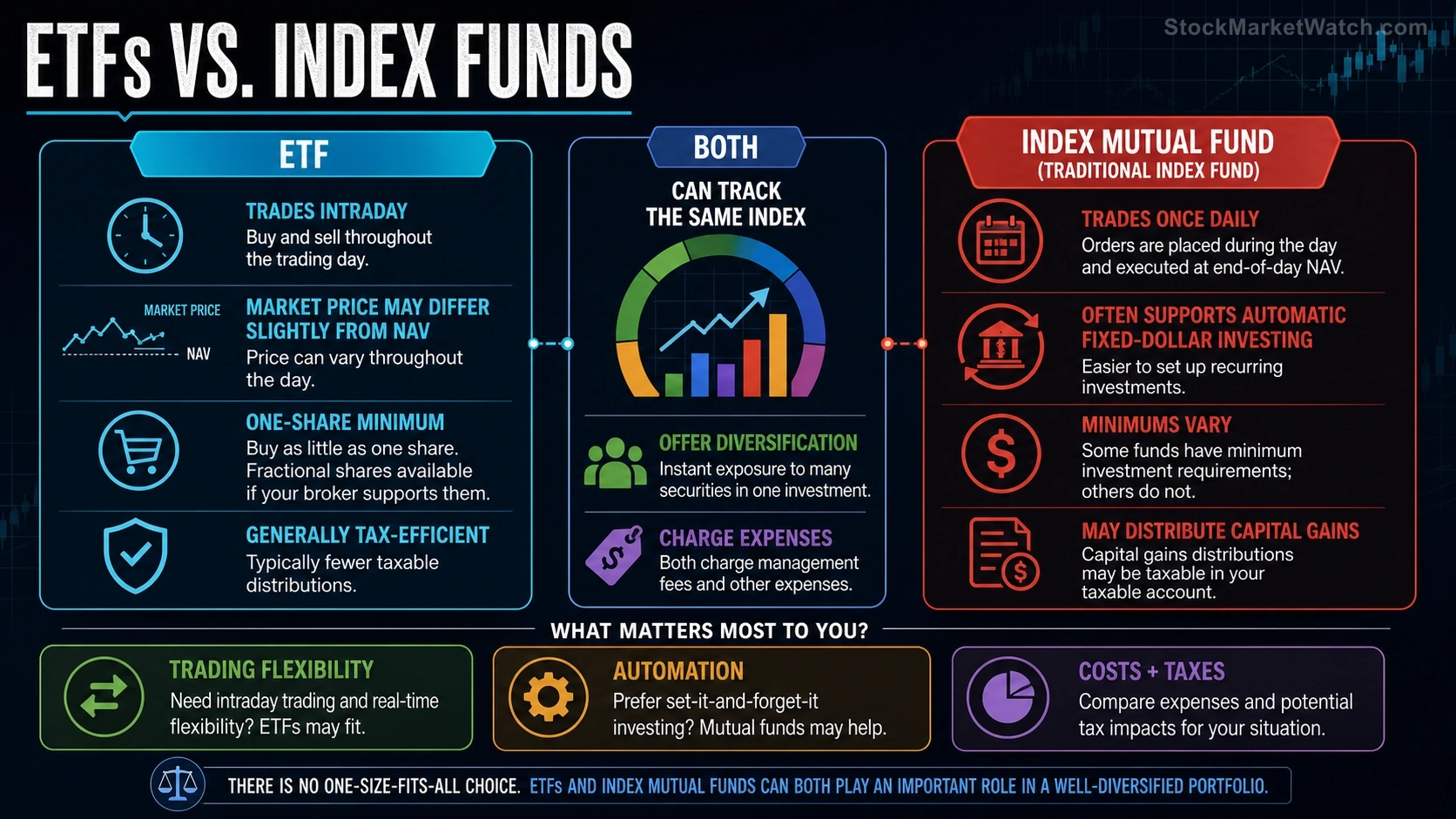
The ETF trades all day at a live market price; the mutual fund transacts once, after the close, at that day's net asset value. For a buy-and-hold investor this difference is smaller than it looks — someone holding for twenty years gains nothing from second-by-second pricing — but the ETF's version has two quiet virtues: you know your exact price when you order (limit orders work), and you're never locked out of acting mid-day. The mutual fund's version has one: it makes impulsive intraday tinkering physically impossible, which for some temperaments is a feature worth real money.
Minimums and Access
ETFs win outright. One share — or a fraction of one, at brokers offering fractional investing — is the entire barrier to entry, and any brokerage account can hold any ETF. Index mutual funds often carry investment minimums (frequently in the thousands) and live most comfortably inside their own provider's ecosystem; moving them between brokers can be clumsy or impossible without selling. The ETF is the portable, no-permission-needed format.
Taxes
In taxable accounts, ETFs hold a structural edge that isn't marketing: the in-kind creation-redemption machinery from the plumbing lesson lets ETFs shed appreciated holdings without realizing gains, while mutual funds meeting redemptions must sell and distribute taxable gains to remaining holders — a bill you can receive in a year you personally sold nothing. Inside tax-sheltered retirement accounts, this entire advantage evaporates, and with it most of the practical difference between the wrappers.
Automation
The mutual fund's home-turf win. Its infrastructure was built for scheduled investing: automatic monthly purchases of exact dollar amounts, automatic dividend reinvestment, no order to place — the machinery of dollar-cost averaging with zero friction, which is why workplace retirement plans run on mutual funds. ETFs are catching up as brokers add automatic and fractional ETF purchases, but support remains uneven. If untouchable automation is what keeps your plan alive, this single row of the scorecard can outweigh the rest.
The Decision, Compressed
Taxable account → the ETF's tax treatment usually decides it. Retirement account through work → the menu decides for you, and the index mutual funds on it are excellent. IRA or brokerage where you want set-and-forget contributions → whichever wrapper your broker automates well. Choosing between a good index ETF and a good index mutual fund is a decision between two right answers — the expensive mistake is neither wrapper, but drifting into high-fee funds or no plan at all, which the previous lesson priced out. Next: the menu itself — the types of ETFs and what each is for.