Lesson 5
The Types of ETFs
Updated Sep 2, 2026 · Reviewed by Terence Scott, founder
- The Core
- Broad-market & S&P 500
- The Slices
- Sector, dividend, factor, international
- The Ballast
- Bond ETFs
- One-Fund Option
- Allocation ETFs
- Level
- Beginner
On this page
Thousands of ETFs trade in the U.S., which sounds unnavigable until you notice they cluster into a handful of families with distinct jobs. This lesson maps the menu — and the organizing rule for all of it: an ETF's risk and behavior are entirely those of its basket. The wrapper is identical every time; only the contents change. Judge funds by looking inside, never by name alone.
Broad Equity: The Core
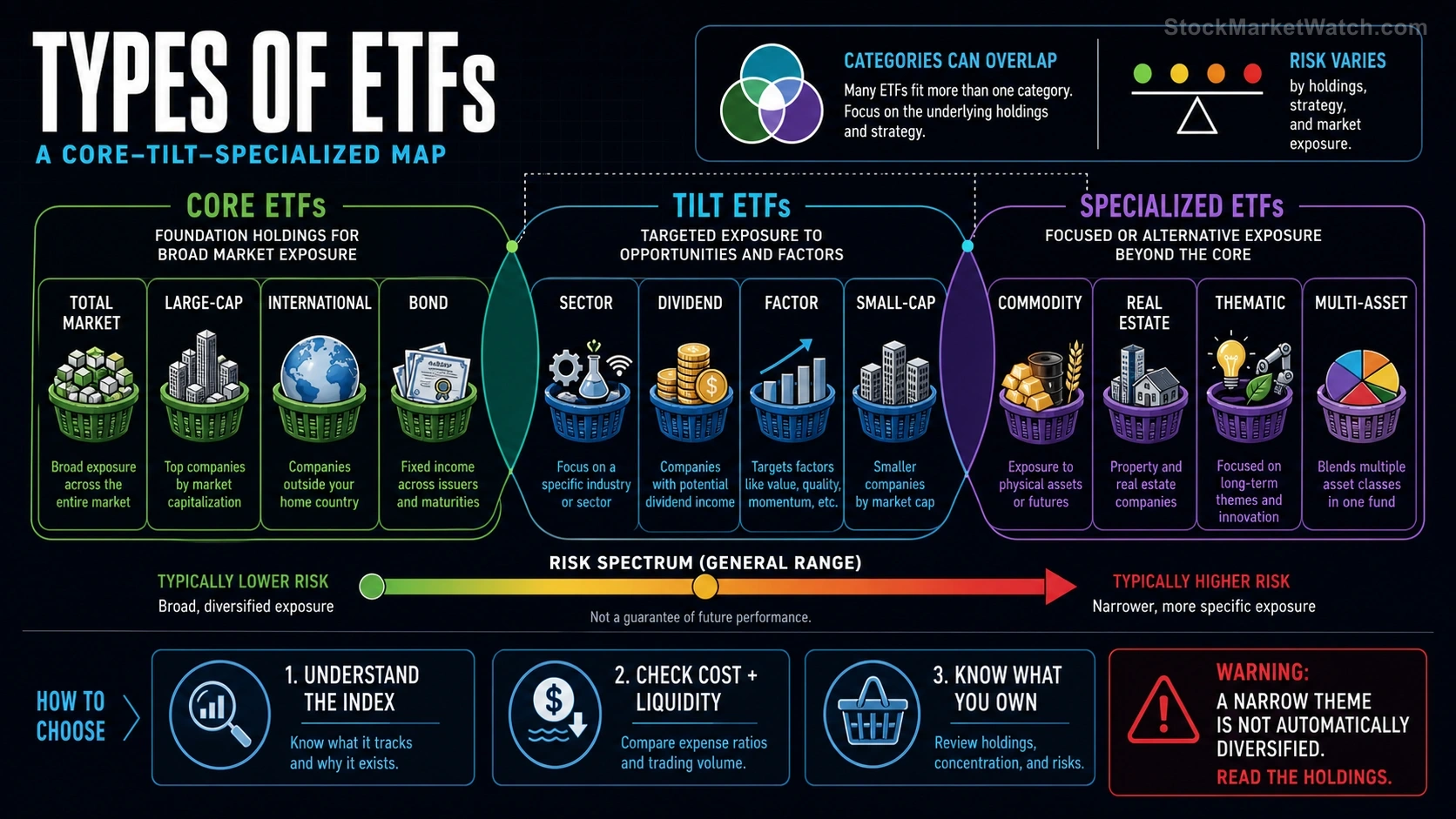
The workhorses. S&P 500 funds (like SPY and its cheaper siblings) own America's large-cap universe in one share; total-market funds extend to thousands of mid and small caps. Either delivers instant diversification across every sector at minimal cost, which is why "a broad equity fund" is the default answer to most portfolio questions in this course. The differences between them are modest; owning one of them is the decision that matters.
The Slices
Sector funds isolate one industry — technology, energy, healthcare — turning a portfolio tilt into one trade, and concentrating exactly the sector risk a broad fund dilutes. Dividend funds screen for yield or dividend growth, packaging the income-investing strategy as a fund (same yield-trap cautions apply). Factor funds systematize value, momentum, and quality screens. International funds add developed and emerging markets — genuine diversification with currency risk riding along. Slices are tools, not foundations: useful in deliberate doses on top of a broad core, hazardous as the whole meal.
Bond ETFs: The Ballast
The same wrapper around lending instead of owning: Treasury funds across every maturity, corporate investment-grade, high-yield, municipal, and total-bond-market blends. Bond ETFs made the asset-allocation lesson executable in two trades — a stock fund plus a bond fund is a complete, rebalanceable portfolio. Two behaviors to know: fund prices fall when rates rise (interest-rate risk in fund form, sharper for longer-maturity funds), and unlike an individual bond there's no maturity date on which the fund hands back par — it holds a perpetually rolling portfolio.
Asset-Allocation ETFs: The One-Fund Answer
Funds that hold other funds in a fixed stock/bond ratio — 80/20, 60/40 — rebalancing themselves internally. One ticker is an entire maintained portfolio: allocation, diversification, and rebalancing discipline outsourced for a small fee on top of cheap underlying funds. Dismissed by hobbyists as training wheels, they are arguably the best behavioral bargain in the industry for anyone who wants investing to take zero ongoing decisions.
Reading Any Fund in Three Steps
The menu keeps growing, but the diligence never changes: what's inside (the full holdings and their weights — our ETF research center lists every tracked fund's complete basket, sector mix, and valuation), what it costs (expense ratio, and spreads for smaller funds), and whether you already own it — overlapping funds are how portfolios fail the di-worsification check while feeling diversified. Every family so far invests in something productive. The next lesson covers the shelf that often doesn't: leveraged, inverse, and alternative ETFs.