Lesson 3
Active vs. Passive Investing
Updated Sep 2, 2026 · Reviewed by Terence Scott, founder
- Passive
- Own the whole index
- Active
- Try to beat it
- The Record
- Most active funds trail
- The Reason
- Costs compound
- Level
- Beginner
On this page
Every fund ever launched embodies one of two philosophies. Active management hires people to pick winners and dodge losers, aiming to beat the market. Passive management gives up that fight on purpose: own everything in an index, at the lowest possible cost, and accept the market's return as your return. For decades this was a genuine debate. The ETF era turned it into something closer to a verdict — and understanding why is essential to using ETFs well, since the instrument itself is philosophy made purchasable.
The Case for Active
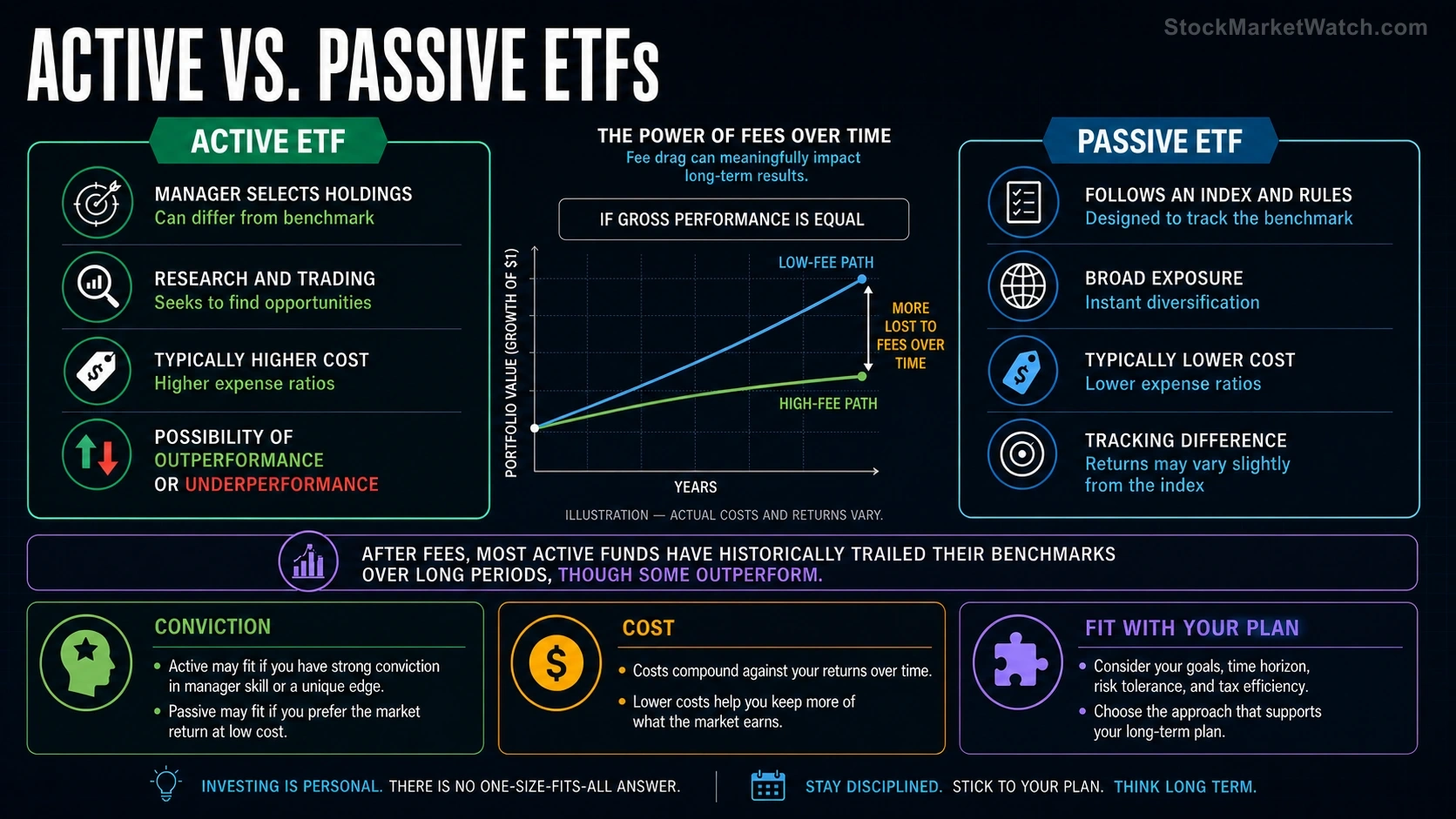
It sounds unanswerable: markets misprice things, skilled analysts exist, so paying for skill should beat owning the average — which, after all, includes every overpriced disaster in the index. Active management also promises defense: a manager can raise cash before the storm an index fund must ride straight through. Every fee brochure ever printed rests on some version of this argument.
What the Record Shows
The evidence has been collected for half a century, and it is brutally consistent: over long horizons, the substantial majority of actively managed funds fail to beat their benchmark index after costs, and the minority that win in one period show little tendency to repeat in the next — making the winners nearly impossible to identify in advance, which is the only time identifying them pays. The efficient market hypothesis explains the headwind: prices already reflect most available information because thousands of skilled professionals compete to trade on it — active managers aren't failing for lack of talent, they're competing against each other, minus fees. And the fees are the decisive half. Active funds charging around 1% a year must outpick passive rivals charging a few hundredths of a percent by that margin every year merely to tie — a gap that, as the compounding lesson showed, snowballs mercilessly over decades.
Why ETFs Sealed It
Passive investing predates ETFs — index mutual funds go back to the 1970s — but the ETF was the delivery vehicle that made it universal: cheaper than any active fund could be, buyable by anyone in one trade, transparent daily. Money followed the evidence by the trillion, and today the large majority of ETF assets sit in index-tracking funds. The market structure now assumes it: when you buy a broad index ETF, you are executing the strategy the data endorses, at a price war's winning price.
The Honest Middle
The verdict has boundaries worth knowing. Some corners of the market — less-covered small caps, parts of the bond market — are plausibly less efficient, and active management persists there with a more defensible record. Actively managed ETFs now exist too, wrapping stock-picking in the ETF's tax-efficient plumbing at fees below old mutual-fund norms — a better vehicle for the same hard game. And picking your own stocks is active management with the fee paid in your time; the stock-picking course teaches exactly that, with the same honesty this lesson owes you: the index is the benchmark that most professionals fail to beat. Doing it yourself doesn't lower the bar.
The Practical Takeaway
Let passive be the default and active the deliberate exception — a considered tilt, not an assumption that someone clever must beat average. Check any fund's approach before buying: its index (or lack of one), its expense ratio, and what it actually holds — our ETF research center shows the holdings for every tracked fund. Next, a sibling rivalry inside the passive family itself: ETFs versus index mutual funds.