Lesson 6
Leveraged, Inverse & Alternative ETFs
Updated Sep 2, 2026 · Reviewed by Terence Scott, founder
- Leveraged
- 2x-3x the DAILY move
- The Catch
- Daily reset decay
- Inverse
- Profits when the index falls
- Alternatives
- Gold, commodities, crypto
- Level
- Intermediate
On this page
The ETF wrapper will hold almost anything, and the industry has obliged: funds that double the market's daily move, funds that profit when indexes fall, funds holding gold bars, oil futures, or bitcoin. This shelf is where the wrapper's convenience becomes a hazard — instruments with genuinely complex mechanics, buyable in one click by anyone who just learned what an ETF is. This lesson is the warning label the products themselves print in small type.
Gold and Commodity Funds
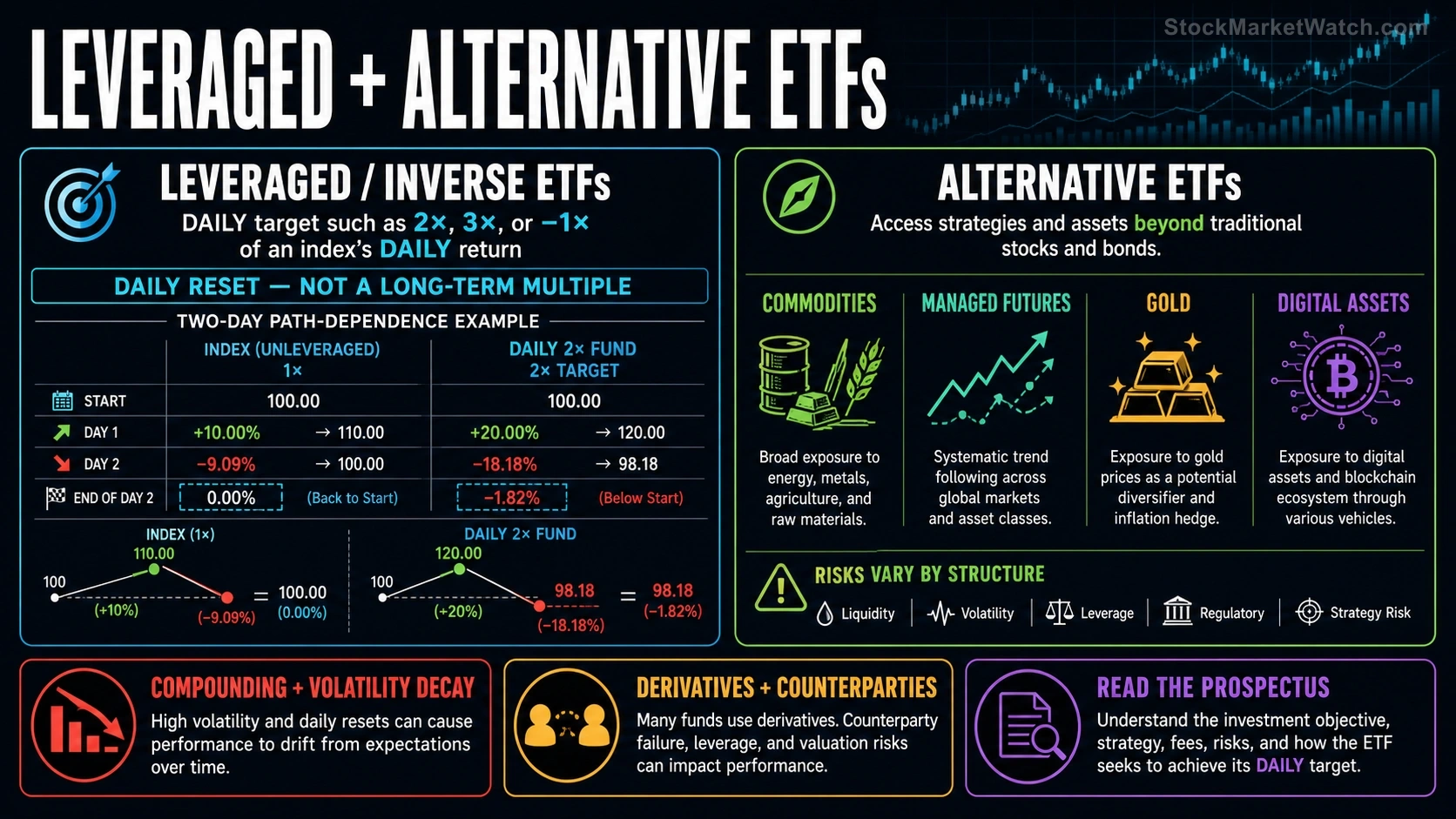
The benign end. Physical gold trusts own vaulted bullion, so a share tracks gold's price — a legitimately useful instrument, remembering from the asset-class lesson that gold produces nothing and is priced purely by what others will pay. Most other commodity funds can't hold the physical stuff (no one vaults a million barrels of oil for retail investors), so they hold futures contracts, rolling each expiring contract into the next — and when later-dated contracts cost more, every roll bleeds a little value. The result: a futures-based fund can lag its commodity badly over months even when the spot-price bet was right. If the fund holds futures, the chart you're imagining is not the chart you'll get.
Crypto Funds
Spot bitcoin ETPs, approved in the U.S. in early 2024, hold actual bitcoin and legitimately track it — solving custody, wallets, and exchange risk in a familiar brokerage wrapper. What they do not solve is the asset itself: drawdowns severe enough to place crypto at the exposed top of the risk ladder. The wrapper is now honest; size the position for the contents.
Leveraged and Inverse: Read This Twice
A 2x leveraged fund delivers twice the index's return — per day, and those two words are the whole trap. Daily rebalancing means returns compound path-dependently, so over any longer period the fund does not deliver twice the index. The arithmetic: an index goes 100 → 110 → 100 (up 10%, down 9.09%, flat overall). The 2x fund goes 100 → 120 → 98.2 — the index round-tripped to even and the leveraged holder lost money. That's volatility decay: every oscillation grinds value away, and choppy sideways markets — most markets, most of the time — are the worst case. Inverse funds ("short the index in one click") carry the same daily-reset math plus a headwind: markets drift upward over time, so buy-and-hold here loses twice — to decay and to direction. These are engineered as single-day trading instruments; their own prospectuses say so. As multi-week holdings they are a slow leak wearing an ETF costume. Anyone drawn to them belongs first in the trading-strategies section, where holding periods match the tool.
The Test That Sorts the Shelf
Before buying anything exotic, answer plainly: what does this fund actually hold, and what is the mechanism between those holdings and the return I expect? Physical gold trust — clean answer. Futures roll — subtle answer, know the drag. Daily-reset leverage — the answer disqualifies it for holding. The risk-and-return lesson put it structurally: return you don't understand is risk you haven't identified yet. A fund you can't explain isn't an investment — it's a bet with better packaging.
Back to Solid Ground
Nothing on this shelf is required. Complete, excellent portfolios are built entirely from the previous lesson's families — which is exactly what the course finale assembles: practical ETF strategies, from the one-fund default to core-satellite.