Lesson 7
ETF Investing Strategies
Updated Sep 2, 2026 · Reviewed by Terence Scott, founder
- The Default
- One broad fund + discipline
- Classic Build
- Core-satellite
- The Engine
- DCA + rebalancing
- Income Sleeve
- Dividend & bond funds
- Level
- Beginner
On this page
Six lessons of machinery, one lesson of assembly. ETF strategies range from a single fund held for decades to elaborate rotating schemes — and, in keeping with this course's habit of honesty, the evidence favors the boring end of that range. Here are the builds that actually get used, in ascending order of effort.
The One-Fund Portfolio
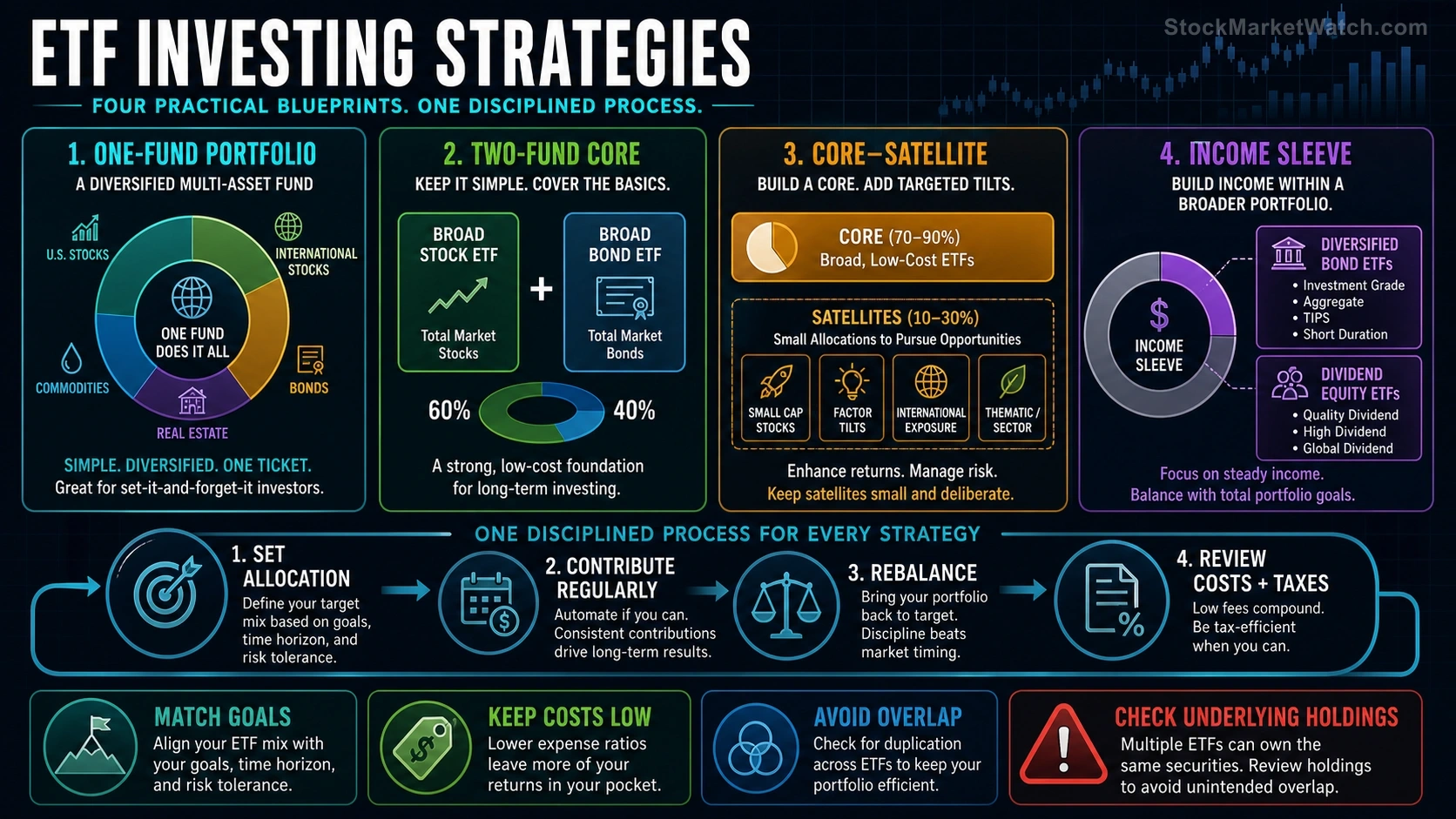
A single broad fund — total market or S&P 500 — bought on a schedule and left alone, or an asset-allocation ETF if you want the stock/bond split maintained for you. This is the whole strategy, and it is not a compromise: it implements the passive verdict at minimum cost with nothing to tinker with, which is precisely why it works — most portfolio damage is self-inflicted through activity. The honest question before adding any complexity: what, specifically, will the addition do that this doesn't?
Two Funds: The Classic Balance
A broad stock fund plus a total bond fund, weighted per the asset-allocation lesson, rebalanced annually. Two tickers give you a complete implementation of everything the fundamentals course taught: diversification across and within asset classes, risk sized to your tolerance, and a rebalancing ritual that mechanically buys low. For most investors, most lifetimes, this is the finish line dressed as a starting point.
Core-Satellite: Conviction, Contained
The framework for anyone who wants deliberate bets without betting the farm: a large passive core (the majority of the portfolio in broad funds) surrounded by small satellites — a sector fund you have a thesis on, a dividend tilt, international overweight, even individual stocks picked with the stock-picking course's discipline. The structure's genius is containment: satellites are sized so that being wrong is affordable tuition, while the core compounds regardless. Two rules keep it honest — write down why each satellite exists and what would close it, and check overlap so satellites aren't secretly re-buying the core (our holdings data makes the check concrete: open both funds and compare what's inside).
The Income Build
Retirees and income-focused investors assemble yield from fund families instead of individual securities: dividend ETFs for the equity sleeve, bond funds across maturities for the fixed side. The income-investing cautions transfer intact — yield-chasing is yield-chasing whether the vehicle is one stock or four hundred, and a fund advertising an outsized yield acquired it by holding what others sold.
The Engine Under Every Build
Strategy selection matters less than the machinery running it: dollar-cost average in on a schedule, reinvest distributions, rebalance to targets, and let compounding do the part no strategy can. Sector-rotation and market-timing schemes promise more and reliably deliver activity instead; every added decision point is another appointment with the behavioral risks the fundamentals course catalogued.
Course Complete
You now know what an ETF is, how its plumbing works, why passive won, which wrapper fits which account, what the whole menu contains, which shelf to avoid, and how the pieces assemble. The concepts stay still; the data moves daily — the ETF research center is where these lessons meet live holdings, breadth, and valuation for every fund we track. From here, the other investing courses deepen whichever direction pulls you.