Lesson 12
Basic Options Risk Management
Updated Aug 29, 2026
- Long option max loss
- 100% of premium paid
- Naked call max loss
- theoretically unlimited
- Naked put max loss
- stock falling toward $0
- Assignment
- can happen anytime an option is in the money
- Rule of thumb
- size positions by what you can fully lose
On this page
Options are often described as a way to control the same number of shares for far less money than buying the stock outright, and that's true, but the leverage that makes them attractive also makes them risky. This lesson covers the risk side plainly: how much you can actually lose in different options positions, why short options carry far more risk than long ones, and how to size and plan a trade so a bad outcome doesn't wreck your account.
The Basic Rule: Size Positions by What You Can Afford to Lose Completely
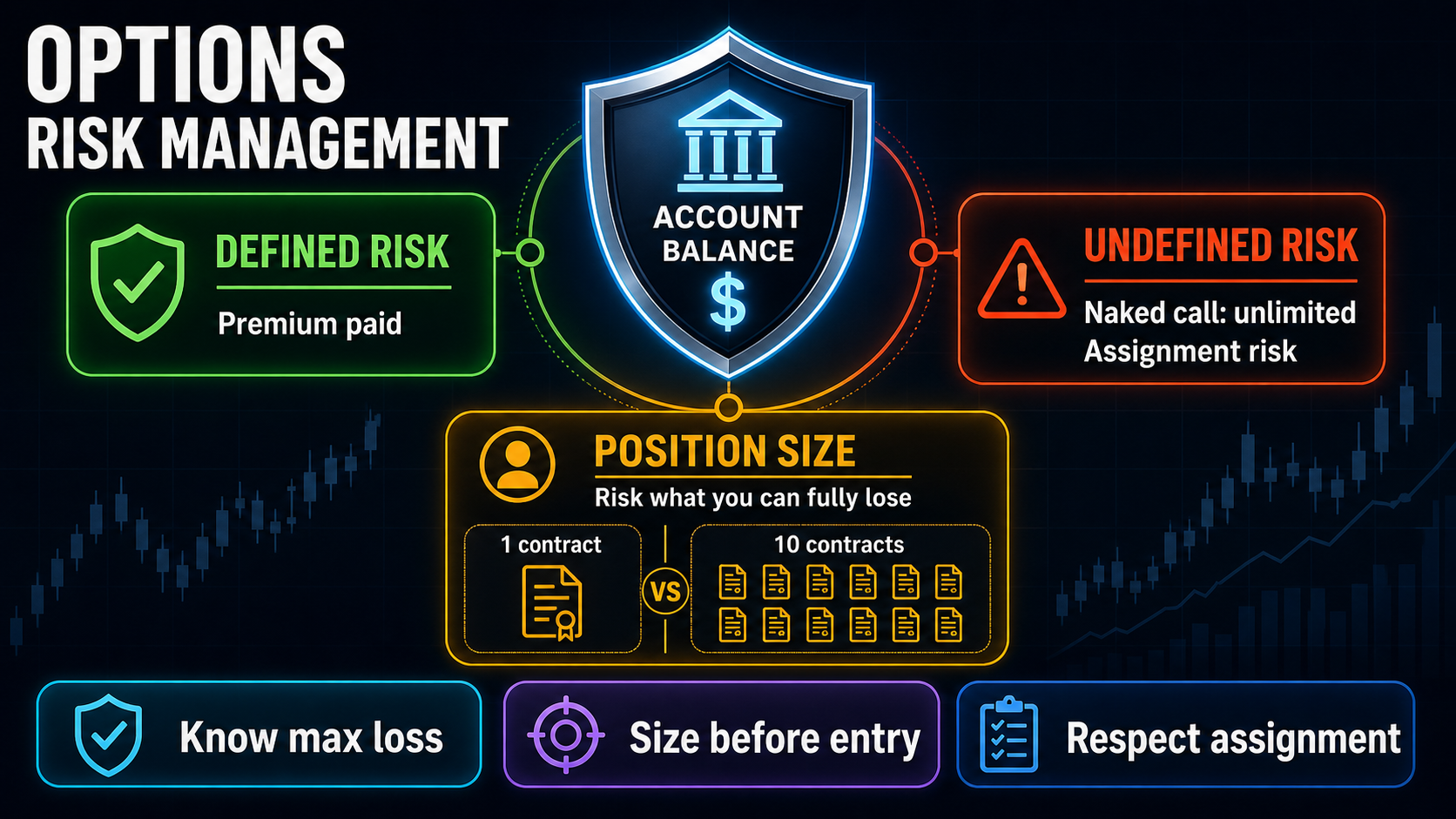
With a long stock position, a total loss (the stock going to zero) is possible but unusual for an established company. With a long option position, a 100% loss of the premium is a routine outcome, not a tail risk, it happens whenever the stock doesn't move enough, moves the wrong way, or moves the right way too slowly before expiration. So a reasonable rule of thumb is to only put into any single long options trade an amount you'd be fully comfortable losing outright.
Long Options: Defined, but Total, Risk
When you buy a call or put, your maximum loss is capped at the premium you paid, no matter how far the stock moves against you. That's the defined-risk appeal of buying options. The tradeoff is that hitting the maximum loss, a complete wipeout of the premium, is common: many options bought by beginners expire worthless because the stock didn't move enough, moved the wrong way, or ran out of time. Defined risk doesn't mean small risk, it means you know your worst case in advance, and that worst case is still losing everything you put in.
Short Options: Larger, and Sometimes Unlimited, Risk
Selling options (writing them) flips the risk profile entirely. A covered call, selling a call against stock you already own, has defined and comparatively modest risk, because you already hold the shares that would be called away. A cash-secured put, selling a put while setting aside the cash to buy the shares if assigned, is similarly defined, your downside is roughly the same as if you'd bought the stock at the strike price.
An uncovered (naked) put is riskier: if the stock falls sharply, you're forced to buy shares at the strike price even as the market price keeps falling, with your loss growing as the stock drops toward zero. An uncovered (naked) call is the most dangerous common options position for a retail trader: because a stock's price has no ceiling, the loss on a naked call is theoretically unlimited. Sell a call for a small premium and the stock unexpectedly doubles, and you can owe far more than you ever collected. This is why brokers require the highest approval level and margin for naked calls, as covered in selecting a broker.
Assignment Risk
If you sell (write) an option, you can be assigned, meaning the option is exercised against you, at any time it's in the money, not only at expiration. Assignment obligates you to deliver or buy the underlying shares at the strike price, whether or not that's convenient for you. Two situations worth specifically knowing about:
- Early assignment near expiration: deep in-the-money short options are more likely to be assigned early, especially in the final days before expiration.
- Early assignment around ex-dividend dates: a short call that's in the money is more likely to be assigned early just before the underlying stock's ex-dividend date, because the option holder may exercise early to capture the dividend. If you're short a call on a dividend-paying stock, check the ex-dividend calendar so an assignment doesn't surprise you.
Being assigned isn't a penalty or a mistake in itself, it's a normal part of how short options work, but it can tie up capital or force a stock position you didn't plan for on a specific date, so it shouldn't come as a surprise.
A Worked Comparison: Long Stock vs. a Long Call
Suppose ABC Corp trades at $30 per share. Investor A buys 1,000 shares outright for $30,000. Investor B instead buys 10 call contracts (controlling the same 1,000 shares) at $1.00 per contract, for a total cost of 10 x 100 x $1.00 = $1,000.
- If the stock rises to $40 (+$10), Investor A gains roughly $10,000 (+33%). Investor B's calls, now worth roughly $10 each (ignoring remaining time value), would be worth about $10,000, a gain of about $9,000 on the original $1,000, a far larger percentage gain on far less capital at risk.
- If the stock falls to $20 (-$10), Investor A loses roughly $10,000 (-33%). Investor B's calls expire worthless, a loss of the full $1,000 (-100%), but no more than that, regardless of how far the stock fell.
That's the real tradeoff options offer: smaller dollar amounts at risk with a defined worst case, in exchange for a much higher chance of losing the entire position outright. Leverage cuts both ways, it doesn't only amplify gains.
Building a Simple Risk Plan
- Size positions small relative to your total account, especially while learning, so a single expired-worthless trade doesn't meaningfully damage your account.
- Know your maximum loss before entering, whether that's the premium paid on a long option or the larger, sometimes undefined, exposure on a short option.
- Set an exit plan in advance, both a profit target and a point at which you'll cut a loss, so decisions aren't made in the heat of the moment.
- Understand assignment risk on any short position, and check ex-dividend dates if you're short calls on dividend-paying stocks.
- Avoid uncovered positions until you understand them fully, and only after your broker has approved you for that level, which itself is a useful checkpoint, not just a formality.
FAQs
Can I really lose 100% of a long option position?
Yes, and it's a common outcome, not a rare one. If the option is out of the money at expiration, it expires worthless and the entire premium you paid is gone.
Is a naked call really riskier than owning the stock short?
They share the same theoretical unlimited-loss exposure to a rising stock, but a naked call also carries options-specific timing risk from expiration and early assignment. Both are advanced, high-risk positions that most beginners should avoid.
What's the difference between a covered call and a naked call?
A covered call is sold against stock you already own, so if you're assigned, you simply deliver shares you already hold, capping your risk. A naked call is sold without owning the stock, so if you're assigned, you must buy shares at the current market price, however high, to deliver them, an exposure with no upper limit.
When can I be assigned on a short option?
Any time it's in the money, not just at expiration. Early assignment is more likely as expiration nears or just before an ex-dividend date on a short call.
Does options trading let me make the same return as stocks with less risk?
Not automatically. Long options can lose their entire value more easily than stocks typically do, and short options can expose you to larger losses than a similar-size stock position. Options change the shape of your risk, they don't eliminate it.
Conclusion
Risk management in options comes down to knowing your maximum loss before you enter a trade, sizing positions so that loss wouldn't be a disaster, and treating short and naked positions with the extra caution their larger, sometimes unlimited, risk deserves. Combined with the earlier lessons on the Greeks and placing a first trade, this is the foundation for trading options in a way that keeps a single bad trade from being an account-altering one.