Lesson 11
Your First Options Trade
Updated Aug 29, 2026
- Contract size
- 1 contract = 100 shares
- Order type
- limit order, not market
- Starting size
- 1 contract while learning
- Cost formula
- premium x 100 x contracts
- Exit plan
- decide before you enter
On this page
- Step 1: Pick an Underlying You Understand
- Step 2: Form a View and Pick a Direction
- Step 3: Choose an Expiration
- Step 4: Choose a Strike
- Step 5: Check Liquidity Before Committing
- Step 6: Size the Position Small
- Step 7: Place a Limit Order, Not a Market Order
- Step 8: Plan Your Exit Before You Enter
- Step 9: Manage or Close the Trade
- What This Trade Does and Doesn't Prove
- FAQs
- Conclusion
Everything up to this lesson has covered the pieces individually: calls and puts, strike prices, expirations, the Greeks, bid and ask, volume and open interest. This lesson puts those pieces together into one realistic, cautious walkthrough of an actual trade, from picking the underlying stock through planning your exit before you ever click "buy." The numbers below are illustrative, not a real quote, so treat them as an example of the process, not a recommendation.
Step 1: Pick an Underlying You Understand
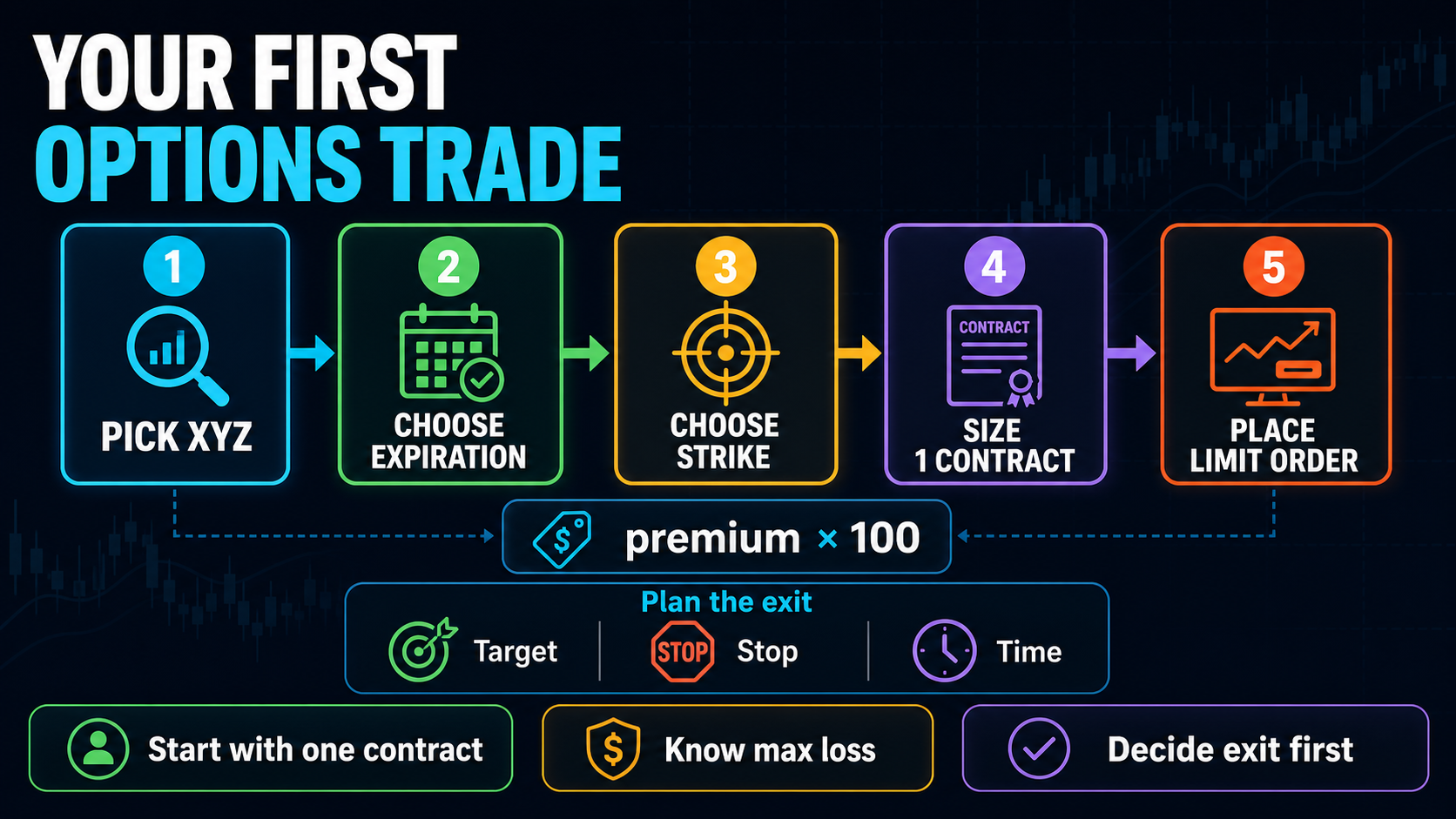
Your first trade should be on a stock (or ETF) you already follow and understand, ideally one that's large, liquid, and doesn't move wildly on news you can't anticipate. For this walkthrough, we'll use a hypothetical stock, ABC Corp, trading at $150.00 per share. Avoid starting with a thinly traded small-cap or a stock you picked because someone online said it was about to move, unfamiliarity with the underlying just adds another layer of risk on top of the options mechanics you're still learning.
Step 2: Form a View and Pick a Direction
Suppose you believe ABC Corp will rise modestly over the next several weeks. That view points you toward buying a call option (the right to buy shares at a fixed price). If you believed the stock would fall, you'd look at buying a put instead. Buying a single call or put, rather than a multi-leg spread, is the simplest way to learn the mechanics before adding complexity.
Step 3: Choose an Expiration
Give your thesis room to play out. If you expect a move over the next month, an option expiring in a week or two leaves almost no margin for error, since time decay accelerates as expiration nears. A reasonable starting point is an expiration roughly 30-60 days out. For this example, we pick an expiration about six weeks away.
Step 4: Choose a Strike
With ABC Corp at $150.00, a $145 call is already in the money (more expensive premium, higher delta, behaves more like the stock). A $155 call is out of the money (cheaper premium, lower delta, needs a bigger move to pay off). Neither is "correct," it's a tradeoff between cost and probability. For a cautious first trade, many beginners choose a strike close to the current price rather than a deep out-of-the-money strike that's statistically less likely to pay off. Let's say we choose the $150 call, at the money, quoted at $4.20 bid, $4.40 ask.
Step 5: Check Liquidity Before Committing
Before entering the order, check the option's bid-ask spread and its volume and open interest. In this example, the $0.20 spread on a $4.30 mid-price (roughly 4.7%) is reasonable for a liquid large-cap stock, and if volume and open interest both comfortably exceed the number of contracts you plan to trade, that's a good sign you'll get a fair fill.
Step 6: Size the Position Small
This is the step beginners skip most often, and it's the one that matters most. Decide how many contracts to buy based on how much you're willing to lose entirely, since a long option can expire completely worthless. For a first trade, one contract is a reasonable size. One contract of our $150 call at the $4.40 ask costs 1 x 100 x $4.40 = $440, the most you can lose if the trade goes against you and you hold to expiration with the stock below $150.
Step 7: Place a Limit Order, Not a Market Order
Rather than paying the full ask of $4.40, place a buy limit order between the bid and ask, for example $4.30 (the mid-price). This protects you from paying more than intended and, on a liquid option, has a reasonable chance of filling. If it doesn't fill after a few minutes, nudge the price slightly toward the ask. Avoid market orders on options, they can cost far more than expected on a wide spread.
Step 8: Plan Your Exit Before You Enter
Decide, before you place the order, what would make you sell for a profit and what would make you cut the loss. For example: "I'll sell if the option reaches $6.60 (a 50% gain), and I'll sell if it falls to $2.20 (a 50% loss), regardless of what the stock is doing that day." Having this plan in place before you're emotionally invested in the position makes it much easier to actually follow through when the moment comes, rather than hoping a losing trade turns around.
Step 9: Manage or Close the Trade
Say three weeks later ABC Corp has risen to $156.00 and your $150 call is quoted at $7.80 bid, $8.00 ask. Selling to close at a $7.90 limit would bring in 1 x 100 x $7.90 = $790, a gain of $350, before any commissions or per-contract fees. Alternatively, if the stock had fallen to $146.00 and the call dropped to $2.10 bid, $2.30 ask, selling to close near $2.20 would return $220, a loss of $220. Either way, you exit according to the plan from Step 8, not a decision made in the moment.
What This Trade Does and Doesn't Prove
A single winning trade doesn't prove a strategy works, and a single losing trade doesn't prove it doesn't. Many beginners lose money while learning options, that's normal and part of why starting with one contract and a plan you can afford to be wrong about matters more than the outcome of any individual trade.
FAQs
How many contracts should I trade as a beginner?
Start with one. There's no benefit to trading more contracts while you're still learning how the mechanics, fills, and emotions of a live trade actually work.
What if my limit order never fills?
It expires unfilled and no trade happens. You can adjust your price and try again, or decide the trade isn't worth chasing at a worse price.
Should I buy in the money or out of the money for my first trade?
There's no single right answer, but an at-the-money or near-the-money strike is a common, balanced starting point: cheaper than deep in the money, and more likely to pay off than a strike far from the current price.
What happens if I hold the option all the way to expiration?
If it's in the money, it will typically be automatically exercised or you can sell to close beforehand. If it's out of the money at expiration, it expires worthless and you lose the entire premium you paid.
Do I have to hold the option until expiration?
No, and most traders don't. You can sell to close a long option at any time the market is open, locking in a gain or a loss well before expiration.
Conclusion
A first options trade doesn't need to be complicated: pick a stock you understand, choose a reasonable expiration and strike, check liquidity, size the position small, use a limit order, and decide your exit before you enter. The next lesson covers risk management in more depth, including how position sizing and short-option risk change the picture once you move beyond simply buying calls and puts.