Lesson 8
Bid & Ask
Updated Aug 29, 2026 · Reviewed by Terence Scott, founder
- Bid
- highest price a buyer will pay right now
- Ask
- lowest price a seller will accept right now
- Spread
- ask minus bid, a real round-trip cost
- Mid-price
- a reference point, not a guaranteed fill
- Order type
- limit orders protect your price on options
On this page
Every option quote you look at is really two prices, not one. The video above covers the basics of reading a bid and ask; this lesson goes a level deeper into why the gap between them matters and how to trade around it. Understanding the bid-ask spread is one of the most practical, immediately useful things a new options trader can learn, because it affects every single trade you place, win or lose.
Bid and Ask, Defined
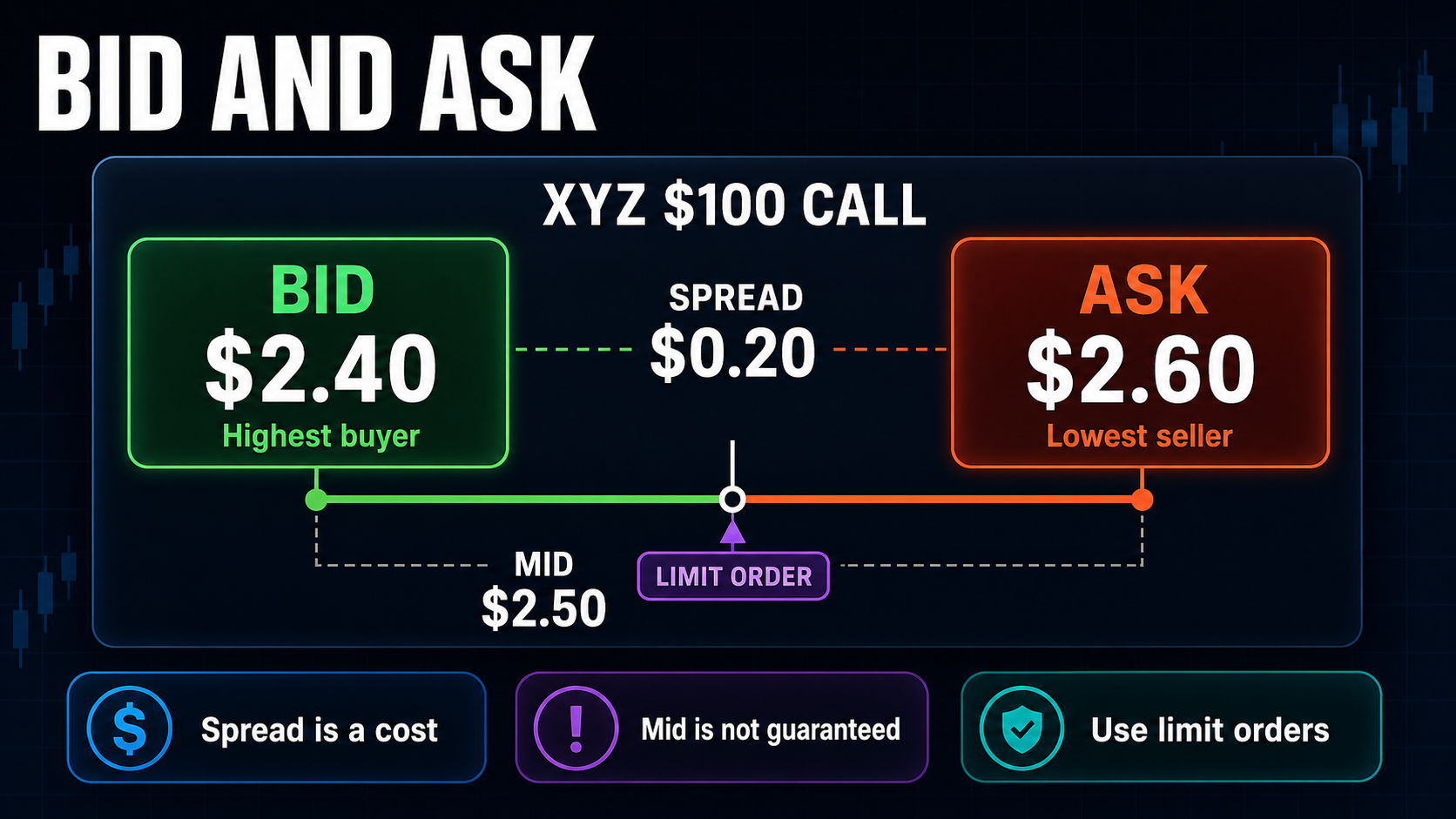
The bid is the highest price a buyer is currently willing to pay for the contract. The ask (sometimes called the "offer") is the lowest price a seller is currently willing to accept. If you place a market order to sell, you'll generally receive something close to the bid. If you place a market order to buy, you'll generally pay something close to the ask.
The difference between the two is the bid-ask spread, and it exists on every option, every stock, and nearly every tradable security. It's the built-in cost of trading, separate from any commission your broker charges.
Why the Spread Is a Real Cost
Imagine an option quoted at $1.00 bid, $1.75 ask. If you buy at the ask ($1.75) and the underlying doesn't move at all, you could only immediately sell back at the bid ($1.00), a loss of $0.75 per share, or $75 per contract, before the stock has moved a single cent. That's a 75% gap between what you'd pay and what you'd receive back, and it's common on illiquid, thinly traded strikes.
Compare that to a liquid option quoted at $20.00 bid, $20.50 ask. The same round trip only costs about $0.50 per share, or $50 per contract, a gap of roughly 2.5%. Liquid options with tight spreads are dramatically cheaper to trade in and out of than illiquid ones, even when the quoted premium looks similar.
What Makes a Spread Wide or Narrow
Spreads tend to widen when there are few market participants trading a particular strike and expiration, when the underlying stock itself is thinly traded, or during periods of high uncertainty (like right before an earnings report) when market makers widen quotes to protect themselves. Deep out-of-the-money or far-dated options, and options on small or obscure stocks, are the most likely to have wide spreads. Near-the-money options on heavily traded stocks like large index ETFs or mega-cap names tend to have the tightest spreads.
The Mid-Price Is a Reference, Not a Promise
The mid-price (the midpoint between bid and ask) is often shown on a broker's platform as a rough "fair value," and it's common to try to trade near it. But the mid-price is not a price anyone has actually agreed to trade at, it's just an average. There's no guarantee your order will fill there. On a liquid option, you can often get filled at or very near the mid with some patience. On an illiquid option, you may need to move your price toward the ask (to buy) or the bid (to sell) before anyone takes the other side.
Why You Should Use Limit Orders
A limit order lets you set the worst price you're willing to accept. A buy limit order will only fill at or below your limit price; a sell limit order will only fill at or above your limit price. A market order, by contrast, fills immediately at whatever price is currently available, no matter how unfavorable.
On stocks, market orders are usually fine because spreads are tiny. On options, especially anything beyond the most liquid strikes, a market order can be dangerous: you might intend to pay around the mid-price but end up paying the full ask, or worse, because a market order has no protection against a sudden, temporary widening of the spread. Placing a limit order costs you nothing extra and protects you from paying (or accepting) a price you didn't intend.
A Worked Example
Say you want to buy 5 contracts of a call quoted at $2.10 bid, $2.40 ask, with a mid-price of $2.25. Instead of hitting the ask at $2.40 (which would cost 5 x 100 x $2.40 = $1,200), you place a limit order to buy at $2.25 (5 x 100 x $2.25 = $1,125), a savings of $75. If the option is reasonably liquid, there's a good chance a market maker or another trader takes the other side within a few minutes. If it doesn't fill, you can nudge your limit price up in small increments until you find where the market will actually trade with you.
How This Connects to Liquidity
Bid-ask spread and liquidity are two sides of the same coin, and they connect directly to volume and open interest, the next lesson in this course. Strikes with high daily volume and high open interest tend to have tight spreads, because there are more buyers and sellers actively quoting that contract. Before entering any options trade, it's worth glancing at both the spread and the volume/open interest columns together, they tell a more complete story than either one alone.
FAQs
Will I always get filled at the bid or ask?
Not necessarily. Those are simply the best current prices being quoted. With a limit order between the bid and ask, you may get a better fill, or you may not get filled at all if no one takes the other side.
Why is the spread on some options so much wider than others?
Wide spreads typically show up on options with low trading activity, far out-of-the-money or far-dated strikes, or underlyings that don't trade heavily themselves. Market makers widen quotes when they're less confident about fair value or when they expect to hold the position longer before offsetting it.
Is it ever okay to use a market order on options?
On extremely liquid, tightly spread contracts (think large index ETF options at the money), a market order's risk is small. On anything wider or less liquid, a limit order is almost always the safer choice.
What happens if my limit order never fills?
It simply expires unfilled at the end of the trading day (or whatever time-in-force you selected), and no trade occurs. You can then decide to adjust your price, wait, or walk away.
Does a tight spread mean the trade will be profitable?
No. A tight spread only means it's cheap to enter and exit the position, it says nothing about whether the stock will move in your favor.
Conclusion
The bid-ask spread is one of the few costs in options trading that's entirely within your control to manage: you can't control where the stock goes, but you can control whether you overpay to get in or underpay to get out. Favor liquid contracts with tight spreads, use limit orders as a default, and treat the mid-price as a target to negotiate toward, not a price you're owed.