Lesson 4
Expirations
Updated Aug 29, 2026
- Standard Monthly
- 3rd Friday
- Weeklies
- Every Friday, liquid names only
- LEAPS
- Long-dated, 1-3 years out
- At Expiration
- ITM auto-exercised, OTM worthless
On this page
Every option contract has an expiration date built into it, and that date matters just as much to the trade as the strike price. This lesson covers the different expiration cycles you'll see on a chain, what actually happens when a contract expires, and how to think about which expiration fits a given trade.
The video above covers the basics on screen; the written version below adds the mechanics of what happens at expiration and how to choose between cycles.
The Expiration Cycles
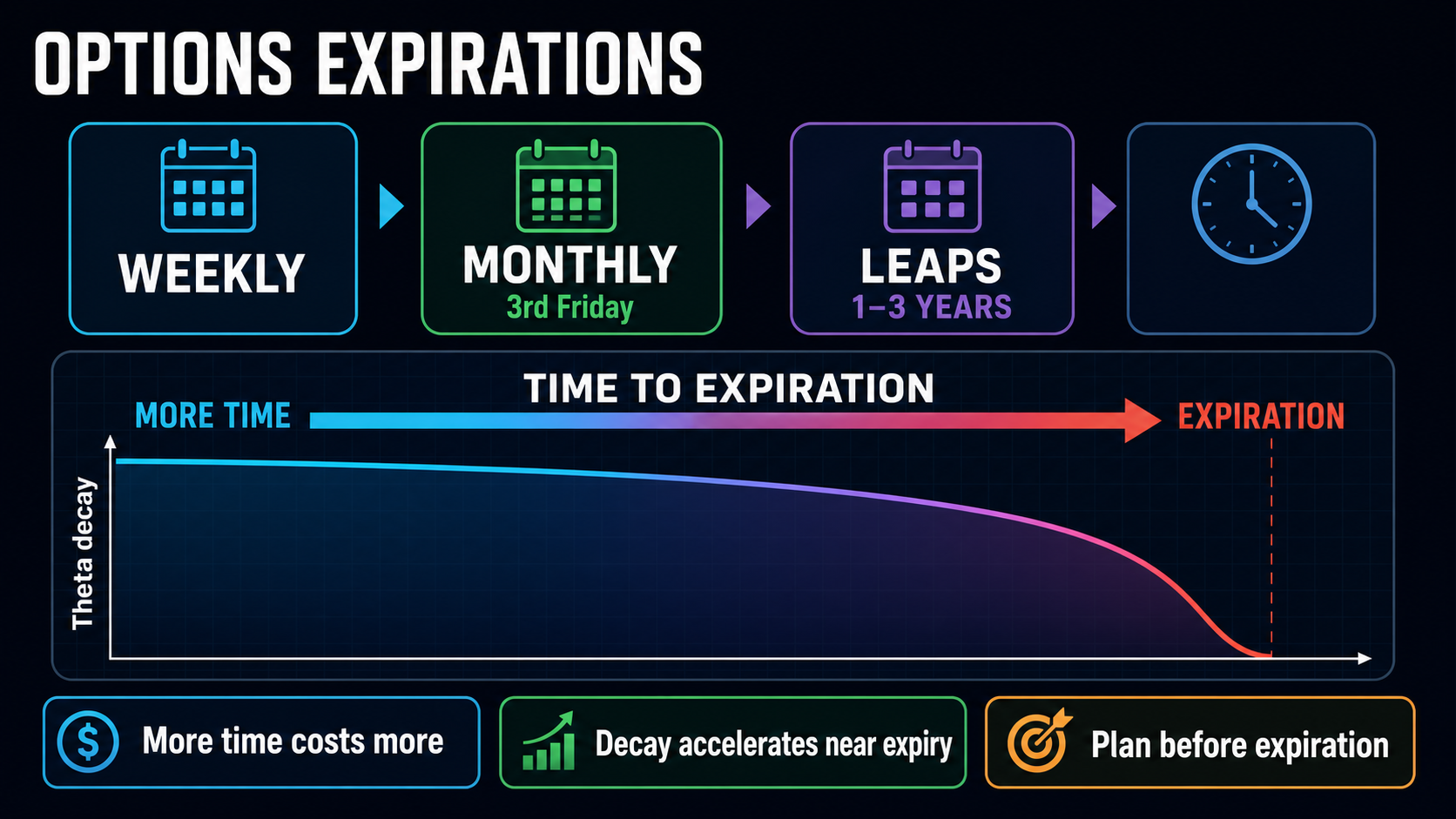
Most optionable stocks and ETFs offer some combination of the following:
- Weekly expirations expire at the close of trading each Friday. First introduced by the exchanges in 2005, weeklies are now available on hundreds of the most actively traded stocks and ETFs, giving traders short-dated contracts every week instead of once a month.
- Monthly (standard) expirations expire on the third Friday of the month. This is the original, most widely available cycle — if a stock has options at all, it has monthly expirations at a minimum.
- Quarterly expirations is a phrase used two different ways, which causes a lot of confusion. Most often it refers to the third-Friday expirations in March, June, September, and December, when stock options, index options, and index futures all expire on the same day — a heavy-volume event traders call triple or quadruple witching. Separately, the exchanges also list End-of-Quarter series on some index products that expire on the last business day of the quarter. Both exist, but the third-Friday meaning is the one you will hear most often.
- LEAPS (Long-term Equity AnticiPation Securities) are long-dated contracts, typically expiring in January and running out one to three years from listing. They follow the same strike and moneyness rules as any other option, just with far more time value built into the premium.
What "Expiring on the Third Friday" Actually Means
For standard monthly contracts, trading stops at the market close on the third Friday of the month — that's the deadline that matters to you as a trader. The official settlement date used behind the scenes is technically the following Saturday, but since you can't trade or exercise on a Saturday, treat Friday's close as the real cutoff.
What Happens When a Contract Expires
At expiration, one of two things happens to each contract:
- If it's in the money (see the moneyness lesson for the full definition), most brokers automatically exercise it on the holder's behalf — often called "exercise by exception" — unless instructed otherwise. That can mean unexpectedly ending up with 100 shares of stock, so check your broker's specific policy well before expiration week.
- If it's out of the money, it simply expires worthless, and the holder loses whatever premium was paid.
Anyone who wrote (sold to open) a contract that gets exercised is assigned the opposite obligation — delivering shares for an assigned call, or buying shares for an assigned put. The order actions lesson covers assignment risk in more detail.
Standard U.S. equity options are American-style, meaning they can be exercised at any time before expiration, not only at the close on expiration day. Some broad index options are European-style instead and can only be exercised at expiration. The strike prices lesson goes deeper on that distinction.
Choosing an Expiration for Your Trade
The general approach is to match the expiration to how long you actually expect the trade to need to play out, with some room to spare:
- Shorter-dated contracts — weeklies, or monthlies close to expiration — cost less in absolute dollars but lose time value fast. Time decay accelerates sharply in the final few weeks before expiration, so the stock has to move quickly and in your favor just to keep pace.
- Longer-dated contracts — monthlies further out, or LEAPS — cost more up front but decay much more slowly day to day, giving a thesis more room to be right without the clock working against it as aggressively.
A common beginner mistake is buying the cheapest, shortest-dated option available without accounting for how fast that time value evaporates. Cheap and short-dated is not the same as good value.
FAQs
What's the difference between LEAPS and a regular monthly option?
Nothing structurally — same contract, same strike and moneyness rules. The only difference is how much time is left until expiration, which shows up as a much larger extrinsic value component in the premium.
Why don't all stocks have weekly expirations?
Exchanges only list weeklies on names with enough trading volume to support them. Less actively traded stocks may only have monthly expirations available.
Can I close a position before its expiration date?
Yes, and most traders do. You are never required to hold a contract to expiration — closing it early by selling, if you're long, or buying back, if you're short, is normal.
What happens if I forget I own an option going into expiration?
If it's in the money, it's typically auto-exercised, which can turn into a stock position or a large cash requirement you weren't expecting. If it's out of the money, it simply expires worthless. Either way, check your position before expiration week rather than finding out after the fact.
Do quarterly expirations matter for a beginner?
Only indirectly. The quarter-end third Fridays in March, June, September, and December carry unusually heavy volume, because stock options, index options, and index futures all expire together — which can make those sessions choppier than normal. Weekly and monthly expirations will still cover the vast majority of what you trade starting out.
Conclusion
Expiration is not a technicality — it's one of the two numbers, along with the strike, that define a contract's price and behavior. Matching the expiration cycle to how much time your trade thesis actually needs is one of the simplest ways to avoid losing to time decay before you even get the direction right.