Lesson 2
Calls and Puts
Updated Aug 29, 2026
- Call Buyer Right
- Buy at strike
- Put Buyer Right
- Sell at strike
- Contract Size
- 100 shares
- Buyer's Max Loss
- Premium paid
- Writer's Risk
- Can exceed premium collected
On this page
Calls and puts are the two building blocks of every options strategy — everything else in this course is some combination of buying or selling one or both of them. This lesson defines exactly what each one gives you, then works through the numbers so the mechanics are concrete rather than abstract.
The video above gives the quick version; the written lesson below adds the numbers and the risk details that don't fit into a two-minute video.
What a Call Option Is
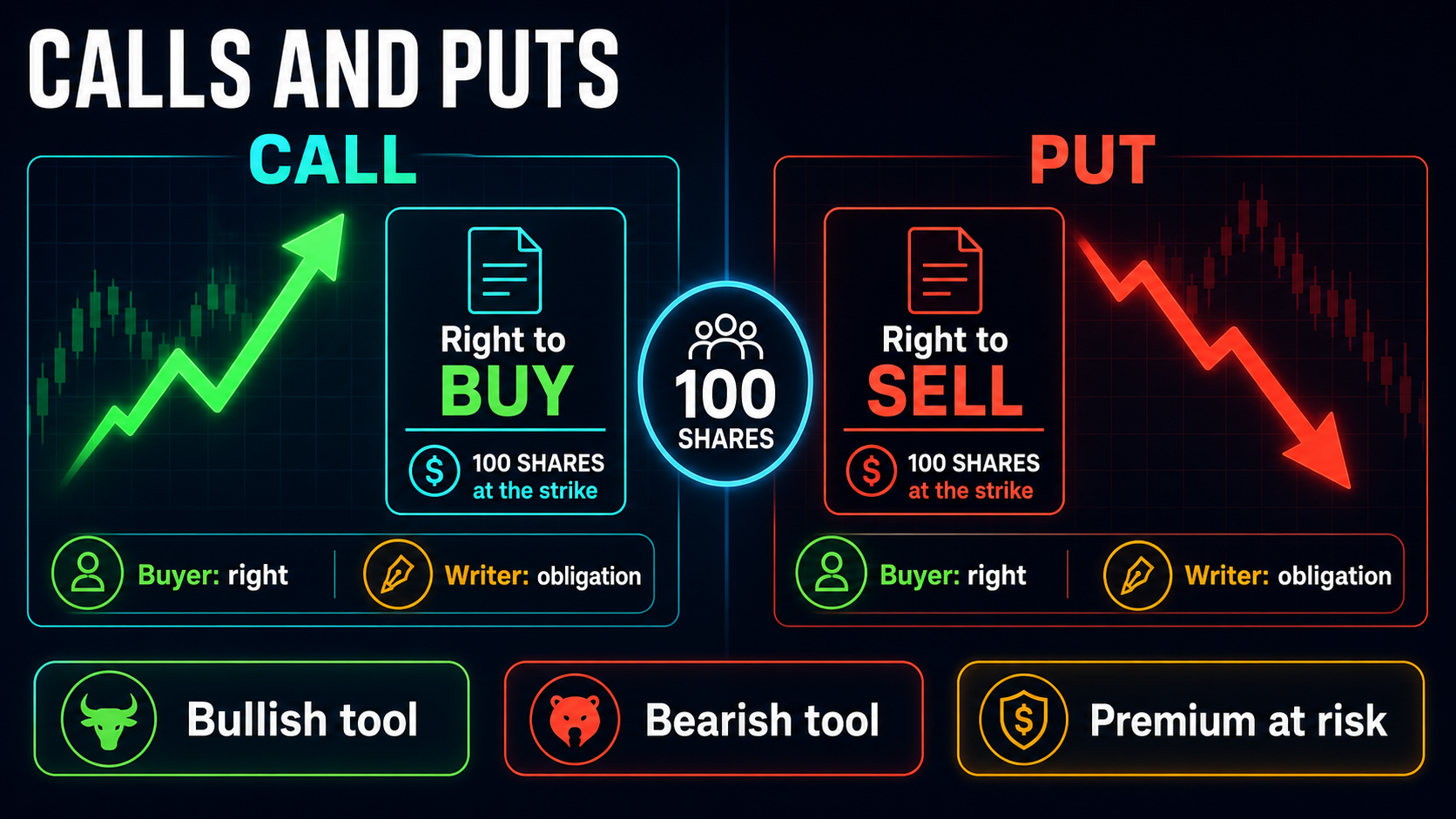
A call option gives its buyer the right, but not the obligation, to buy 100 shares of the underlying stock at a fixed strike price, on or before the contract's expiration date. The seller of that call — known as the writer — takes on the opposite obligation: if the buyer exercises, the writer must deliver 100 shares at the strike price, whether or not they already own them.
What a Put Option Is
A put option gives its buyer the right, but not the obligation, to sell 100 shares of the underlying stock at the strike price, on or before expiration. The put writer takes on the obligation to buy those 100 shares at the strike price if assigned.
A Simple Way to Remember It
Traders who expect a stock to rise typically buy calls; traders who expect it to fall typically buy puts. That's the most common use of each, though as later lessons in this course cover, calls and puts can also be sold (written) to express the opposite view or to collect income.
Worked Example: Buying a Call
Suppose XYZ trades at $50 and you buy one 30-day call at the $52 strike for a premium of $1.50. One contract controls 100 shares, so the total cost is $150 ($1.50 x 100) — that's also your maximum possible loss.
- If XYZ rises to $58 by expiration: the call is worth at least its intrinsic value of $6 ($58 minus $52), or $600 total. Minus the $150 you paid, that's a $450 profit.
- If XYZ is still at $50 at expiration: the call is out of the money and expires worthless. You lose the full $150 premium — 100% of what you put in.
Worked Example: Buying a Put
Suppose XYZ trades at $50 and you buy one 30-day put at the $48 strike for a premium of $1.20, or $120 total.
- If XYZ falls to $40 by expiration: the put is worth at least $8 of intrinsic value ($48 minus $40), or $800 total — a $680 profit after the $120 cost.
- If XYZ is still at $50 at expiration: the put is out of the money and expires worthless, and you lose the full $120 premium.
Buying Options vs. Shorting Stock
A common comparison for the put example above is short selling the stock outright. Short selling has a real structural problem: your loss potential is theoretically unlimited, because a stock's price can keep rising with no ceiling. Buying a put instead caps your loss at the premium you paid, no matter how high the stock goes.
That doesn't mean puts have "unlimited" profit potential, though — a stock can only fall to $0, so the maximum a put can ever be worth is the strike price itself. A long call is the one with theoretically unlimited upside, since there's no ceiling on how high a stock can climb before expiration.
Leverage Cuts Both Ways
Because one contract controls 100 shares for a fraction of the cost of owning them outright, options amplify percentage moves in both directions. That leverage is exactly why a wrong bet more often ends in a 100% loss of premium than a stock position does — a stock you own outright can only go to zero, but it rarely does over a matter of weeks, while an out-of-the-money option runs out of time constantly. Leverage is not free upside; it's a trade-off between smaller dollar amounts at risk and a much higher probability of losing all of it.
Who's on the Other Side?
Every call or put you buy has to be sold by someone. That someone — the writer — collects your premium and takes on an obligation instead of a right. Writing options is a legitimate and common strategy, but it's a fundamentally different risk profile than buying, covered in the order actions lesson next.
FAQs
Can I buy a call and a put on the same stock at the same time?
Yes — that combination has its own name (a straddle or strangle, depending on the strikes) and is covered in the strategies section of this course. It's a bet on a big move in either direction rather than a specific direction.
What happens if I do nothing and my option expires in the money?
Most brokers automatically exercise options that are in the money by even a small amount at expiration, unless instructed otherwise. Check your broker's specific policy, since being auto-exercised into 100 shares you didn't plan to buy — or a short position you didn't plan to hold — can be an unpleasant surprise.
Do I have to hold a call or put until expiration?
No. Most option buyers close their position before expiration by selling the contract back into the market rather than exercising it or letting it expire.
Is selling (writing) a call or put the same risk as buying one?
No, and this is one of the most important distinctions in options trading. Buying a call or put risks only the premium paid. Writing one collects a premium up front but can carry much larger risk — a covered call and a naked call, for instance, have very different risk profiles despite both starting with a sale. Compare the covered call and naked call strategy guides to see the contrast.
Which should I trade — calls or puts?
Neither is inherently better; the choice depends on your view of the stock — up, down, or sideways — and how much risk you're willing to take to express that view. This entire course exists to help you make that decision deliberately rather than by habit.
Conclusion
A call is the right to buy at a fixed price; a put is the right to sell at a fixed price; both come in 100-share contracts, and both can be bought or sold. Everything else — strike selection, expiration choice, and the strategies later in this course — is built from those two definitions.