Naked Call
Updated Aug 29, 2026
- Outlook
- Bearish to neutral, expecting the stock to stay below the strike
- Max Profit
- Premium received
- Max Loss
- Unlimited, since a stock's price has no ceiling
- Breakeven
- Strike price plus premium received
- Complexity
- Advanced
On this page
A naked call carries theoretically unlimited risk. Selling a call option without owning the underlying stock means that if the stock rises without limit, your potential loss rises right along with it — there is no ceiling. This strategy collects premium up front and profits if the stock stays below the strike price, but it is one of the highest-risk positions available to retail options traders and is not appropriate for beginners.
How a Naked Call Works
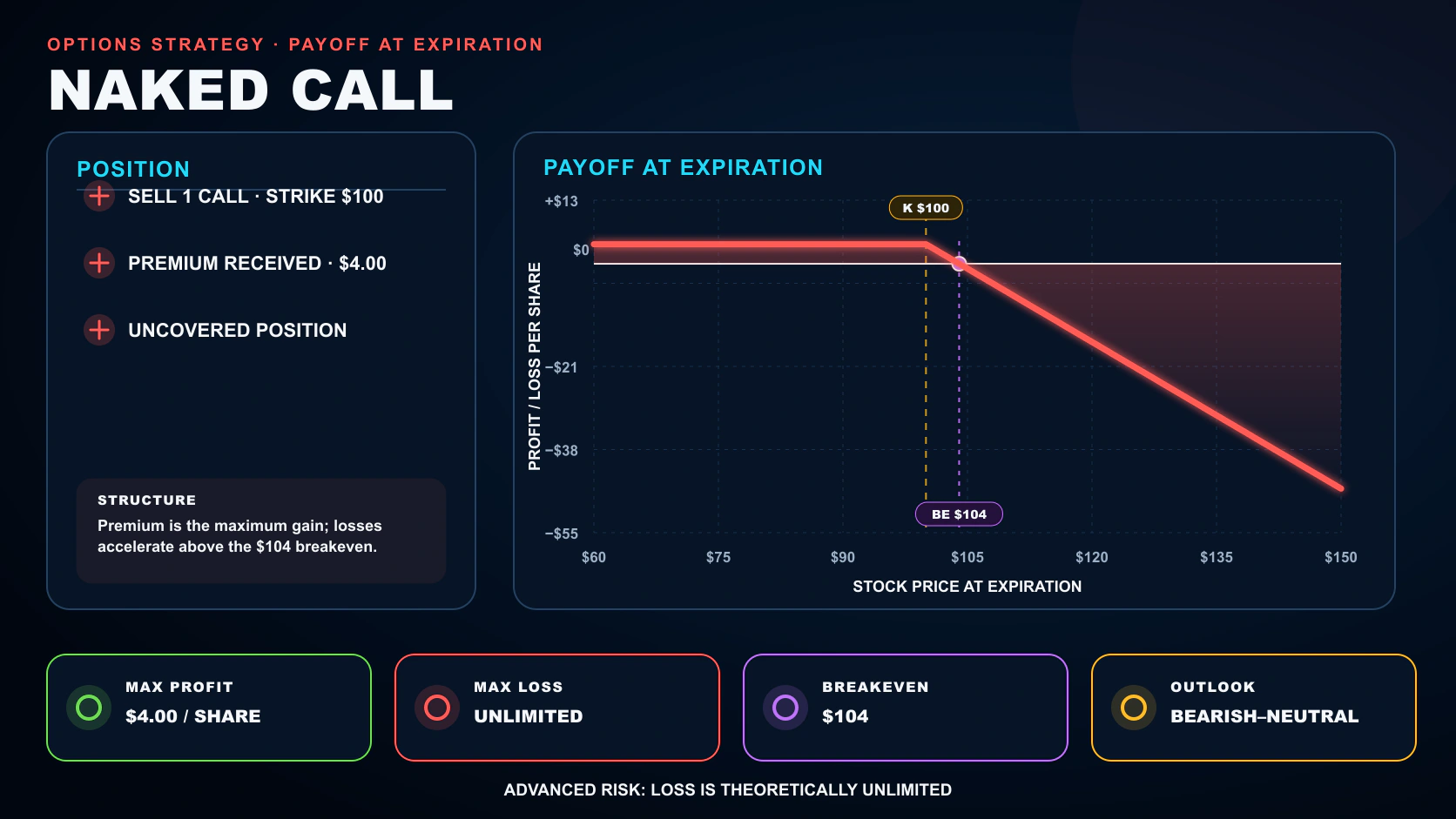
Selling, or "writing," a call option obligates you to deliver 100 shares of the underlying stock at the strike price if the buyer exercises, at any time up to expiration. In a covered call, that obligation is backed by shares you already own. A naked call has no such backing: if assigned, you must buy shares on the open market, at whatever price they're trading, in order to deliver them at the lower strike price.
Because of this exposure, brokers require their highest options approval tier for uncovered calls and demand significant margin, calculated on a percentage of the underlying's value plus the option premium, well beyond what a covered position or a defined-risk spread requires.
Max Profit, Max Loss, and Breakeven
- Max profit = the premium received, in full, realized if the stock closes at or below the strike at expiration and the call expires worthless.
- Max loss = unlimited. There is no cap, because a stock's price has no theoretical ceiling; the higher it rises above the strike, the larger the loss.
- Breakeven = strike price plus premium received.
This is the mirror opposite of a long put, where the maximum loss is capped at the premium paid because a stock cannot fall below zero. A short call has no equivalent floor on the upside.
Worked Example
JKL is trading at $45. You sell one $50 call for $1.20 per share, collecting $120 for the one-contract position. Breakeven is the $50 strike plus the $1.20 premium, or $51.20.
| Stock at Expiration | Call Value (intrinsic) | P/L (per contract) |
| $40 | $0 | +$120 (max profit) |
| $50 | $0 | +$120 (max profit) |
| $51.20 (breakeven) | $1.20 | $0 |
| $60 | $10.00 | -$880 |
| $100 (sharp rally) | $50.00 | -$4,880 |
Nothing stops the stock from continuing higher. A further rally to $150 would push the call's intrinsic value to $100 per share, for a loss of $9,880 on a single contract sold for $120, more than 80 times the premium received, with no point at which it stops growing.
When Traders Use This Strategy
Traders sell naked calls to collect premium on a stock they believe will stay flat or decline, usually favoring shorter-dated, out-of-the-money strikes so time decay works quickly in their favor. Because of the risk profile, most traders who want this kind of exposure choose a bear call spread instead, buying a further out-of-the-money call to cap the loss in exchange for a smaller net credit. A naked call is the bearish counterpart to a naked put, which sells premium on the belief that a stock will hold above a given level rather than stay below one.
Risks and Assignment
Beyond the unlimited loss potential, a naked call carries real assignment risk. Because equity options are American-style, the buyer can exercise at any time the call is in the money, not only at expiration. Assignment risk rises sharply just before an ex-dividend date: a call holder may exercise early to capture the dividend if the option's remaining time value is smaller than the payout, leaving the naked call writer suddenly short 100 shares of stock, and on the hook for the dividend as well.
A sharp, fast rally, on a takeover bid, a short squeeze, or unexpected news, can produce a margin call and a forced buy-in at the worst possible price, since the position has no hedge to slow the bleeding. This is why brokers restrict uncovered calls to their most experienced, best-capitalized options customers and require margin that scales with the stock's price and volatility.
FAQs
How is a naked call different from a covered call?
A covered call sells the identical call option but backs it with 100 shares already owned per contract, converting the unlimited-risk profile into a defined, if still substantial, opportunity cost if the stock rallies past the strike.
What broker approval do I need to sell naked calls?
Nearly every broker requires their highest options trading tier, along with a margin or portfolio margin account, before permitting uncovered call writing, given the unlimited-loss potential.
Can I be assigned before expiration?
Yes. Equity options can be exercised at any time they are in the money, and assignment is especially common right before ex-dividend dates on calls with little remaining time value.
How can I limit the risk of this strategy?
Buying a further out-of-the-money call against the short call turns the position into a bear call spread, capping the maximum loss at the width between the strikes minus the credit received.
Does time decay help a naked call?
Yes, time decay works in the seller's favor every day the option is held, but that benefit is small compared with the risk of an adverse move in the underlying stock, which can overwhelm weeks of theta in a single session.
A naked call can generate steady premium income when a stock behaves as expected, but the unlimited loss potential means a single adverse move can erase far more than months of collected premium. Traders considering this strategy should understand the margin requirements and assignment mechanics in full before selling their first uncovered call.